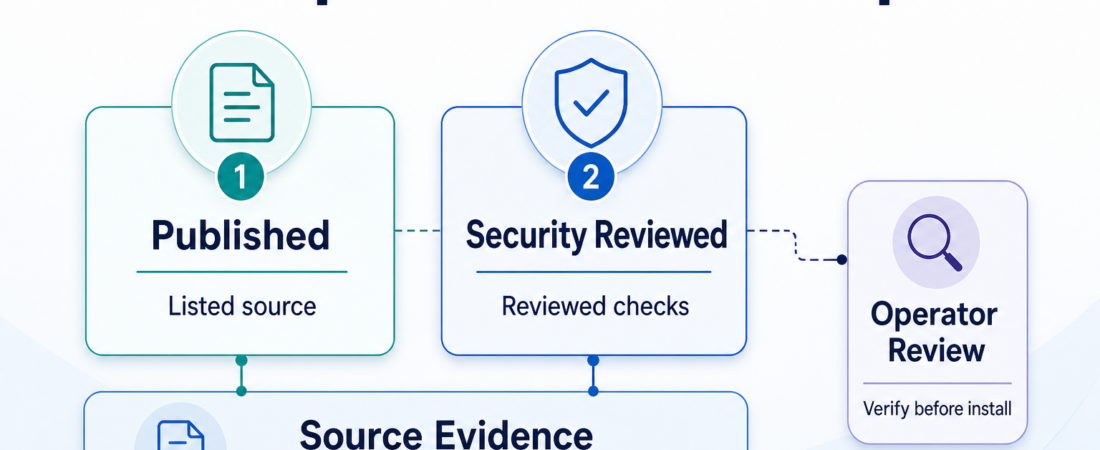
The Trust Tier Model ASE Should Keep Simple
Agent skill marketplaces do not earn trust by inventing more badges. They earn it by making the few visible signals mean something, keeping uncertain metadata blank, and showing operators what still needs review before a skill touches real work.
That is why ASE should keep its user-facing trust model simple: Published for skills that are listed with enough source context to evaluate, and Security Reviewed for skills that have passed an additional review layer. Everything else belongs in the evidence around the skill, not in a growing pile of confusing labels.
| Visible tier | What it should mean | What operators should still check |
|---|---|---|
| Published | The skill is in the catalog with source, category, and marketplace context where available. | Read the source link, installation path, prerequisites, and workflow boundary. |
| Security Reviewed | The skill has an additional security review signal on top of being published. | Check whether the skill matches your threat model, data access, and approval needs. |
| Evidence fields | Stars, package links, docs, and metadata support the listing but are not separate trust tiers. | Treat missing fields as unknown, not as hidden approval or hidden failure. |
In Short
ASE should keep trust tiers deliberately small. Published should mean a skill is listed with source-backed marketplace context. Security Reviewed should mean the listing has gone through additional security-oriented checks. GitHub stars, package metadata, framework tags, category routing, and documentation links are useful evidence, but they should not become separate user-facing trust levels. A simple model helps operators decide what to inspect next without mistaking catalog metadata for a guarantee.
Why simple trust tiers work better
Trust labels fail when they try to compress too much into one badge. A marketplace can know that a skill has a source URL, that the source URL maps to a repository, that the repository has stars, that a package exists, that documentation is present, and that a review happened. Those facts are different. Some are provenance signals. Some are popularity signals. Some are security signals. Some are just useful context.
If each of those becomes a tier, the reader has to decode the marketplace before evaluating the skill. That is backwards. A person deciding whether to install a browser automation skill, a dependency scanner, or a database connector needs a quick answer to one question: how much extra review has this listing had, and what should I check myself?
The simple answer is two user-facing states. Published means the skill is discoverable and has passed the basic catalog bar. Security Reviewed means ASE is surfacing an additional review signal. That leaves room for supporting evidence without turning every field into a badge.
Published is not the same as approved for your environment
A Published skill should be treated as a catalog entry, not a deployment approval. It can still be the right skill for a workflow, but the operator owns the final fit check. That means reading the source link, checking install steps, confirming the framework, and understanding what kind of system access the skill expects.
For example, a security-oriented skill such as SafeDep Vet for package and skill repo screening is valuable because it helps evaluate supply-chain risk before adoption. But the fact that a listing exists does not remove the need to decide which repositories, package manifests, or CI environments it should inspect.
The same is true for verification and browser skills. A team might use Playwright scripts with managed dev servers to check local web apps before release. Published status helps the skill be found and evaluated. It does not prove the test script covers your payment flow, admin permissions, or customer-specific configuration.
Security Reviewed should stay narrow
Security Reviewed is strongest when it means less, but means it clearly. It should signal that a skill has received additional review for security-relevant concerns. It should not imply legal approval, clinical safety, financial advice, universal correctness, or guaranteed maintenance.
That matters because many ASE skills operate near sensitive systems. OWASP ZAP Security Scanner Agent, Gitleaks Git Repository Secret Scanner, and Trivy Security Scanner for Containers and IaC are all useful in security workflows, but they do different jobs. One probes application security, one looks for secrets in Git history, and one scans containers and infrastructure definitions. A review signal should make the reader more confident in the listing, not blur those operational differences.
This is also why ASE’s broader marketplace writing keeps returning to source alignment. The article on source alignment as a ranking signal explains why popularity metrics need context. A parent repository’s stars may help orient the reader, but they are not proof that a specific skill file, wrapper, or workflow is safe for a production environment.
Evidence belongs beside the tier, not inside it
The best version of the ASE skill page separates visible trust state from supporting evidence. A reader should be able to see the tier, then inspect the fields that explain the listing: source URL, repository alignment, package identity, documentation, framework, category, install notes, and review status.
This is the same discipline behind ASE’s blank is better than wrong metadata rule. If the source does not back a field, leaving it blank is more honest than filling it with a plausible guess. Blank metadata can be checked later. Wrong metadata quietly teaches operators to trust the wrong thing.
Consider OSV-Scanner Dependency Vulnerability Detector and Sigstore Cosign Container Signature Checker. Both can support software supply-chain review, but they answer different questions. OSV-Scanner is about known vulnerabilities in dependencies. Cosign is about artifact signatures. A good marketplace should not flatten those into one broad “secure” claim. It should show the tier and preserve the specific evidence trail.
How operators should use the tiers
The practical move is to treat trust tiers as routing signals. Published tells you a skill is ready for evaluation. Security Reviewed tells you the listing has another layer of security-oriented attention. Neither tells you to skip local review.
Before using a skill in real work, start with the method in How to Read an ASE Skill Page Before Installing Anything. Confirm the upstream source, inspect what the skill asks the agent to do, check whether it reads or writes external systems, and decide where human approval belongs. For higher-risk workflows, add an evidence packet: source URL, install command, permissions, test result, expected output, and rollback or removal path.
For teams browsing broadly, the safest path is to start at Browse Skills, filter by the job you need, then compare a few candidates. Category pages such as Security & Verification help narrow the field, but the final choice should still be workflow-specific.
What ASE should avoid
ASE should avoid trust-tier inflation. Labels like “verified metadata,” “listed,” “source aligned,” “popular,” “maintained,” and “reviewed” may all describe useful internal facts, but they do not all deserve equal space in the user-facing trust model. Too many badges make the page look more precise while making the decision harder.
ASE should also avoid guarantee language. Security Reviewed does not mean “safe in every environment.” Published does not mean “recommended for production.” Stars do not mean “low risk.” Package metadata does not mean “actively maintained.” These distinctions may feel conservative, but they protect the reader from overinterpreting signals that were never meant to carry that much weight.
The better stance is plain: here is what ASE knows, here is what ASE reviewed, here is what is unknown, and here is what you should inspect before use.
FAQ
Does Published mean ASE recommends the skill?
No. Published means the skill is listed in the marketplace and has enough catalog context to be evaluated. It is a discovery and evaluation state, not a production approval.
Does Security Reviewed mean a skill is risk-free?
No. It means the listing carries an additional security review signal. Operators still need to check permissions, data access, install steps, and fit for their environment.
Why not show more trust tiers?
Because more tiers can make weak distinctions look stronger than they are. Source links, stars, package metadata, and docs are important evidence, but they should support the decision rather than become a confusing badge hierarchy.
What should I check before installing a skill?
Check the source URL, framework, install path, permissions, expected outputs, and whether the workflow needs human review. For security-sensitive work, compare several skills and keep evidence from the first test run.