Source Alignment Is a Ranking Signal, Not a Vanity Metric
In Short
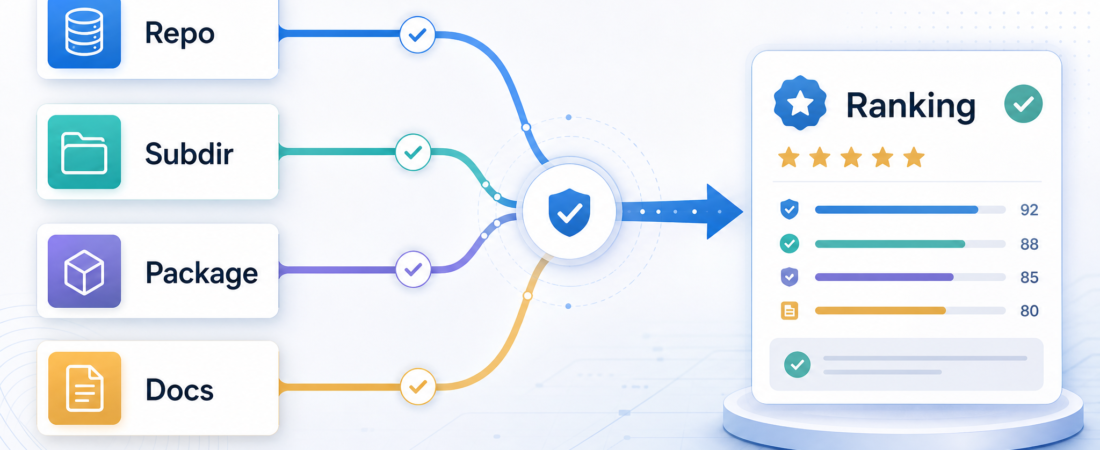
- Source alignment means the popularity signal shown for a skill should point to the actual upstream project, package, or documentation behind that skill.
- GitHub stars and package downloads are useful only when they are attached to the right source. A huge parent repository can make a tiny subdirectory look more proven than it is.
- ASE uses source alignment as a ranking signal because operators need provenance before they trust install steps, examples, and workflow claims.
- When the source is unclear, ASE would rather leave a signal blank than inflate a listing with popularity that belongs somewhere else.
| Source pattern | Signal ASE can trust | Ranking caution |
|---|---|---|
| Repo root | GitHub stars, releases, README, issues, and license usually describe the listed tool directly. | Still check whether the skill is about the project itself or only one integration inside it. |
| Subdirectory in a monorepo | The parent repo can prove maintenance, but not necessarily adoption of that specific skill surface. | Do not let parent-repo stars overpower weaker evidence from the subproject. |
| Package registry | Downloads help when the package name maps exactly to the upstream project. | Package-name collisions and wrappers can make download counts misleading. |
| Docs-only source | Official docs can prove how to invoke an API, workflow, or platform feature. | No stars or downloads should be invented when there is no exact public repo or package. |
Popularity is useful in an agent skill marketplace, but only when it points to the right thing. A GitHub repository with tens of thousands of stars can tell an operator that a project is widely used. It does not automatically prove that every folder, plugin, workflow, or example inside that repository is equally mature. A package with high weekly downloads can show real adoption. It does not automatically prove that a similarly named wrapper, template, or skill has the same traction.
That is why ASE treats source alignment as a ranking signal, not a vanity metric. The goal is not to decorate listings with large numbers. The goal is to help operators decide which skills deserve attention, what evidence backs them, and where they should slow down before installing or routing a workflow through an agent.
Why source alignment matters for skill ranking
An agent skill is not just a product card. It usually contains assumptions about setup, invocation, permissions, tools required, and failure boundaries. If the source is wrong, those assumptions become brittle. A skill might point to an official project, a community wrapper, a plugin folder inside a larger repo, or only an API documentation page. Each source type carries different evidence.
This matters most when ASE ranks or highlights skills. A listing backed by an exact upstream repository can safely inherit that repository’s public maintenance signals. A listing backed by a subdirectory needs more care. The parent repository may be famous, but the relevant integration may be new, experimental, or lightly documented. A docs-only integration can still be valuable, but it should not pretend to have package-download evidence when the workflow is really an API pattern.
Readers can see the same philosophy in ASE’s broader trust model. The post on Skill of the Day, Featured Skills, and Trust Signals explains why surfacing better skills is not just a popularity contest. The metadata rule in Blank Is Better Than Wrong is the same idea applied to empty fields. If the source cannot back the claim, the honest answer is to leave the claim out.
What counts as aligned evidence
Aligned evidence starts with a plain question: does this signal describe the thing the operator is about to use? If the skill tells an agent to use a CLI from a named project, the source should be that project or its official package. If the skill wraps an API, the source can be official docs. If the skill explains how to run a workflow across multiple tools, the source evidence may be split across several official references, but the article or listing should say that clearly.
GitHub stars are one useful signal because they are public and easy to inspect. GitHub’s own documentation on saving repositories with stars explains stars as a way for users to save and show interest in repositories. That is helpful, but stars are repo-level evidence. They do not automatically measure install reliability, security posture, active maintenance, or skill-level usefulness. ASE can use stars as one input only after the repo is matched to the actual source.
Package downloads are similar. The npm registry can show whether a package is widely pulled into projects, but a package name must map cleanly to the upstream tool. If a skill source is a GitHub repo and the package is a separate wrapper, the download count may belong to a different surface. That is not useless, but it needs to be labeled carefully or omitted.
How operators should read popularity signals
When evaluating a skill, start with the source before the number. Open the source link and ask what it proves. Does the README describe the same tool the skill describes? Are install instructions consistent? Is the package name exact? Is the documentation official? Are releases or commits recent enough for the workflow’s risk level?
Then compare the source to the task. A support workflow that reads documents needs different evidence from a browser automation workflow that can click buttons. A release-check skill needs trace and evaluation examples. A data-access skill needs clear permission boundaries. Popularity helps, but only after the source and workflow match.
ASE’s Browse Skills page and Categories page are useful starting points because they let operators inspect a skill in context instead of treating one metric as the whole story. The source-backed metadata post, Why ASE Keeps Some Metadata Blank Until the Source Backs It Up, is the companion rule: absence of a number is often a sign that the catalog refused to guess.
Skill examples where alignment changes the read
Source alignment is easiest to understand with concrete listings. Future AGI is a release-evaluation workflow where official docs and product positioning matter more than a borrowed package count. PostHog Product Analytics and Feature Flags SDK and Metabase are cases where repo and product evidence can support operational use, but the workflow boundary still matters. Invariant, Playwright MCP, and Playwright CLI for coding agents show why ASE needs exact source links: similar names can represent different invocation paths, packages, or agent runtimes.
What to watch
The easiest mistake is parent-repo inflation. A monorepo can host many tools, examples, and integrations. If a skill maps to one small folder, using the parent repository’s full star count without context can make the listing look more mature than it is. The correct answer is not to ignore the parent repository. It is to treat that signal as maintenance context, not proof of subproject adoption.
The second mistake is package confusion. Some ecosystems have similarly named packages, forks, scoped variants, and unofficial wrappers. Downloads should be attached only when the package is exact enough that an operator would install it for the same workflow the skill describes.
The third mistake is treating docs-only sources as second class. Official documentation can be the best source for a platform feature, API route, or managed service workflow. The limitation is not quality. The limitation is measurement. A docs-backed skill can be credible without stars or downloads, as long as the listing explains the source honestly.
Recommended ASE reading
- Browse Skills when you want to compare source, category, framework, and trust tier in one place.
- Categories when you know the type of work but not the exact tool.
- Skill of the Day, Featured Skills, and Trust Signals for how ASE thinks about surfacing useful listings.
- Blank Is Better Than Wrong for the metadata discipline behind empty fields.
- Why ASE Keeps Some Metadata Blank Until the Source Backs It Up for the source-proof rule behind the catalog.
FAQ
Does source alignment mean popularity does not matter?
No. Popularity matters when it belongs to the exact source behind the skill. The problem is borrowing popularity from a nearby but different project.
Are monorepo skills less trustworthy?
No. Monorepos can be very trustworthy. They just need careful labeling so parent-repo stars are not confused with adoption of one subdirectory or integration.
Why leave some signals blank?
Because a blank field is less harmful than a misleading number. Operators can work around missing data; they have a harder time recovering from false confidence.
What should I check first on a skill page?
Check the source link, install path, required tools, and trust tier before you weigh stars or downloads. Metrics should confirm the source story, not replace it.