PandasAI vs DuckDB vs Metabase: Which Data Skill Should an Operator Start With?
Most teams do not need a grand data platform decision when they first let agents work with data. They need a safer starting point. The right first skill depends on how the operator thinks, where the data lives, how often the question repeats, and who needs to trust the result afterward.
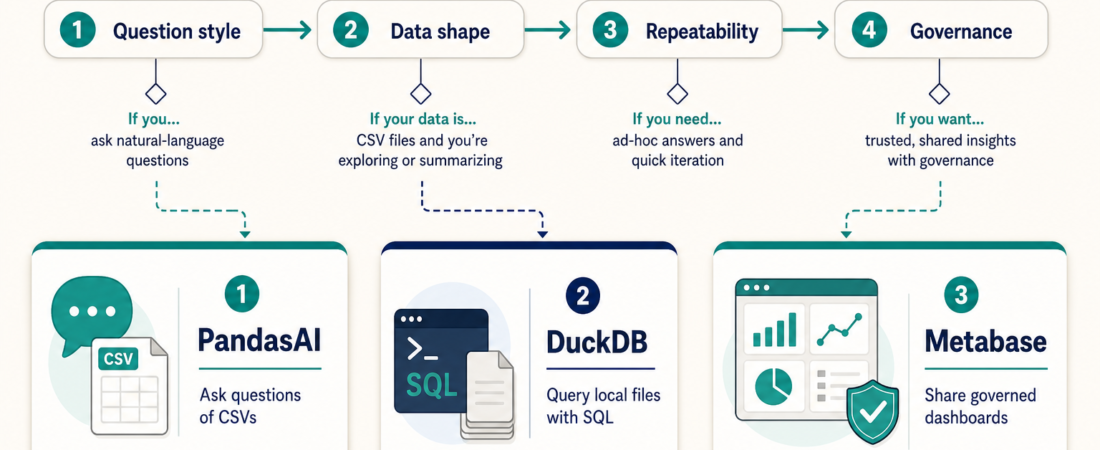
That is why PandasAI, DuckDB, and Metabase should not be treated as interchangeable “analytics tools.” They answer different operator questions. PandasAI is useful when the job starts as a natural-language question over a spreadsheet or CSV. DuckDB is the better first move when the operator needs repeatable SQL over local files. Metabase is the place to start when the output must become a shared dashboard, scheduled question, or governed reporting surface.
| Operator need | Start with PandasAI | Start with DuckDB | Start with Metabase |
|---|---|---|---|
| Question style | Exploratory natural language | Precise SQL questions | Recurring business metrics |
| Data shape | CSV, spreadsheet, dataframe | CSV, Parquet, JSON, local tables | Databases and modeled sources |
| Repeatability | Low to medium | Medium to high | High |
| Governance need | Human-reviewed notebook or output | Versioned query and file boundary | Shared permissions and dashboards |
In Short
- Choose PandasAI when an operator has a spreadsheet or CSV and wants to ask fast exploratory questions before formalizing the analysis.
- Choose DuckDB when the data is file-based, too large or repetitive for ad hoc spreadsheet work, and the team can express the analysis in SQL.
- Choose Metabase when the result needs to be reused by other people, scheduled, permissioned, or turned into a stable reporting view.
- Do not connect an agent to production data first. Start with exports, read-only replicas, or narrowed datasets, then add stronger governance only after the workflow proves useful.
Who this is for
This comparison is for operators who own practical analysis work: finance teams checking invoice exports, product teams reviewing launch signals, support leads summarizing ticket trends, and founders trying to understand a messy CSV without waiting for a formal BI project. It is also for builders assembling internal agent workflows from the ASE skill catalog and trying to decide which data skill belongs at the beginning of the stack.
If the task is “help me understand this file,” PandasAI often gets the first look. If the task is “run this analysis every week over fresh exports,” DuckDB is usually a cleaner foundation. If the task is “make this metric visible to the team,” Metabase is closer to the end state.
Decision Path
Start by asking four questions before installing anything.
1. Is the operator asking in natural language or SQL?
PandasAI fits the moment when the human knows the business question but not the query shape. A finance operator might ask, “Which vendors changed most month over month?” A support lead might ask, “Which issue types drove the longest response times?” The skill can help turn exploratory intent into analysis over dataframes or spreadsheet-like files. That is useful for first-pass investigation, especially when the alternative is manual spreadsheet filtering.
DuckDB fits when the question can be stated as a query. It is not just a database; it is a local analytical engine that can query CSV, Parquet, JSON, and relational-style data without standing up a warehouse. For agent workflows, that matters because the boundary can stay local and narrow: one folder, one export, one query, one result.
Metabase fits when the operator is no longer asking a one-off question. The work has become reporting. The team needs dashboards, shared questions, alerts, and a place where non-technical users can inspect numbers without rerunning an agent transcript.
2. Where does the data live?
If the data is an uploaded spreadsheet, a CSV from a tool, or an analyst’s one-off export, PandasAI is a reasonable first stop. The workflow should still keep a copy of the source file and the generated output so someone can review the answer against the raw data.
If the data is a folder of exports, event files, Parquet snapshots, or joined CSVs, DuckDB is usually the sharper tool. It gives the agent a deterministic query layer and makes it easier to rerun the same question after the source files change. DuckDB also pairs well with adjacent data-quality skills such as Great Expectations when the workflow needs checks before analysis.
If the data already lives in a database that the business trusts, Metabase can sit on top as the shared interface. That does not mean the agent should receive broad database access. Start with read-only credentials, limited schemas, and prepared questions where possible. The earlier ASE guide on choosing read-only database skills is the safer companion for that decision.
3. Will the answer become a recurring workflow?
Exploration and operations have different failure modes. PandasAI can be helpful when the value is speed: “show me what might be going on.” But as soon as the same question matters next week, the operator should extract the logic into a more repeatable form. That might mean a DuckDB SQL query, a validated notebook, or a Metabase question.
DuckDB is the strongest middle layer for repeatability without platform overhead. A small team can keep queries in a repo, run them over exported files, and produce evidence that is easier to inspect than an opaque chat answer. For finance workflows, this pairs naturally with the Xero, Google Sheets, and invoice intake starter stack, where the agent prepares analysis but does not approve money movement.
Metabase is the repeatability endpoint when the audience expands. If managers, support leads, or product owners need the same metric every day, the right artifact is probably a dashboard or scheduled question, not another agent run.
4. Who needs to trust the result?
The more people rely on the answer, the more the workflow needs controls. For personal exploration, a reviewed PandasAI output may be enough. For operational decisions, keep the query, source file, date range, filters, and assumptions. For shared reporting, use Metabase permissions, saved questions, and dashboard review.
This is especially important for the Product Analytics & Growth Ops and Finance & Filings collections. In both cases, agents should assemble evidence and reduce manual effort, not quietly change the source of truth.
Recommended ASE Skills
| Skill | Best starting use | Watch before adopting |
|---|---|---|
| PandasAI for conversational CSV and spreadsheet analysis | Exploratory questions over CSVs, spreadsheets, and dataframe-style exports. | Require review of generated analysis, especially if code or charts are produced. |
| DuckDB SQL Analytics Agent | Repeatable SQL over local files, snapshots, and lightweight analytical datasets. | Keep file scope explicit and save query text with the result. |
| Metabase Open Source Business Intelligence and Embedded Analytics | Shared dashboards, saved questions, embedded analytics, and team-facing reports. | Use read-only database access and review permissions before broad rollout. |
| PostHog Product Analytics and Feature Flags SDK | Product event context, feature flag evidence, and launch-analysis workflows. | Separate observation from rollout decisions; keep human approval on launch changes. |
| OpenReplay Self-Hosted Session Replay and Product Analytics Platform | Connecting quantitative trends to session evidence during product investigation. | Respect privacy boundaries and avoid exposing sensitive replay data unnecessarily. |
| SQLFluff SQL Linter and Auto-Formatter | Keeping repeated SQL analysis readable before it becomes part of a workflow. | Linting does not validate business logic; pair it with result review. |
What to watch
The biggest mistake is choosing a tool based on what sounds most advanced. PandasAI, DuckDB, and Metabase form a progression only sometimes. In many workflows, they are alternatives. PandasAI can help the operator find the first question. DuckDB can make the analysis repeatable. Metabase can make the result visible. But a small team may need only one of the three.
Also watch for access creep. A conversational data agent that starts with a harmless CSV can become risky if it later receives live database credentials, customer records, or financial data without a new review. Treat each new data source as a separate trust decision. Use exports and read-only replicas while the workflow is young.
Finally, keep the artifact. A useful data skill should leave behind more than a confident answer. It should leave a source file name, query or transformation, timestamp, assumptions, and a result that another person can inspect.
FAQ
Is PandasAI a replacement for DuckDB or Metabase?
No. PandasAI is strongest for exploratory conversational analysis. DuckDB is better for repeatable local SQL over analytical files. Metabase is better for shared reporting and dashboards.
Should an agent connect directly to production databases?
Not as the first step. Start with exports, read-only replicas, limited schemas, or saved questions. Production access should come only after the workflow has clear scope, logging, and review.
When should a spreadsheet workflow move to DuckDB?
Move when the same joins, filters, or calculations repeat, when files grow beyond comfortable spreadsheet work, or when the team needs query text that can be reviewed and rerun.
When should a DuckDB workflow move to Metabase?
Move when the result needs a shared audience, dashboard permissions, scheduled refreshes, or a stable reporting surface that does not depend on rerunning an agent conversation.
The practical answer
If you are holding a CSV and asking, “What is going on here?”, start with PandasAI. If you are holding a folder of files and asking, “Can we rerun this every week?”, start with DuckDB. If the team is asking, “Where can we all see the same trusted metric?”, start with Metabase.
The safest operator path is to begin with the smallest useful boundary, keep evidence with every result, and promote the workflow only when the question becomes repeatable enough to deserve more structure.