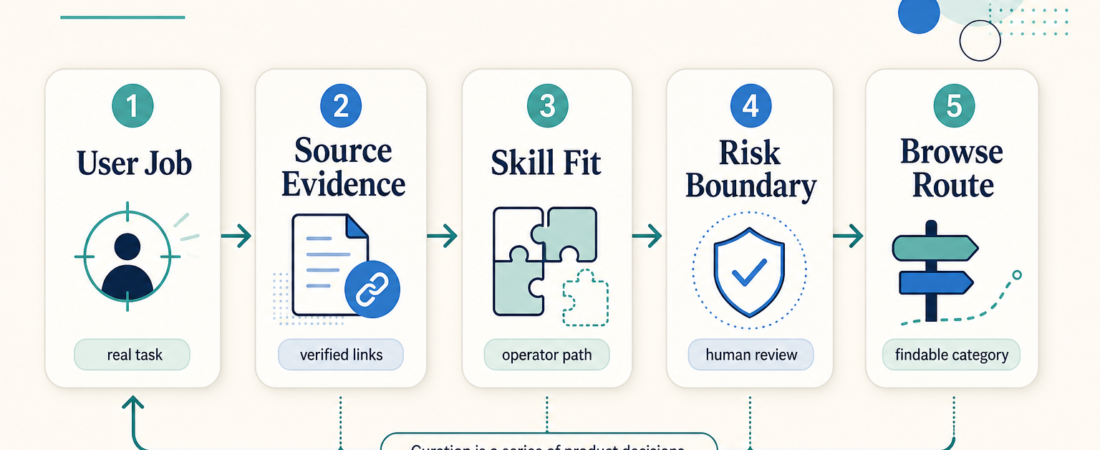
Marketplace Curation Is Product Work, Not Just Tagging
Marketplace curation looks simple from the outside. Add a category, attach a few tags, publish the page, and the catalog appears organized. That is the easy version. It is also the version that stops helping people as soon as the catalog gets large.
For Agent Skill Exchange, curation has to behave more like product work. A useful marketplace does not only answer “what is this skill?” It answers “who should try this, what job does it fit, what evidence backs it up, what should stay under review, and where should a reader go next?”
| Curation question | Product decision | Bad shortcut |
|---|---|---|
| What job does this serve? | Route by operator task and adoption path. | File by vague tool type. |
| What evidence supports it? | Prefer source-aligned links, docs, and reviewable outputs. | Borrow trust from a parent repo or vendor name. |
| Where are the boundaries? | Name review points, data access, and risky claims. | Present every skill as production-ready. |
In Short
Marketplace curation is product work because discovery is part of the user experience. A tag can describe a skill, but it cannot decide whether the skill belongs in a category, whether the source is aligned, whether the setup path is realistic, or whether the reader needs a safer first step.
ASE should treat each curated placement as a small product decision. The useful unit is not the tag. It is the route from an operator’s job to a skill page, a comparison, a review boundary, and a next action. That is why curation has to combine taxonomy, source evidence, workflow fit, and trust language.
The practical test is simple: if a curated page helps someone choose, compare, reject, or safely test a skill, it is doing product work. If it only makes the catalog look full, it is just tagging.
Why tags are not enough
Tags are useful as retrieval aids. They help search, filters, and related-content systems. But tags are not a substitute for judgment. Two skills can share a tag and still serve very different jobs.
A browser automation skill, for example, may be good for deterministic regression checks, exploratory client tasks, visual GUI understanding, or fragile one-off web operations. Those are not the same adoption path. A reader comparing Playwright MCP with Stagehand Browser Automation SDK needs to know more than “browser automation.” They need to know which one fits repeatable checks, which one tolerates ambiguity, and which one should stay behind human review.
The same issue appears in analytics. DuckDB SQL Analytics Agent, Metabase, and PostHog can all sit near data or product analytics. But the operator question is different in each case: local analysis, shared dashboarding, or product behavior evidence. A tag can group them. Product curation explains the difference.
The job is routing, not labeling
A curated marketplace should reduce the number of reasonable wrong turns. That means ASE has to think in routes. A route starts with a user’s job, passes through constraints, and ends with a small set of candidates or a reason to pause.
The Browse Skills page is the broad entry point. Industry pages, comparison posts, and skill spotlights narrow the path. A trust article such as The Trust Tier Model ASE Should Keep Simple gives the reader language for evaluating safety. A metadata article such as Blank Is Better Than Wrong explains why missing fields can be more honest than invented completeness.
That is product surface area. The user may experience it as navigation, editorial content, category placement, or a skill page. Internally, it is one job: help a person move from problem to usable next step without pretending the marketplace knows more than the source supports.
Good curation starts with evidence
The most important product decision is what evidence deserves to influence placement. A skill can look attractive because the upstream project is popular, the name is familiar, or the category is fashionable. None of that is enough by itself.
ASE’s source-alignment work matters because it separates broad project popularity from skill-level usefulness. A monorepo may have thousands of stars while the relevant subdirectory is small, experimental, or unrelated to the task. A package may be widely installed but poorly matched to an agent workflow. A docs page may be official, but not enough to prove that a skill is ready for a regulated process.
That does not mean weak evidence disqualifies every skill. It means the page should say what is known. Source URL, repository fit, install path, docs quality, output shape, and review boundaries all affect the route. If the evidence is thin, curation should make the skill easier to inspect, not easier to overtrust.
Risk boundaries are part of the product
A marketplace that covers legal, healthcare, finance, analytics, browser automation, and release checks cannot treat all skills as equal-risk utilities. The product has to distinguish assistance from autonomous action.
A document parsing skill may be useful in legal operations and healthcare intake, but the boundary changes. In one setting, the review question may be contract evidence. In another, it may be protected health information and clinical claims. In both cases, curation should avoid implying that extraction equals approval.
Product analytics has a similar boundary. A feature-flag or evaluation skill such as LaunchDarkly rollout safety checks can support launch discipline, but it should not be framed as an autonomous release authority. The useful framing is narrower: assemble evidence, verify targeting, check outputs, and keep a human decision point.
This is where curation becomes a trust feature. The marketplace should not only surface the skill. It should surface the conditions under which the skill is sensible.
Useful categories are opinionated
Neutral taxonomies often sound fair, but they can become junk drawers. If every skill can belong anywhere, the category stops helping. A useful category has an opinion about the job it serves and the evidence required to belong there.
The Industry Collections pages are a good example. A finance collection should not contain every finance-adjacent AI tool. It should contain skills that support finance operations jobs such as filings research, invoice intake, reconciliation support, spreadsheet review, and audit-friendly handoff. A DevRel collection should organize specs, SDKs, examples, docs, and changelogs. A support collection should separate ticket triage, knowledge lookup, response drafting, and escalation.
That opinionated shape is what makes categories useful. It gives readers a mental model. It also gives maintainers a standard for saying no.
The curation product loop
Good curation should improve through use. Search behavior, broken links, duplicate submissions, weak source evidence, and repeated reader questions are product signals. They reveal where the route is unclear.
If readers keep landing on a broad category and bouncing, the category may need a decision path. If two skills repeatedly appear in the same comparison, the marketplace may need a short guide. If a popular skill lacks source alignment, the page may need a clearer caveat. If an industry page attracts risky submissions, the acceptance rules need sharper boundaries.
This is why curation cannot be a one-time tagging pass. Tags age. Sources move. Skills change. Operator jobs become clearer. The product has to absorb those signals and make the next route better.
What ASE should optimize for
ASE should optimize for useful confidence, not maximum catalog fullness. A reader should feel that the marketplace is helping them make a better decision, including the decision not to use a skill yet.
That means skill pages should continue to prefer source-backed fields over decorative completeness. Blog posts should connect ideas to real pages when those pages help the next step. Category and industry pages should explain fit, not just list inventory. Changelogs should say what changed for operators, not only what changed internally.
It also means some work should remain deliberately unglamorous: checking links, cleaning duplicate categories, keeping trust tiers simple, and refusing to inflate signals. Those are product decisions because they shape whether people can use the marketplace without being misled.
References
FAQ
Is marketplace curation the same as moderation?
No. Moderation decides what should not be allowed or shown. Curation decides how useful, findable, and appropriately framed accepted items should be. A good marketplace needs both, but they are different jobs.
Why not let tags and search handle discovery?
Search helps when the reader already knows what to ask for. Curation helps when the reader knows the job but not the tool. Most operators start with the job.
Should every skill belong to an industry collection?
No. Industry placement should require a real workflow fit. A generic tool can still be useful in the catalog without pretending it is a vertical solution.
What is the strongest sign of good curation?
The reader can make a better next decision: try one skill, compare two candidates, request more evidence, or reject the fit before spending time on setup.