A Per-Query Retrieval Regression Packet Before Swapping Embedding Models
In Short
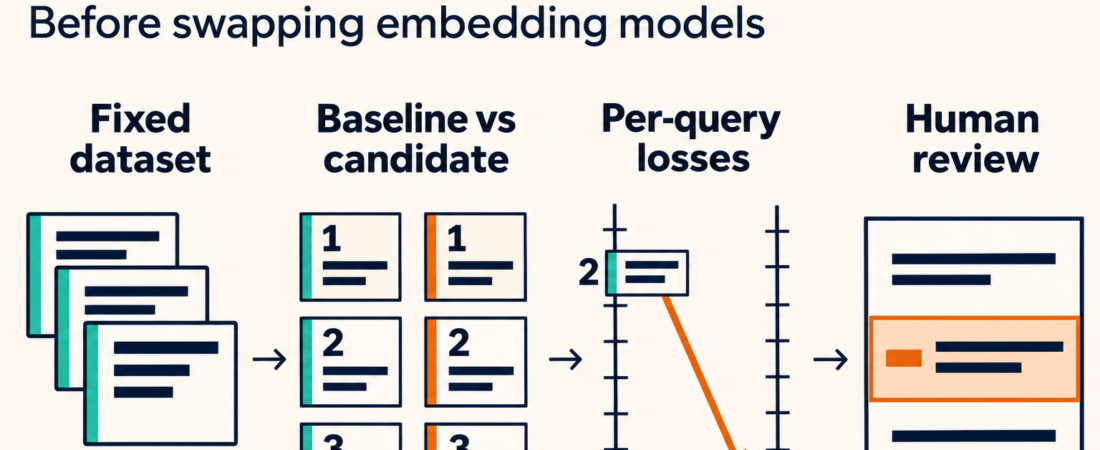
A better average retrieval score can hide a worse experience for particular users. Before swapping embedding models, build a per-query retrieval regression packet: identical inputs, two saved ranking runs, a table of losses, and a human recommendation. Keep the corpus, query set, relevance judgments and split fixed so you can explain what changed.
This workflow starts with the BEIR skill added to ASE on November 6. It combines a controlled ranking comparison with a documented FlagEmbedding candidate and an optional, separate Ragas answer check. The deliverable is evidence for a deployment decision; this article reports no executed benchmark or measured model improvement.
Who this is for
This is for search and RAG maintainers replacing an embedding model, and reviewers who need more than an aggregate score. Use it when a candidate looks promising but could push a crucial document outside the context window. Assign an evaluation owner to prepare the packet and an application owner to decide whether the observed losses are acceptable.
Bring a relevance-labeled dataset, the current retrieval configuration and enough compute for both runs. A public benchmark helps test the comparison procedure. Evidence about your own application requires representative queries and judgments from that application. For broader release decisions, pair the packet with the LLM app evaluation release gate.
Starter workflow
- Freeze the inputs. Save corpus and query identifiers, file checksums, relevance-label version and split. Freeze chunking and text preprocessing. Define the primary cutoff before looking at results: for example, inspect recall at the number of passages your generator actually receives. Select review slices such as language, rare entities and short queries in advance.
- Record the environment. Create an isolated Python environment and lock package versions after a smoke test. Save model identifiers and resolved revisions, query instructions, document formatting, normalization, similarity function, truncation, precision and batch settings. Record hardware and index settings. Rebuild candidate document embeddings; vectors from different embedding models should not be mixed in one comparison index.
- Check the adapter. FlagEmbedding’s official quick start documents loading an embedding model with FlagAutoModel and a query instruction. Implement and inspect the adapter to your pinned BEIR retriever interface. Confirm query/document encoding paths, output dimensions, ordering and score direction on a tiny sample. A reranker requires a separate stage with a fixed candidate pool. Do not assume the two libraries offer a turnkey integration.
- Save matched runs. The BEIR official example loads corpus, queries and qrels through GenericDataLoader, retrieves through EvaluateRetrieval, and computes ranking metrics at configured cutoffs. It also demonstrates run-file and metric exports. Retain both ranked document lists and their configurations, not just a screenshot of the aggregate. Keep reranking disabled or identical when isolating an embedding change.
- Compute query-level differences. For every judged query, calculate the same metric under each run and subtract baseline from candidate. Join the runs to relevance judgments and record relevant-document rank movement. An illustrative loss is a document moving from rank 2 to rank 9 when the application takes only five passages. Inspect losses even when the overall mean improves.
- Write the recommendation. Attach aggregate results, slice summaries, the regression table, raw run files and reproduction instructions. Label each loss as understood, unresolved or accepted by the application owner. Recommend further investigation when important regressions remain unexplained. Record the reviewer and decision date.
| Packet part | Evidence to retain |
|---|---|
| Fixed inputs | Corpus, queries, qrels, split and checksums |
| Matched runs | Baseline and candidate rankings plus configurations |
| Loss review | Query ID, relevant document, both ranks, metric delta, reviewer note |
| Decision | Open issues, accepted losses, owner and recommendation |
Recommended ASE skills
- Compare retriever rankings with BEIR: organize the fixed-dataset comparison and retain rankings for review.
- Generate and evaluate embeddings with FlagEmbedding: prepare the candidate representation or a separately controlled reranker.
- Evaluate RAG quality with Ragas: add downstream answer evidence after the retrieval comparison is understood.
For an optional follow-up on generated answers, teams already using Inspect AI evaluation suites can retain scored traces for reviewer inspection; its official guide documents evaluation components and analysis. Teams using DeepEval regression tests can consult the official quickstart for answer test cases. Choose one existing harness if needed. Neither is required for this packet, and neither replaces the saved retrieval rankings or relevance judgments.
If the investigation exposes a larger design problem, use the data platform retrieval playbook to scope that follow-up.
What to watch
Missing judgments are uncertainty, not proof that an unjudged document is useless. Check ties, duplicate documents, missing query IDs and truncated text before blaming the candidate model. Keep relevance-label corrections versioned and rerun both systems after a correction. Track runtime and memory alongside quality so a reviewer understands operational costs.
Use Ragas’s official RAG evaluation tutorial for a separate answer-quality experiment. Prepare suitable questions, retrieved contexts, answers and reference data as required by the selected metrics. Fix generator and evaluator settings, retain prompts and versions, and use authorized provider access. Answer scores cannot establish which relevant document fell below a retrieval cutoff.
FAQ
Is a higher average enough to approve the swap?
No. Review query losses and important slices against acceptance rules chosen beforehand. A small overall gain can coexist with an unacceptable failure on a critical query.
Must the candidate use the same query instruction?
Use each model’s documented formatting and record it explicitly. Hold the task and evaluation inputs fixed. Changing instructions later creates a new configuration that needs another matched comparison.
Does passing BEIR prove application readiness?
No. State which benchmark and split were tested, then gather application-specific evidence. Keep the current model available until a human owner approves deployment and its rollback plan.