A Data Platform Retrieval Playbook for Analytics Engineering Teams
Analytics teams rarely have one retrieval problem. They have warehouse tables, semantic layers, dashboards, dbt docs, notebooks, PDFs, slide decks, customer exports, and experimental vector indexes sitting beside each other. A data platform retrieval playbook gives the team a reviewable path for deciding which context layer an agent should use, how each layer is tested, and where humans keep control.
| Retrieval layer | Best first question | Evidence to keep |
|---|---|---|
| SQL and metrics | Which governed data answers this? | Query plan, metric owner, row limits |
| Vectors and documents | Which source passages support it? | Chunks, citations, freshness notes |
| Graph and multimodal | Which relationships or media matter? | Entities, links, image or file traces |
In Short
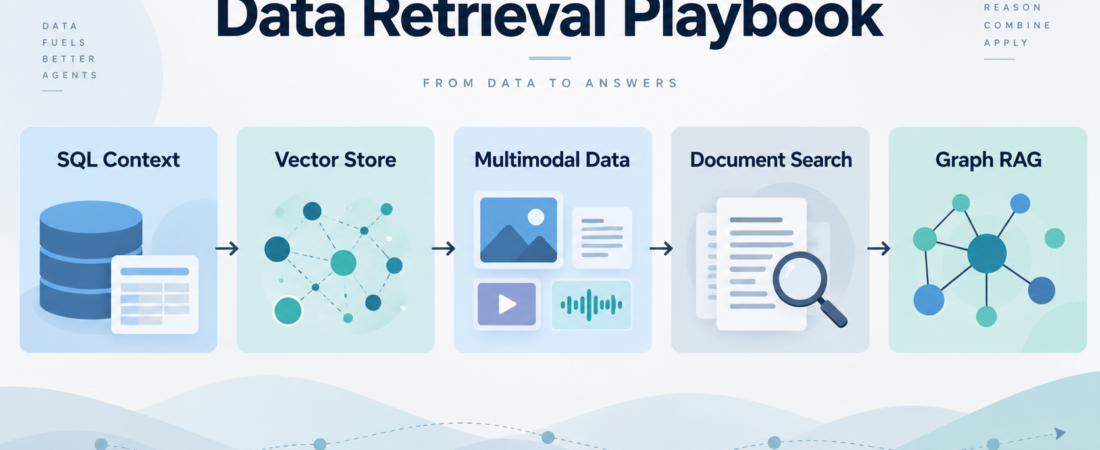
A retrieval playbook matches analytics questions to the right context layer. SQL belongs close to governed metrics and warehouse facts. Vector search helps with notes, docs, and loosely phrased questions. Multimodal stores matter when files include images, audio, video, or mixed media. Document search is useful when analysts need citations back to source pages. Graph RAG helps when relationships between entities, events, and concepts are part of the answer.
The queued ASE stack points to TiDB for SQL plus vector context, Chroma MCP for embedding database operations, Deep Lake for multimodal AI data, Morphik for document search over visually rich and multimodal documents, and LightRAG for graph-based retrieval-augmented generation. Treat those as example routes in the same playbook, not as interchangeable tools.
Who this is for
This guide is for analytics engineering teams, data platform owners, BI leads, AI platform teams, and internal tooling groups that want agents to answer data questions without bypassing the rules that make analytics trustworthy. It is most useful when questions span structured tables, unstructured docs, historical analysis, semantic definitions, and private business context.
Starter workflow
1. Sort questions before choosing storage. Start with the analytics jobs people actually ask for: explain a metric change, find a dashboard owner, compare customer segments, summarize research, inspect a pipeline failure, or answer a policy question about data use. Label each job as structured, document-heavy, multimodal, relationship-heavy, or mixed.
2. Keep SQL close to governed facts. TiDB describes itself as an open-source, cloud-native distributed SQL database designed for high availability, scalability, strong consistency, and performance. For agent work, the key point is keeping factual questions tied to SQL, schema, filters, and reviewable query behavior.
3. Use vector search where language is fuzzy. Chroma’s MCP project presents Chroma as an open-source embedding database for LLM apps with memory, document operations, persistent storage, and vector search configuration. That fits analyst notes, runbooks, experiment summaries, product docs, and support context where the user may not know the exact phrase to search.
4. Add multimodal retrieval only when files demand it. Deep Lake’s project describes a database for AI powered by a storage format optimized for deep-learning applications, including storing and searching data plus vectors for LLM applications. Bring this layer in when charts, screenshots, call recordings, images, or mixed-media datasets carry information that text-only retrieval drops.
5. Give documents their own quality gate. Morphik Core describes tools to ingest, search, transform, and manage unstructured and multimodal documents, including MCP access. Test scanned PDFs, embedded tables, slide decks, bad OCR, duplicate exports, and stale policy pages.
6. Use graph retrieval for relationships. LightRAG frames itself as retrieval-augmented generation with graph-oriented storage and retrieval options, plus local deployment support for embedding, reranking, and storage backends. Reach for this when the answer depends on lineage, ownership, incidents, accounts, entities, or decision history.
Recommended ASE skills
- Build SQL and vector retrieval context layers with TiDB when analytics agents need governed SQL context plus vector retrieval.
- Chroma MCP Server for Embedding Database Operations when an agent needs bounded embedding database operations exposed through MCP.
- Build multimodal retrieval context layers with Deep Lake when the retrieval set includes images, rich files, or AI datasets.
- Build document search layers for AI apps with Morphik when the main problem is ingesting and searching unstructured or visually rich documents with citations.
- LightRAG Graph-Based Retrieval-Augmented Generation Framework when entity relationships and graph context are central to the analytics question.
What to watch
Do not let retrieval bypass metric ownership. An agent that can answer with a convenient SQL query can still use the wrong metric, grain, or time window. Tie common questions to approved semantic definitions and named owners.
Chunk quality matters more than index count. Five stores with weak chunking, missing titles, and stale source metadata are worse than one small reviewed index. Keep retrieval examples in version control or another durable review surface.
MCP is a boundary, not a policy. Exposing retrieval through MCP can make tool calls inspectable, but the team still needs source permissions, logging, rate limits, and rules for sensitive data.
Graph work needs maintenance. Relationship extraction can drift as teams rename metrics, move dashboards, or change customer/account models. Assign an owner before agents depend on graph context for operational answers.
FAQ
Should analytics teams start with SQL or vector search?
Start with the question type. If the answer depends on governed facts, measures, and joins, start with SQL. If the answer depends on notes, docs, or loosely phrased context, start with vector or document search.
When is a graph RAG layer worth it?
Use it when relationships are the hard part of the answer: lineage, ownership, incidents, accounts, entities, or decisions. If simple citations answer the question, graph retrieval may add work without enough benefit.
How many ASE skills should a first pilot use?
One or two is usually enough. Pick the layer that matches the highest-value question, then add the next retrieval type only after reviewers can explain what changed.
What is the smallest useful review packet?
A question map, source inventory, permission note, five successful examples, five failure examples, citations or query traces, and an owner for each retrieval layer.