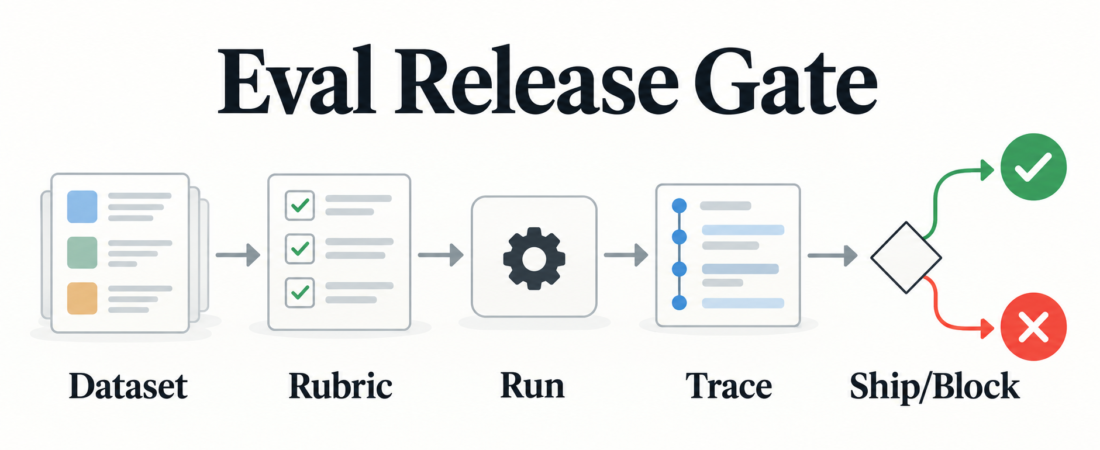
An LLM App Eval Release Gate Before Prompt or Model Changes Ship
Prompt and model changes should not ship on confidence alone. A useful LLM app release gate turns the change into a small evidence packet: the dataset used to test it, the rubric that defines acceptable behavior, the run output, the traces that explain failures, and the human decision to ship or block.
| Gate step | Release question | Evidence to keep |
|---|---|---|
| Dataset | Does this sample represent the work users actually send? | Cases, source notes, owners, and known edge cases |
| Rubric | What would make the answer acceptable, risky, or wrong? | Scoring criteria, thresholds, reviewer notes |
| Decision | Should this prompt or model variant reach production? | Run result, traces, failure examples, ship/block owner |
In Short
An LLM app eval release gate is a practical checkpoint before prompt, retrieval, agent, or model changes ship. It does not need to start as a large benchmark program. Start with workflows that already create risk: support answers, code changes, compliance summaries, document extraction, customer-facing text, or tool-calling agents.
The selected ASE queue item points to official sources for Kiln, Inspect AI, DeepEval, Promptfoo, and Opik. Treat those sources as tool context, not a reason to publish a generic tools list. The operating habit matters more: every candidate change needs a representative dataset, a clear rubric, a repeatable run, enough trace evidence to debug regressions, and a human decision that can block the release.
Who this is for
This workflow is for product engineers, AI platform teams, developer productivity groups, and technical leads who already have an LLM feature in use or close to release. It fits teams that are changing prompts weekly, testing a newer model, adding tools to an agent, or tuning retrieval instructions and need something firmer than a few hand-checked examples.
It is also useful for small teams. A release gate can begin with 30 to 100 curated cases, two or three failure labels, and one reviewer who owns the ship/block call. The point is to stop treating each prompt change as an isolated judgment call hidden in a chat thread.
Decision path
First, define the release question. Good questions are narrow: does the new prompt reduce unsupported claims in refund-policy answers? Does the model change preserve code-review severity labels? Does the agent still refuse tool calls when required fields are missing? A gate that says only “is quality better?” will be too vague to block anything.
Second, assemble the dataset. Include common cases, recent failures, edge cases, and examples the team would be embarrassed to regress. Keep the source of each case visible. For customer or internal data, redact sensitive values and record who approved the sample.
Third, write the rubric before running the variant. Use pass/fail checks where possible, then add graded judgments only where humans truly need nuance. For example: grounded citation present, policy outcome correct, no invented order status, tone acceptable, required escalation included. A rubric should make disagreement inspectable, not pretend that every answer can be scored by one number.
Fourth, run the baseline and candidate side by side. Keep raw outputs, scores, evaluator settings, model names, prompt versions, and timestamps. If the app uses retrieval or tools, keep enough trace detail to explain whether a failure came from the prompt, the model, the retrieved source, the tool call, or the judge.
Fifth, make the decision explicit. Ship when the candidate improves the target behavior without unacceptable regressions. Block when critical cases fail, trace evidence is missing, or the dataset no longer represents the release risk.
Recommended ASE skills
Build and optimize agent eval workflows with Kiln fits teams that need a structured place to build datasets, compare variants, and turn example review into a repeatable eval workflow.
Run repeatable model and agent eval suites and inspect scoring traces with Inspect AI fits release gates where transparent scoring traces matter as much as the final pass/fail result.
Regression test LLM apps and agents with metrics, traces, and eval suites using DeepEval fits app teams that want regression checks around prompts, RAG outputs, agents, and user-visible behavior.
Regression-test prompts, agents, and RAG outputs before shipping changes fits prompt and model-change gates where the team wants CLI-friendly checks and reviewable failures before deployment.
Trace, evaluate, and monitor agentic workflows with Opik fits workflows where traces, evaluation records, and monitoring need to connect before and after release.
Use the required skill slugs first because they map directly to the queue topic. Add another tool only when it covers a missing control.
What to watch
Watch for tiny datasets that only prove the happy path. If a change can affect production users, the gate needs failure cases and borderline cases, not just examples where the new prompt looks polished.
Watch for evaluator drift. When the judge prompt, scoring labels, or model judge changes at the same time as the app prompt, the team may not know what improved. Version the evaluator materials like release artifacts.
Watch for trace gaps. A score without trace evidence is hard to debug. If a candidate fails because retrieval found the wrong paragraph, a tool returned stale data, or the model ignored an instruction, the reviewer needs to see that path.
Watch for gates that never block. A release gate earns trust by stopping changes sometimes. Keep a short log of blocked releases and why they were blocked. That log becomes the next dataset refresh.
FAQ
How large should the first eval dataset be? Start small enough that reviewers will maintain it. For many LLM app teams, 30 to 100 cases is enough to catch obvious regressions and learn which cases deserve expansion.
Should the gate compare prompts, models, or both? Compare one major change at a time when possible. If the prompt and model both change, keep a baseline run and record which variant produced each output.
Can automated judges make the ship decision? They can help with consistency and volume, but a human owner should still own release approval for high-impact workflows. Automated scores are evidence, not accountability.
When should a change be blocked? Block when critical cases fail, required trace evidence is missing, sensitive-policy behavior regresses, or the dataset no longer matches the release risk. A blocked change is useful when it leaves a clear next action.