Future AGI for Agent Release Checks: What Evaluation Skills Should Catch Before Launch
In Short
- Agent release checks should produce evidence, not just a confident pass or fail.
- Future AGI fits teams that need traces, evaluations, simulations, and guardrails before widening access to an agent workflow.
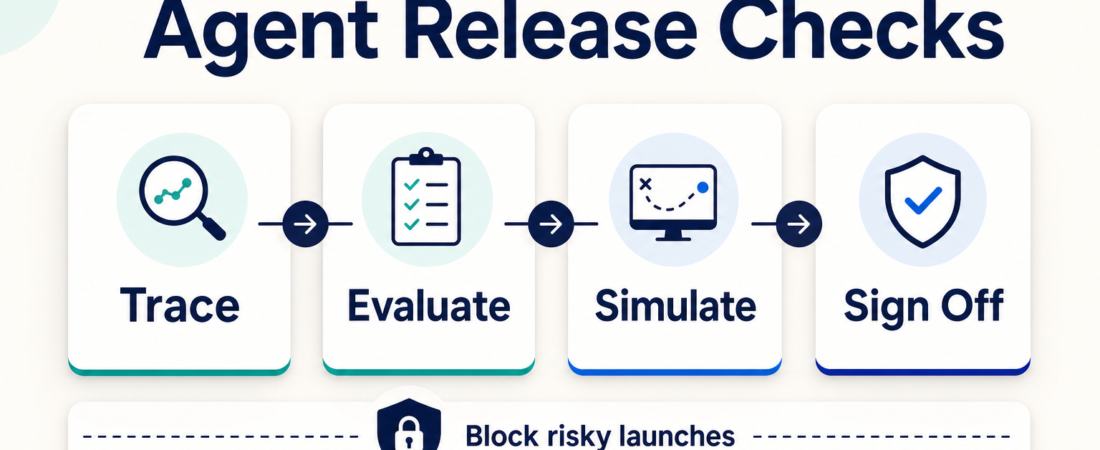
- The useful launch model is simple: trace the workflow, evaluate expected behavior, simulate risky cases, and require human sign-off for boundary decisions.
- Pair evaluation skills with browser checks, product analytics, and rule-based guardrails so a release can be blocked when the evidence is weak.
Most agent failures do not arrive as dramatic system crashes. They look quieter: a support assistant cites the wrong source, a browser agent clicks through a stale flow, a finance workflow mixes test data with live data, or a release agent summarizes a risky change as routine. That is why agent release checks need a different bar from ordinary demo testing. The goal is not to prove that the agent can succeed once. The goal is to catch the cases that should block launch.
| Step | Operator question | ASE evidence |
|---|---|---|
| Choose | What job should the agent help with? | Skill page, category, or industry collection |
| Check | What source, setup, and boundary evidence exists? | Source URL, trust tier, docs, and signals |
| Route | Where should a human review before action? | What to watch, FAQ, and escalation notes |
That is where Future AGI belongs in the ASE catalog. It is not a generic productivity booster. It is a release-readiness skill for teams that want to inspect agent behavior through traces, evaluations, simulations, and guardrails before they give a workflow more access or a larger audience. The official Future AGI documentation frames the product around evaluation and observability for AI systems, which maps well to the operational question ASE cares about: what evidence should an operator review before launch?
Who this is for
This workflow is for teams preparing to widen access to an agent that can answer from sources, use tools, browse a product surface, summarize releases, or make recommendations that another person may act on. It is most useful when the operator needs a release packet with traces, evaluation results, simulation coverage, and a clear human sign-off point.
Why release checks need their own workflow
Traditional software release checks usually ask whether the code builds, tests pass, infrastructure is healthy, and the user interface behaves as expected. Agent workflows add another layer. The same code can produce different behavior depending on context, retrieved documents, model output, tool state, and user phrasing. A release gate that only checks whether the endpoint responds is too shallow.
A useful agent release check asks more specific questions. Did the agent use the right source? Did it call the right tool? Did it stay inside its permission boundary? Did it refuse or escalate when the user request crossed a line? Did it produce an artifact a human can inspect? Did the latest version regress on cases that passed last week?
Those questions explain why release checks should be treated as a workflow, not a single score. Future AGI can sit near the center of that workflow, but it should not be the only control. A practical launch stack combines evaluation traces, deterministic product checks, runtime guardrails, analytics, and human approval for decisions that need judgment.
Decision path
The simplest model is trace, evaluate, simulate, and sign off. Each stage catches a different failure mode.
Trace means preserving what actually happened. For an agent, that includes user input, model reasoning boundaries where available, tool calls, retrieval results, citations, browser actions, structured outputs, and final messages. Without traces, release review turns into storytelling. With traces, the team can inspect the exact path that led to a result.
Evaluate means comparing behavior against expected outcomes. That can include golden examples, rubric-based scoring, citation checks, tool-call expectations, policy checks, or regression comparisons. This is where Future AGI-style evaluation earns its keep: it can help turn scattered test runs into a reviewable set of results.
Simulate means testing cases the team expects to be uncomfortable. Stale documents, ambiguous instructions, missing permissions, adversarial prompts, broken integrations, empty search results, and duplicate records should all appear before launch, not after a customer finds them.
Sign off is the human boundary. Some launches should not be decided by a score alone. If a workflow touches production data, regulated content, customer communication, payments, account changes, or destructive browser actions, the release packet should identify who approved it, what scope they approved, and what conditions would trigger rollback.
Where Future AGI fits
Use Future AGI when the release question is about agent behavior over time, not just one successful run. It is especially useful for agent workflows that depend on tool use, retrieval quality, multi-step planning, or guardrail behavior. The skill can help teams build a repeatable evaluation habit: capture traces, run cases, compare versions, and keep enough evidence to explain a launch decision later.
Good first pilots are narrow. Do not begin with the hardest production workflow in the company. Start with a support assistant answering from approved documents, a research agent assembling a cited packet, a browser agent checking a staging flow, or a release assistant summarizing pull requests. For each pilot, write five to ten cases that represent normal success, known edge cases, and behavior that should block release.
Future AGI should also be paired with skills that test the surrounding system. For browser-heavy releases, ASE lists options such as Playwright MCP, Playwright CLI for coding agents, and local web app verification with Playwright scripts. Those checks tell you whether the product path still works. Future AGI-style evaluation tells you whether the agent behaved well while using or explaining that path.
Recommended ASE skills
What the release packet should include
A lightweight release packet is enough for most teams. It should answer five questions in plain language: what changed, what was tested, what failed, what is still risky, and who approved the rollout. The packet does not need to be a bureaucratic document. It needs to be clear enough that another operator can understand why the agent was allowed to launch.
For an agent workflow, the packet should include representative traces, evaluation results, a short simulation list, unresolved risks, and the rollout plan. If the workflow uses retrieval, include the source corpus date and citation behavior. If it uses browser automation, include screenshots or action logs. If it uses data, include the access scope and whether the agent saw live or copied data. If it sends messages or files externally, include the human confirmation step.
This is also where analytics and observability skills help. A release check before launch is incomplete without a way to notice problems after launch. For product behavior, PostHog Product Analytics and Feature Flags SDK can support rollout controls and event tracking. For shared metrics, Metabase can turn release health into dashboards or alerts. For trace-level guardrails, Invariant gives teams a rule-based way to inspect agent traces and tool flows.
What to watch
The strongest release checks are explicit about blockers before testing starts. A vague “looks good” review is easy to pass and hard to defend. A release should be blocked when the agent cannot cite critical sources, uses a tool outside its intended scope, fails a high-priority regression case, ignores a refusal or escalation rule, or produces output that a human cannot audit.
Blockers should match the risk of the workflow. A content-drafting assistant can tolerate more revision than an account-change workflow. A research assistant can return uncertainty; a compliance workflow must preserve boundaries. A browser QA agent can fail a task and report the failure; a browser purchasing agent needs much stricter confirmation before acting.
Runtime guardrail skills can help here, but they are not a substitute for release discipline. VoltAgent guardrails and Invariant-style trace rules are useful when teams know what they want to prevent. They work best when paired with real evaluation cases and a human owner who can decide whether a blocked launch is a false positive or a real risk.
A practical first setup
For a small team, the first setup can be simple. Choose one agent workflow and create a release folder with three files: a scenario list, expected outcomes, and a launch checklist. Run the scenarios through the current agent version, capture traces through Future AGI or a similar evaluation setup, and mark each case as pass, fail, or needs human review.
Then add one deterministic check for the product surface. If the agent touches a web app, use Playwright. If it depends on retrieval, add a small citation test set. If it depends on data, run the workflow against copied or read-only data first. If it sends user-facing messages, require a human approval step until the team has enough history to automate more of the path.
The final launch checklist should be short: no critical evaluation failures, no unresolved permission drift, no missing source citations for grounded answers, no destructive action without confirmation, post-launch monitoring in place, and a named owner for rollback. That checklist is not glamorous, but it is the difference between an agent that demos well and an agent a team can operate.
How to browse next
Future AGI is a good starting point if the immediate problem is agent evaluation and release confidence. If the problem is product flow verification, start with ASE’s three-layer launch safety model and the Playwright-related skills. If the problem is source-grounded support or research, pair release checks with document and retrieval skills before widening access.
The core rule is the same across all of these routes: launch decisions should be based on inspectable evidence. Traces show what happened. Evaluations show whether behavior met the bar. Simulations show whether the uncomfortable cases were tested. Human sign-off shows who accepted the remaining risk. Agent release checks are useful when they make that evidence harder to skip.
FAQ
Should Future AGI replace product smoke tests?
No. Use evaluation skills to inspect agent behavior and use product smoke tests to verify the underlying app or workflow still works.
How many release cases are enough for a first pilot?
Start with five to ten cases: normal success, known edge cases, and at least two cases that should block or escalate.
What is the minimum evidence to keep?
Keep the trace, evaluator result, failure notes, launch scope, owner, and rollback condition. If the workflow uses sources or browser actions, keep citations or screenshots too.