Which Skill Should I Use for Research: Local Deep Research, GPT Researcher, or DocsGPT?
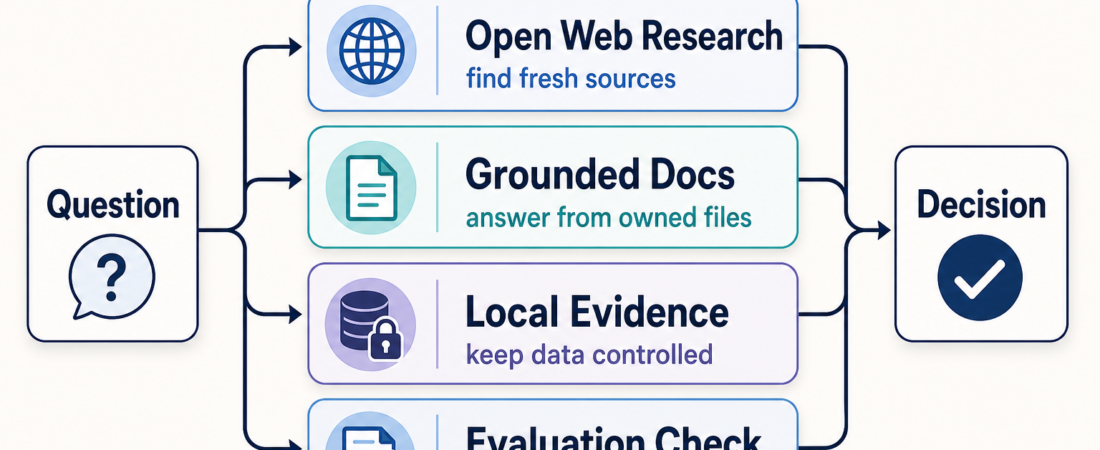
Research skills fail in boring ways before they fail in dramatic ones. The agent finds fresh-looking sources but cannot explain why they matter. It answers from a document corpus but misses what changed this week. It keeps everything local, then produces a tidy summary with weak citations. The right first question is not “which research agent is best?” It is “what kind of evidence do we need, and where is that evidence allowed to live?”
| Research job | Best fit | Review before trusting |
|---|---|---|
| Find what changed recently | Open web research | Source list, dates, and missing counterexamples |
| Answer from owned files | Grounded document assistant | Corpus scope, citations, and stale documents |
| Keep data controlled | Local evidence workflow | Local index quality, export path, and human signoff |
In Short
Use an open web research skill when the answer depends on current public sources. Use a document-grounded skill when the answer should come from a known file set. Use a local research workflow when privacy, auditability, or offline review matters more than breadth. For most teams, the safest pattern is not one research agent for every job. It is a small set of skills with clear intake rules, citation checks, and a human review point before decisions leave the research stage.
The calendar brief names Local Deep Research, GPT Researcher, and DocsGPT as the comparison frame. On ASE, the live skill pages that map cleanly to this decision are Open Deep Research, Scientific Agent Skills, and QMD. Adjacent evidence tools such as NotebookLM search and evidence-backed codebase memory are useful when the research surface is a notebook, source tree, or internal knowledge base.
Who this is for
This is for operators choosing a research skill before they hand it a live question: founders checking a market claim, support leads turning docs into answer briefs, analysts building a source-backed memo, educators collecting research material, and engineering teams asking agents to inspect a technical corpus. It is also for people who are tempted to ask one agent to “research this” without defining what counts as evidence.
If the result will be used only as background reading, a broad web research pass may be enough. If the result will shape a customer answer, investment memo, policy note, or release decision, the skill needs stricter boundaries. The output should show what was searched, what was excluded, which sources support each claim, and where the agent is uncertain.
Decision path
Start with source location. If the best evidence is on the public web and freshness matters, choose an open web research skill. A GPT Researcher-style flow or ASE’s Open Deep Research page fits questions like “what changed in this ecosystem this month?” or “which vendors support this capability now?” The review burden is source quality: dates, authoritativeness, duplicate reporting, and whether the agent looked for dissenting evidence.
Move to document grounding when the answer must come from your corpus. DocsGPT-style work is not mainly about discovery. It is about constrained answers from a known library: product docs, internal policies, onboarding notes, transcripts, or support articles. On ASE, QMD points toward this local-note and transcript search pattern, while NotebookLM search is a better mental model when the source set is already organized into notebooks and study artifacts.
Choose local evidence when control is the main requirement. Local research workflows are slower to set up, but they reduce ambiguity about where data went and what was indexed. That matters for unpublished research, private customer material, legal review packets, unreleased technical docs, or any corpus that should not be sent through a general web retrieval path. Skills such as evidence-backed codebase memory show the pattern: index the source, answer with citations, and keep the review trail close to the files.
Add an evaluation check before decisions. Research output should be treated as a draft evidence packet, not a conclusion. For benchmark-style work, MiroEval is relevant because it frames deep research around factual, quality, and process dimensions. For academic or replication-heavy questions, academic writing and replication workflows are a stronger fit than a generic web search pass.
Recommended ASE skills
Open Deep Research is the first stop for configurable, multi-source research passes. Use it when the question benefits from breadth and the operator can inspect the resulting source trail.
Scientific Agent Skills fits structured research and analysis tasks where the goal is not just a summary, but a repeatable research process with clearer reasoning around evidence.
QMD is useful when the research question starts inside local notes, documents, or meeting transcripts. It is a better match for owned context than for public trend scouting.
NotebookLM search helps when the source material is already grouped into notebooks and study artifacts, especially for education and research teams that need to revisit the same source sets.
MiroEval belongs at the review layer. Use it when you need to compare research quality, not just collect more material. The external projects behind this space are also worth reading directly: GPT Researcher documentation for autonomous web research patterns and DocsGPT documentation for document-grounded assistant patterns.
What to watch
Do not let a research skill hide its retrieval path. A useful result names the sources, shows enough context to verify citations, and separates facts from interpretation. Watch for summaries that cite homepages instead of the specific supporting page, merge old and new evidence without dates, or answer from a corpus that was never described.
Also watch the privacy boundary. A local research question can quietly turn into a web research question if the operator asks for “more context” without specifying where the agent may search. Put that boundary in the prompt and in the skill choice: public web, approved document set, local files only, or human-approved expansion.
Finally, avoid false precision. Research agents are good at turning messy material into a readable brief, but readability is not proof. The operator still needs to check the handful of claims that would change a decision.
FAQ
Should one team standardize on a single research skill?
Usually no. Standardize the decision path first. One skill can handle public source discovery, another can answer from owned documents, and a third can evaluate whether the output is strong enough to use.
When is a DocsGPT-style tool better than a deep research tool?
Use it when the answer should come from a specific document set. Deep research is better for discovery; document grounding is better for controlled answers from known material.
What should every research output include?
A short answer, a source list, citation-level support for important claims, uncertainty notes, and the exact next review step. Without those, the post-processing burden moves back to the human.
Where should a new ASE reader start?
Start with Browse Skills, then narrow by the actual evidence surface: public web, owned docs, local files, or evaluation. That prevents the common mistake of choosing the most general research skill for a constrained job.