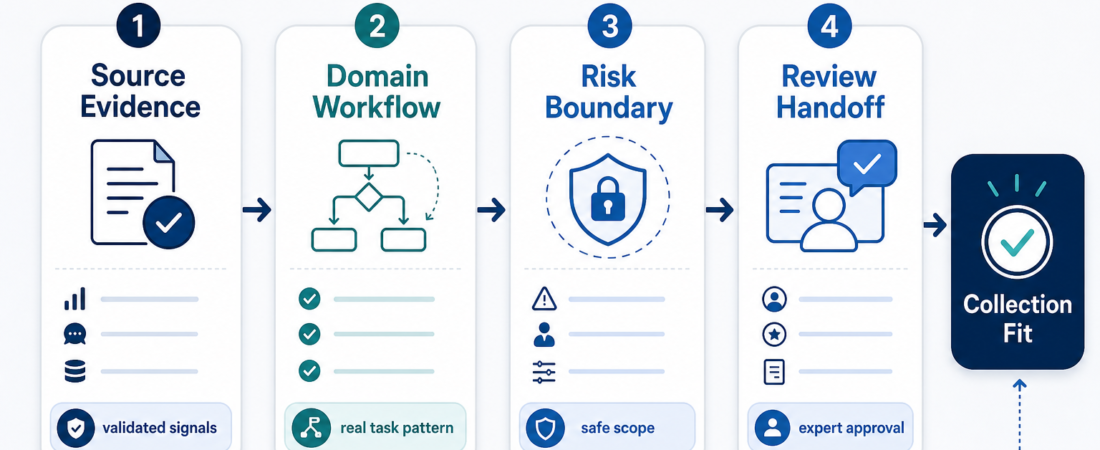
When a Skill Belongs in an Industry Collection and When It Does Not
Industry collections are useful only when they help operators make a better routing decision. A finance collection should not become a dumping ground for every spreadsheet tool. A healthcare collection should not imply clinical judgment just because a skill can parse a PDF. The test is narrower: does the skill support a real domain workflow, with clear boundaries, source evidence, and a human review path?
| Industry-fit check | Belongs in collection when… | Keep out or cross-list carefully when… |
|---|---|---|
| Source evidence | The upstream project, docs, or package clearly supports the domain use case. | The domain claim is inferred from generic features. |
| Workflow fit | The skill maps to a repeated job in that industry. | It is merely a broad utility that any team might use. |
| Risk boundary | The page states what the agent should not decide or automate. | The skill could be mistaken for advice, approval, diagnosis, or authority. |
| Review handoff | Outputs naturally become packets, drafts, checks, or queues for humans. | The workflow encourages unreviewed action in a high-stakes area. |
In Short
- A skill belongs in an industry collection when it helps with a recognizable industry job, not just because the tool could be used there.
- Good collection placement depends on source evidence, workflow specificity, risk boundaries, and review handoffs.
- Generic skills can still be valuable, but they should usually stay in broader categories unless a domain pattern is clear.
- Regulated or high-stakes collections need stricter wording: assistance, preparation, and review support are different from advice or autonomous decisions.
Who this is for
This guide is for creators deciding how to submit a skill, operators browsing ASE industry collections, and reviewers trying to keep collections useful.
The core distinction is simple. A category says what the skill does. An industry collection says where that work repeatedly shows up with domain-specific constraints. Broad skill search is for discovery. Collections are for faster operator routing.
Decision path
Start with the job, not the label. If the skill is framed as “finance,” “legal,” “healthcare,” “real estate,” or “support,” ask what concrete work it helps someone finish. “Reads documents” is not enough. “Turns vendor invoices into a reviewed reconciliation packet” is a better fit for Finance & Filings. “Summarizes PDFs” is broad. “Stages intake documents for staff review without clinical claims” is closer to Healthcare Documentation & Intake.
Next, check source alignment. A collection page should not promote a domain claim that the source cannot support. If a package, repository, or official documentation only describes a general browser agent, then the industry page should describe the practical use case conservatively. Empty or broad is better than pretending the source proves something it does not.
Then look for a boundary. A legal operations skill may organize clauses, compare drafts, or prepare a review packet. It should not sound like it gives legal advice. A healthcare skill may expose FHIR resources or stage intake data. It should not imply diagnosis, treatment, or independent triage. A support skill may draft replies from knowledge-base evidence, but a person should still own refunds, account actions, or escalations.
Finally, ask whether the output has a review handoff. Industry collections are strongest when the agent produces something a team already knows how to inspect: a ticket draft, source-backed answer, contract summary, invoice exception list, release checklist, or browser test artifact. If there is no obvious reviewer, queue, or approval step, the collection placement needs more caution.
Recommended ASE skills
| Use case | ASE skill | Why it fits an industry collection |
|---|---|---|
| Finance research packets | LangAlpha finance research workspaces | It is tied to a finance research workflow with persistent evidence context. |
| Healthcare data access | FHIR healthcare data resources for MCP agents | The boundary is explicit: data resources and review, not clinical authority. |
| Support ticket handling | Zendesk ticket and Help Center workflows | It maps to a known support workflow: ticket context, knowledge lookup, and reply preparation. |
| Support conversation lookup | Help Scout conversation search | It supports evidence gathering before drafting, which is a clear reviewable step. |
| Agency delivery checks | Stagehand Browser Automation SDK | It belongs in agency operations when used for supervised client workflow QA. |
| Real estate research | RAG-backed real estate property research | It is domain-specific research support, not a claim to price or advise on transactions. |
These examples are intentionally different. Some are domain-native, such as FHIR data access. Others are broader tools that fit only when the use case is carefully scoped, such as browser automation inside AI Agency Operations & FDE Workflows.
What to watch
Watch for inflated placement. A skill should not appear in Legal Ops & Compliance merely because it can summarize long documents. It should support a legal operations pattern such as intake, comparison, clause extraction, records handling, or reviewed drafting. The same applies to support: a chatbot framework is not automatically a support workflow unless the page explains ticket context, source grounding, escalation, and account-action limits.
Also watch for under-placement. Some skills are too useful to hide in a generic bucket when they clearly solve repeated industry work. If a creator can show the source, name the job, define what the agent must not do, and point to a human handoff, the skill probably deserves collection placement or a carefully worded cross-list.
For creators, the practical next step is to document source evidence, domain fit, and review boundaries before submission. For operators, the safer habit is to read the collection label as a routing hint, then inspect the individual skill page before installing anything.
FAQ
Can one skill belong to more than one industry collection?
Yes, but only when each placement has a real workflow reason. A document parser may fit finance, legal, and healthcare, but each collection should describe a different review path and risk boundary.
Should generic tools be excluded from industry pages?
Not always. Generic tools belong when the industry use is specific enough to help operators choose. Otherwise, they are better left in broad categories or search results.
What is the fastest rejection signal?
The fastest signal is a domain claim with no source support. If the source only says “automation framework,” the collection page should not imply finance, legal, or healthcare expertise.
How should high-risk industries be handled?
Use stricter language. Focus on intake, evidence gathering, drafting, routing, and human review. Avoid wording that suggests autonomous decisions, professional advice, or unsupervised action.