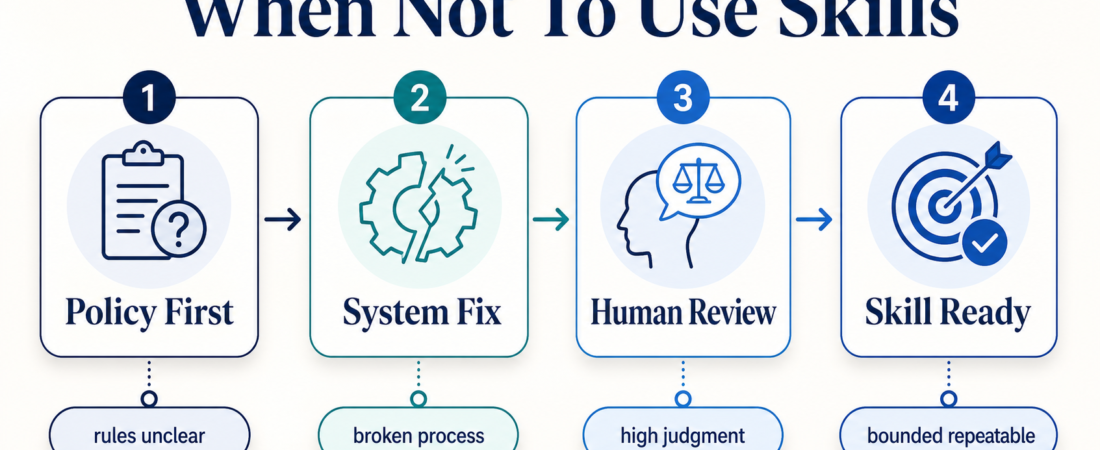
When Not to Use an Agent Skill
Agent skills work best when the task is bounded, repeatable, inspectable, and worth delegating. They are much less useful when the real problem is missing policy, broken ownership, unsafe permissions, or a decision that still needs human judgment.
That distinction matters for trust. A marketplace for agent skills should not imply that every operational problem is one skill away from being solved. Some workflows need a clearer rulebook. Some need better software. Some need a human to remain accountable. A good skill can accelerate those systems, but it should not become a disguise for decisions nobody has actually made.
| Signal | Stop and fix first | Continue with a skill when |
|---|---|---|
| Policy | The team cannot state the rule the agent should follow. | The rule is written, owned, and testable. |
| Process | The workflow changes every time because ownership is unclear. | The handoff, inputs, and review step are stable. |
| Risk | A bad output can trigger legal, financial, medical, or security harm. | The skill prepares evidence for a qualified reviewer. |
| Access | The skill would need broad write access to production systems. | Permissions are narrow, logged, and reversible. |
| Evidence | The output cannot cite sources, logs, files, or decisions. | The result includes enough context to audit or replay. |
In Short
Do not use an agent skill just because a task is annoying. Use one when the task has stable inputs, a clear output, a known review path, and a small enough blast radius that mistakes can be caught before they matter.
When those conditions are missing, start somewhere else. Write the policy. Repair the source system. Add deterministic checks. Define the owner. Then bring in a skill to gather context, draft a review packet, run a bounded check, or make a repetitive handoff easier.
The strongest agent workflows usually do less than people expect at first. They do not replace judgment. They reduce the amount of messy preparation required before judgment can happen.
The wrong job for a skill
An agent skill is not a policy engine. If a team cannot describe what should happen when a customer asks for a refund, when a vendor invoice is disputed, or when a security scan finds a vulnerable dependency, a skill will not magically supply a defensible rule. It may produce confident language, but confidence is not governance.
This is especially true in regulated work. The ASE guide to regulated work makes the key distinction: assistance is not the same as advice, and automation is not the same as authority. A document intake skill can extract fields, summarize source material, and flag missing evidence. It should not quietly become the person making legal, medical, financial, or employment decisions.
The same boundary appears in security. A skill such as Gate pull requests with targeted diff-aware AI security review using Claude Code Security Review can help reviewers focus on risky changes. It should not be treated as the final arbiter of whether a system is safe to deploy. The better pattern is assistive: collect findings, cite files, rank concerns, and hand the decision to an accountable owner.
When the workflow is really a broken process
Teams often reach for skills when the process itself is unstable. Tickets arrive without owners. Customer requests mix support, product, legal, and billing questions in one thread. Release notes depend on whoever remembers to update them. A skill can help collect the mess, but it cannot compensate for the absence of ownership.
If every run requires a different exception, start by fixing the handoff. Define what counts as a valid input, who reviews the output, and what happens when the skill cannot answer. Once that is clear, a skill becomes useful because the agent can follow a known path instead of improvising around organizational ambiguity.
For example, Search Help Scout conversations and thread context before drafting support replies is a good fit when the support workflow already has a human owner and the goal is better context before drafting. It is a poor fit if nobody has decided who is allowed to promise refunds, disclose roadmap details, or escalate sensitive account issues.
Likewise, Extract invoice fields from vendor PDFs into structured records works best when invoice review has a known approval path. If the finance process is still a pile of side-channel approvals and undocumented exceptions, the first fix is process design, not more automation.
When deterministic software should come first
Some problems should be solved with ordinary software, not an agent. If the task is a pure transformation with strict rules, a script, validation rule, database constraint, or product feature may be cheaper and safer. Agents are valuable around ambiguity, language, context gathering, and decision preparation. They are not a substitute for deterministic controls.
If every invoice needs a required vendor ID, add validation. If a release cannot go out without a changelog entry, make the release pipeline check it. If a GitHub Actions workflow should never use broad permissions, run a purpose-built control such as Audit GitHub Actions for privilege and supply-chain risks with zizmor or Pin GitHub Actions and reusable workflow refs to immutable SHAs before CI changes merge with pinact. Let the agent explain results and prepare remediation, but keep the invariant deterministic.
This matches the direction of broader AI risk guidance. The NIST AI Risk Management Framework emphasizes governance, measurement, and risk management rather than treating model behavior as inherently trustworthy. OWASP’s Top 10 for LLM Applications similarly warns about prompt injection, excessive agency, sensitive information disclosure, and overreliance. Those are system design problems as much as model problems.
When the skill should only prepare the decision
There is a large middle ground where a skill is useful, but only as preparation. The skill gathers evidence, normalizes inputs, drafts options, or runs a repeatable test. The human still decides.
That is the right shape for many early deployments. A browser testing skill such as Drive token-efficient browser testing from coding agents with Playwright CLI can verify whether a signup, checkout, upload, or export flow still works. The decision to ship remains with the team, but the evidence is stronger than a vague manual spot check.
A data skill such as DuckDB SQL Analytics Agent can answer bounded questions from local exports. That is helpful when a manager needs a repeatable view of overdue approvals or support volume. It becomes risky when the same skill is allowed to mutate production records, infer sensitive conclusions, or produce unexplained metrics that people treat as official.
Document-grounded assistants follow the same rule. Use DocsGPT for document-grounded enterprise assistants can be valuable when the output cites the underlying material and makes uncertainty visible. It should not be used as a source of truth when the documents are stale, contradictory, or outside the assistant’s actual index.
A practical decision path
Before adding a skill, ask five questions.
First: can we state the rule? If not, write the rule before automating the task. This may be a policy, a checklist, an escalation matrix, or a definition of done.
Second: can we bound the input and output? A useful skill knows what it receives and what it should produce. “Handle customer issues” is too broad. “Search prior Help Scout context and draft a reply with citations and unresolved questions” is workable.
Third: can a reviewer inspect the result? If the output cannot show sources, logs, assumptions, and open questions, the team cannot learn from it or catch mistakes reliably.
Fourth: can permissions be narrow? A skill that reads a folder, scans a pull request, or runs a local browser check is easier to govern than one with broad production write access.
Fifth: is the failure reversible? If a bad run sends money, deletes data, exposes private information, or makes a regulated decision, the skill should not execute the action. It can prepare the packet for someone who is authorized to act.
If the answer to any of those questions is weak, that does not mean the workflow is impossible. It means the next improvement is probably policy, process, access design, or deterministic validation. The skill comes after that foundation.
What ASE should reward
A skill marketplace earns trust by rewarding restraint. The best listings should make scope obvious: what the skill does, what it does not do, what inputs it expects, what evidence it returns, and what permissions it needs. A vague promise to “automate operations” is less useful than a narrow skill with a clear review step.
This is why trust signals, categories, and internal links matter. Operators should be able to browse the ASE catalog, compare skill pages, and understand whether they are looking at document intake, browser verification, security review, policy enforcement, or data analysis. The marketplace should make the safer first step easier to find.
Skills are credible when they are honest about their boundaries. That honesty makes them usable.
FAQ
What is the clearest sign that we should not use an agent skill yet?
The clearest sign is an unclear rule. If the team cannot explain what a good decision looks like, a skill should not be asked to make or execute that decision.
Are agent skills unsafe for regulated work?
No, but the role matters. Skills can help with intake, summarization, evidence preparation, and review packets. They should not present themselves as licensed advice or final authority unless the surrounding system, policy, and accountable humans support that use.
When is a normal script better than a skill?
Use a script or product control when the task is deterministic and rule-based: validation, formatting, required fields, permission checks, or repeatable build gates. Use a skill when the task requires context gathering, language understanding, or structured preparation for review.
How much access should a first skill have?
As little as possible. Read-only access, local files, scoped pull requests, sandboxed browser checks, and reversible outputs are better starting points than broad production permissions.
Can a skill ever take action without a human?
Yes, but only after the workflow is stable, permissions are scoped, logging is in place, and failure is reversible or low impact. Until then, the safer pattern is to let the skill prepare the evidence and leave the action to a person or deterministic control.