The Agent Skill Stack for Legal and Compliance Review Packets
Legal and compliance teams do not need an agent that “does legal work.” They need an agent that can assemble the packet a qualified reviewer would have built anyway: the relevant documents, the extracted facts, the clauses or policy sections that matter, the source citations, the open questions, and a clean trail of what was reviewed.
That distinction matters. A useful legal workflow skill should reduce the time spent hunting, converting, sorting, and summarizing. It should not pretend to replace counsel, invent conclusions, or blur the line between document assistance and legal advice. The safest pattern is a review packet: a structured bundle of evidence that makes human judgment faster and more defensible.
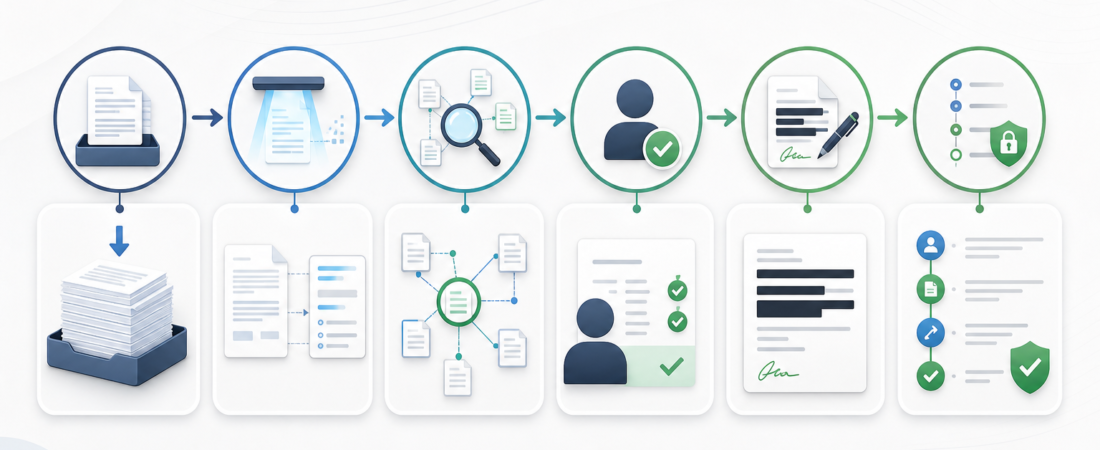
Review Packet Workflow
The agent prepares the packet. Legal, compliance, security, or business owners make the decisions.
Start With the Review Boundary
The first design choice is not which model to use. It is what the agent is allowed to do. In a legal or compliance setting, the agent should be framed as a document assistant and evidence organizer. It can identify candidate clauses, extract dates, compare versions, summarize source-backed facts, and prepare review notes. It should not decide whether a contract is acceptable, approve a regulated communication, or tell the business what legal position to take.
Write that boundary directly into the skill. A good instruction sounds practical, not performative: “Prepare a review packet with citations and unresolved questions. Do not provide legal advice or final approval. Escalate ambiguous, missing, conflicting, or high-risk items.” That one rule prevents a lot of downstream mess because every later step has a clear job.
The output should also make uncertainty visible. If OCR confidence is low, say so. If a clause appears in one version but not another, point to both pages. If a contract references an exhibit that is missing from the upload, put it in the gaps section instead of quietly ignoring it. A packet is only useful when it helps a reviewer see what is known, what is missing, and where the sources are.
Build the Stack in Layers
A legal review packet usually needs five layers: document preparation, extraction, retrieval, action handling, and evidence logging. Each layer can be handled by a different skill or tool, which keeps the workflow easier to test and safer to operate.
The preparation layer turns messy inputs into stable material. Legal teams receive scanned contracts, board packets, PDFs exported from old systems, email attachments, and screenshots of screenshots. Before an agent summarizes anything, it needs reliable text and page structure. ASE skills such as qpdf PDF normalization, LiteParse for local PDF parsing, and olmOCR for dense PDFs fit this stage because they focus on making the source material usable before reasoning begins.
The extraction layer pulls out fields and sections the reviewer cares about. For a commercial agreement, that might include parties, effective date, renewal period, termination rights, governing law, data processing obligations, security addendum references, indemnity limits, and signature status. For a compliance packet, it might include policy citations, control IDs, evidence dates, system owners, reviewer names, and exception notes. A skill such as Nutrient Agent Skill for OCR, redaction, extraction, and signing is useful here because document operations often need to stay tied to the original file, not just a loose summary.
The retrieval layer prevents the packet from becoming a single-document summary. Many legal questions depend on related material: prior amendments, archived web pages, policy versions, ticket history, procurement notes, or public filings. For broader evidence gathering, RAGFlow document-grounded workflows, Local Deep Research, Percollate web-to-PDF archiving, and warc2text for archived pages give the agent ways to assemble supporting context without losing provenance.
Make the Packet Reviewer-Friendly
The final artifact should not read like a chatbot transcript. It should look like something a legal operations, compliance, procurement, privacy, or security reviewer can scan quickly. A strong packet has a short executive summary, a document inventory, extracted facts, cited findings, open questions, risk flags, and a decision log area. Each finding should point back to a file name, page, section, URL, or record ID.
For example, instead of writing “the agreement has an auto-renewal clause,” the packet should say: “Auto-renewal appears in Master Services Agreement v4, section 7.2, page 14. Notice period: 60 days before renewal. Related amendment dated 2025-11-03 does not modify section 7.2.” That phrasing gives the reviewer a path to verify the claim. It also makes the agent’s work auditable.
Use tables sparingly. They are excellent for inventories, obligation lists, clause comparisons, and exception tracking. They are weaker for nuanced reasoning. When a topic requires interpretation, the packet should separate source-backed facts from reviewer questions. A useful pattern is: “Observed evidence,” “Why it may matter,” and “Question for reviewer.” The middle section can explain context, but the final decision belongs to the human reviewer.
Redaction and signing should be treated as actions with checkpoints. If the agent proposes redactions, it should list the basis for each redaction and ask for approval before producing a redacted file. If it prepares signature routing, it should identify missing signers, signature blocks, dates, and attachments before anything is sent. The agent can reduce clerical work, but consequential movement still needs an explicit review step.
Add Governance Before Scale
Legal and compliance workflows are tempting to automate because the manual work is repetitive. That is also what makes them risky. The more repeatable the workflow becomes, the easier it is for one bad assumption to affect many matters. Governance skills help prevent that.
For agent execution controls, ASE includes patterns such as DefenseClaw for agent skill and tool-call governance and LACP for policy-gated auditable execution. These are not legal-specific, but they map well to regulated review work: require approvals for sensitive actions, log tool use, separate read-only analysis from write actions, and create an audit trail when the agent touches documents or external systems.
Observability belongs in the stack too. A packet workflow should record which documents were processed, which extraction methods ran, which prompts or skill versions were used, where retrieval results came from, and which reviewer accepted or rejected each item. Skills such as Phoenix for tracing and evaluation can help teams inspect agent behavior instead of relying on vague confidence.
The evaluation set should include uncomfortable cases: unreadable scans, conflicting amendments, missing exhibits, duplicate contracts with different dates, ambiguous governing-law clauses, partial signatures, and records that should not be summarized because of privilege or access restrictions. If the skill handles only clean examples, it is not ready for real legal operations.
A Practical First Workflow
A sensible first version is narrow: contract intake for internal review. The agent receives a contract folder and a short review objective, such as “prepare a privacy and security review packet for vendor onboarding.” It normalizes the PDFs, extracts named fields, searches for data processing and security clauses, flags missing exhibits, compares the agreement against a checklist, and returns a packet with citations and open questions.
Do not connect that first workflow directly to signature routing or external systems. Start with read-only packet assembly. Once reviewers trust the packet shape, add controlled actions: generate a redaction proposal, prepare an approval checklist, draft a vendor question list, or create a matter folder. Each new action should have its own permission boundary and rollback story.
The best legal and compliance agent stacks are boring in the right ways. They are explicit about scope. They preserve source evidence. They escalate ambiguity. They separate preparation from approval. And they make the reviewer faster without pretending the reviewer is optional.
That is the standard worth aiming for: not an agent that gives legal advice, but an agent that reliably turns scattered documents into a clean, cited, human-reviewable packet.