The 100-Day Blog Check: What ASE Content Should Keep and What It Should Drop
One hundred blog posts is enough to notice what helps operators and what just fills a calendar. The next phase of the Agent Skill Exchange blog should be more direct: fewer broad essays, more practical routes through the catalog, and clearer evidence for why a skill belongs in a given workflow.
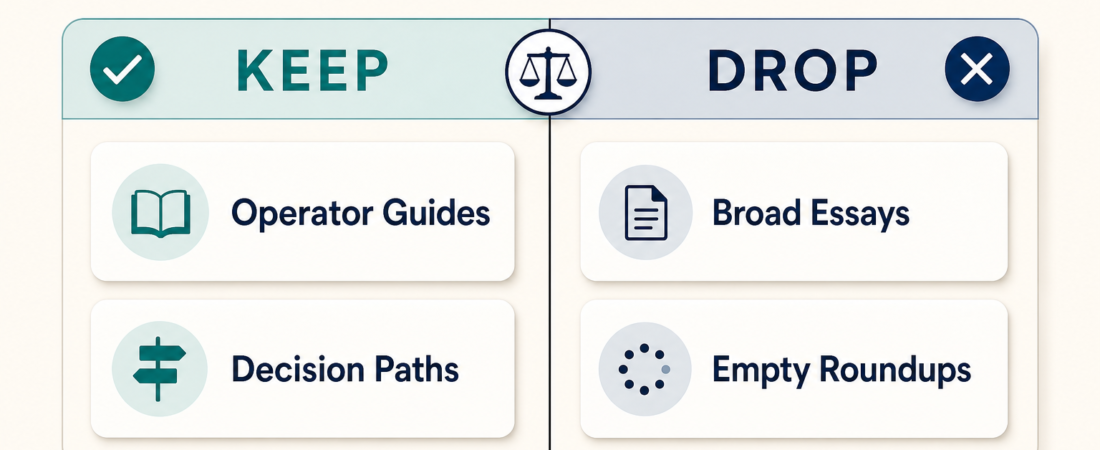
| Keep | Drop | Why it matters |
|---|---|---|
| Operator guides | Generic “AI is changing work” essays | Readers need the next decision, not another category sermon. |
| Decision paths | Lists with no selection criteria | A good post should help someone choose, test, or reject a skill. |
| Evidence-backed skill coverage | Roundups that do not say what changed | Marketplace trust depends on source, scope, and verification signals. |
In Short
The ASE blog should keep publishing from a bounded calendar, but the format should get tighter. The best posts are the ones an operator can use while making a real choice: which skill category to browse, which candidate to test first, what evidence to ask for, and where human review should remain in the loop.
The weakest posts are usually broad. They describe the agent skills ecosystem, repeat familiar AI adoption claims, or summarize new entries without enough context to change a reader’s next action. Those pieces may be easy to produce, but they do not compound into authority.
This is also aligned with Google’s guidance to create “helpful, reliable, people-first content” rather than content written mainly to satisfy a publishing machine. Search engines are not the main audience here. Operators are. But the incentives point in the same direction: answer the real job clearly, show evidence, and avoid padding.
What ASE Content Should Keep
Keep practical operator posts. The strongest ASE articles translate the marketplace into a next step. A reader should be able to leave with a small plan: use Browse Skills, narrow by category, inspect source alignment, test one candidate, and decide whether it deserves a production path.
That is why “which skill should I use?” articles work. The question is humble, but it is exactly how buyers, builders, and internal automation leads think. They rarely start with a taxonomy. They start with a messy job: too many PDFs, too many support tickets, too many release checks, too much stale documentation.
Keep decision paths. A post about research skills should not merely say that DocsGPT is useful. It should explain when a document-grounded assistant is a better fit than open-ended web research, when local research matters, and when the right answer is to improve the source corpus before adding an agent.
Keep evidence-backed skill coverage. Skill spotlights should remain concrete. If a post covers browser automation, it should connect the reader to actual options such as Nanobrowser, Playwright CLI browser testing, or Playwright MCP. It should also say what each one is good for and what it should not be trusted to do without review.
Keep marketplace philosophy when it changes behavior. Trust posts are worth publishing when they explain a rule operators can apply. “Blank is better than wrong” works because it clarifies why missing metadata is sometimes a quality choice. Source alignment works because it tells readers how to interpret stars, downloads, and monorepo signals without being misled.
What ASE Content Should Drop
Drop broad ecosystem essays unless they contain a real decision. “Agents are changing work” is true, but not useful by itself. ASE does not need to win a thought-leadership contest. It needs to help someone choose, install, compare, verify, or reject skills with less confusion.
Drop empty roundups. A roundup earns its place only when it identifies what changed and why that change matters. “New skills were added” is not enough. A better roundup groups skills by operator job, calls out trust changes, and explains which workflows are now easier to test.
Drop long posts that hide the answer. Cornerstone pieces still matter, but length should buy clarity. If the practical answer is buried under context, the post has failed. A 1,500-word article should contain a usable model, not just more sentences.
Drop fake completeness. Some topics should say “not enough evidence yet.” A marketplace blog should not pretend every category is mature or every skill belongs in production. When a skill is experimental, niche, missing source context, or risky for regulated work, the article should say that plainly.
The New Editorial Test
Every ASE blog post should pass a simple test before it publishes: what can a reader do after reading this that they could not do before?
For a practical post, the answer should be obvious. The reader can pick a category, compare two skills, build a small test plan, or ask a better approval question. For a cornerstone post, the reader should leave with a durable mental model: how to think about trust tiers, source alignment, curation, or automation boundaries.
This also changes how internal links should work. Links should not be decoration. If an article mentions content production, it can point to SEO Machine. If it talks about citation hygiene, it can point to citation and bibliography formatting. If it talks about design context for coding agents, it can point to Figma layout context through MCP. The link should extend the reader’s path, not merely satisfy a quota.
How the Calendar Should Work From Here
The calendar is still useful. It prevents the blog from chasing random topics, and it gives the marketplace a steady editorial rhythm. But the calendar should be treated as a bounded queue, not a permission slip for filler.
Weekly changelogs should be short and specific. Category deep dives should explain the work pattern, not just the category label. Skill spotlights should include fit, setup burden, safety boundaries, and alternatives. Comparison posts should name the selection criteria before naming a winner.
The most valuable pattern is a compact operator guide with a decision path. Start with the job. Name the constraints. Show the route. Link to relevant skills. Say what to watch. End with a few questions a sensible team would ask before adoption.
That format is less flashy than a grand essay, but it is more useful. It also gives ASE a sharper editorial identity: a marketplace that cares about practical adoption, not just catalog growth.
References
- Google Search Central: Creating helpful, reliable, people-first content
- ASE Blog
- ASE Industry Collections
FAQ
Does this mean ASE should stop publishing daily?
No. A daily rhythm can work if the posts stay bounded and useful. The problem is not frequency by itself. The problem is publishing a post that does not help the reader make a better decision.
Should every post include skill links?
Most practical posts should. ASE is a marketplace, so the blog should connect ideas to real skill pages when those links help the reader continue the job. The link should be relevant, specific, and checked.
What makes a roundup worth publishing?
A roundup should explain what changed, who should care, and what to try first. If it is just a list of additions, it belongs in an internal log rather than a public article.
What should cornerstone posts do differently?
Cornerstone posts should give readers a durable model for evaluating agent skills. They can be longer, but they still need a practical table, clear examples, and an answer that is visible early.