Skill Spotlight: Yuxi for Private RAG and MCP Skill Workspaces
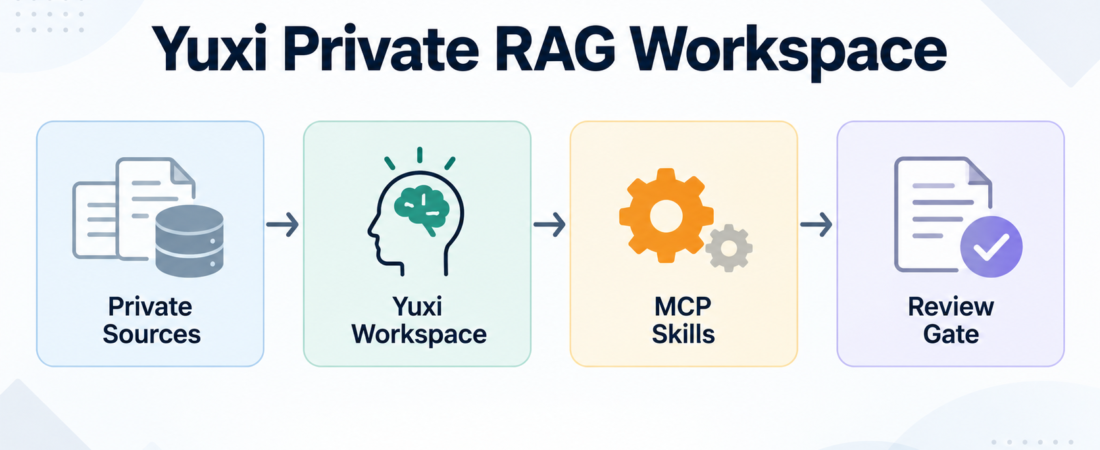
Private RAG workspaces are useful only when the operator can explain what the agent saw, which tools it could reach, and where a human reviewed the result. Yuxi is interesting because its official project positions it as a privately deployable, multi-tenant knowledge-agent platform that brings knowledge retrieval, knowledge graphs, LangGraph-style multi-agent orchestration, MCP/Skills, sandbox tools, and permission management into one workspace.
| Stage | Operator question | Evidence to keep |
|---|---|---|
| Scope | Which sources and users belong in this workspace? | Tenant, department, corpus, and model boundary notes |
| Retrieve | Can the agent cite the documents it used? | Chunks, citations, graph context, and failed queries |
| Act | Which MCP skills or sandbox tools can run after retrieval? | Allowed skills, human approvals, and rollback notes |
In Short
Use Yuxi when the job is not just document search. The better fit is an internal workspace where teams need private deployment, multiple users, controlled permissions, knowledge-base retrieval, and agent actions in the same operating surface. Its README describes document parsing, chunking, vector indexes, Neo4j-backed knowledge graph extraction, MCP/Skills, sandbox execution, and team-level scope controls. That mix makes it worth a close look for teams that want retrieval to sit near agent execution without pushing internal documents into a generic chat tool.
The practical test is simple: can your team name the private sources, restrict who can query them, review what was retrieved, and approve any tool action that follows? If not, start with a narrower retrieval layer before adopting a broader workspace.
Who this is for
This post is for platform, data, security, and automation leads who are turning internal documents into agent context. The pattern fits teams with product specs, runbooks, support notes, sales knowledge, engineering docs, or compliance material that should remain under local deployment and team permissions.
It is less useful for a single public FAQ, a small personal note collection, or a one-off research batch. In those cases, a lighter document search skill may be easier to operate. Yuxi is more compelling when the workspace itself matters: users, departments, shared knowledge bases, model settings, skills, and review trails all need to be managed together.
Starter workflow
Start with one bounded workspace, not the whole company corpus. Pick a team, name the data sources, and write down which documents are allowed. Yuxi’s official quick-start path uses Docker Compose and describes services around FastAPI, Vue, LangGraph, Milvus, Neo4j, PostgreSQL, MinerU, and PaddleOCR, so treat deployment as an application environment rather than a plug-in you can casually drop into production.
Next, create a retrieval check before any agent action. Ask five ordinary questions and two hostile questions. Ordinary questions should prove that the workspace can find useful context. Hostile questions should prove that the agent does not cross tenant, department, or source boundaries. Keep the retrieved chunks, citations, and refusal behavior as launch evidence.
Then connect skills gradually. A private RAG workspace becomes risky when retrieval and execution blur together. Before an MCP skill can act, require a short review record: what source supported the action, what command or external system will be touched, and who can roll it back. That review can be lightweight, but it should exist before the action reaches production data, customer files, or infrastructure.
Finally, compare Yuxi with companion retrieval systems instead of assuming one layer should do everything. OpenRAG’s official README frames it around document search, document ingestion, Langflow-powered retrieval workflows, OpenSearch, and Docling. RAGFlow emphasizes deep document understanding, template-based chunking, knowledge compilation, agentic retrieval, grounded citations, and heterogeneous data sources. Those tools can help a team decide whether it needs a full private agent workspace, a document-search layer, or a stronger parsing and citation pipeline.
Recommended ASE skills
Begin with Run private RAG and MCP skill workspaces with Yuxi. Use it as the workspace candidate when private deployment, permissions, knowledge graphs, skills, and sandboxed execution need to live near each other.
Add Connect agents to OpenRAG knowledge bases over MCP when the immediate job is document search over a knowledge base rather than a broader workspace rollout. Pair that with Build document-grounded agent context workflows with RAGFlow when chunking, document understanding, and grounded citations are the central concern.
For adjacent review paths, keep Use RAGFlow as a retrieval and context layer for agent workflows available as a second RAGFlow route, and use Run local document RAG with citations over MCP using Haiku.RAG when the safer pilot is a local citation-first document setup.
What to watch
Watch permission drift first. Multi-tenant knowledge tools fail quietly when a new corpus, user group, or model setting inherits too much access. Review tenant and department boundaries after every new source import.
Watch citation quality next. A retrieval answer without visible source evidence should not trigger tool execution. Require the agent to show the source material that supports a recommendation, especially when the next step writes a file, opens a ticket, edits a record, or calls an MCP skill.
Watch operational weight as well. A Docker Compose workspace with vector storage, graph storage, parsing services, application services, and model configuration needs backups, upgrade tests, secret handling, and logs. The value is in keeping private knowledge and agent work together; the cost is that the workspace becomes real infrastructure.
FAQ
Is Yuxi only a RAG tool?
Not according to the official project description. It includes RAG, but also describes multi-user workspaces, knowledge graphs, LangGraph orchestration, MCP/Skills, sandbox tools, and permission management.
When should OpenRAG be the first choice?
Choose OpenRAG first when the main need is agent-powered document search and conversation over uploaded documents, especially if a team wants Langflow-based ingestion and retrieval workflows.
When should RAGFlow be the first choice?
Choose RAGFlow first when document understanding, chunking controls, heterogeneous file formats, knowledge compilation, and grounded citations are the core evaluation points.
What is the first production gate?
Before connecting actions, prove that the workspace retrieves allowed sources, refuses out-of-scope material, shows citations, and records the human review point for any MCP skill or sandbox step.