Skill Spotlight: Slack Digest and Task Routing for Busy Teams
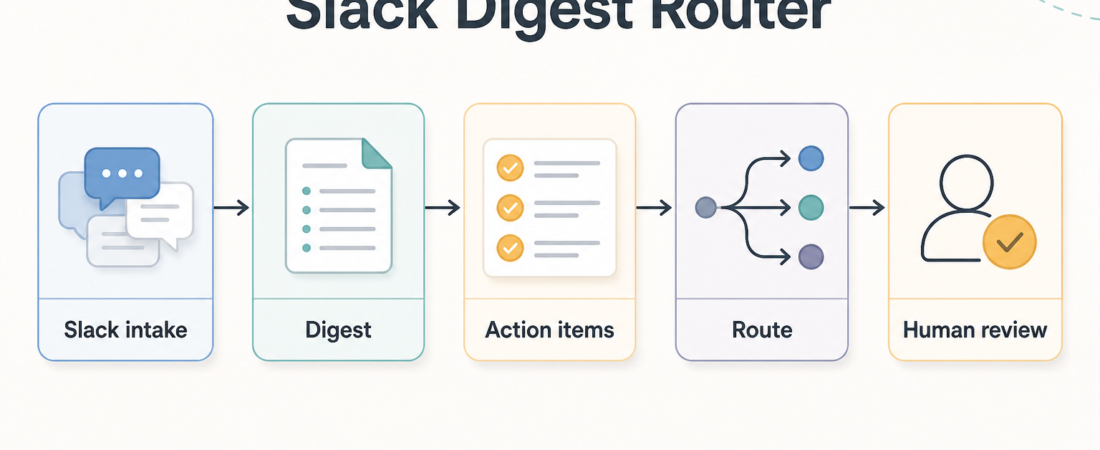
Slack is often where work first appears, but it is a poor place to let every request become an immediate interruption. A useful agent workflow treats Slack as intake: collect the right messages, summarize what changed, extract action items, and route only the work that needs a next step.
Read bounded channels and threads.
Group updates by project or owner.
Separate questions, blockers, and decisions.
Send work to Gmail, Notion, or Linear.
Keep writes and sends human-approved.
In Short
The Slack Digest and Task Router skill is useful when a team already coordinates in Slack and wants an agent to prepare a daily or periodic routing packet without giving it open-ended authority. The right outcome is not an autonomous Slack bot that reacts to everything. It is a constrained assistant that reads specified channels, finds unresolved work, and prepares handoffs for a person to approve.
The source-backed shape matters. Slack’s platform exposes conversation and app surfaces through its official developer APIs, including channel and message workflows documented at Slack API. The workflow should use that access narrowly: selected channels, clear time windows, explicit message types, and no broad promise that every thread will be understood correctly.
Who this is for
This is for founders, operations leads, support managers, and engineering managers whose work begins in Slack but finishes somewhere else. A customer issue may need an email follow-up. A product request may need a Notion task. A sprint blocker may need a Linear issue. A long thread may simply need a clean summary before standup.
It is less appropriate for teams that still need real-time moderation, incident paging, or compliance archiving. Those jobs have sharper reliability and retention requirements. Start with digest and routing work where a missed item is inconvenient, not catastrophic, and where the agent can show its evidence before any write happens.
Starter workflow
Begin with one or two channels and a short lookback window, such as the last 24 hours. Ask the Slack digest skill to return five fields: source channel, thread link, summary, proposed owner, and proposed destination. That structure makes the output easy to review and easy to reject.
For email handoffs, pair it with Gmail Thread Summarizer and Action Extractor. Google’s official Gmail API documents thread retrieval through users.threads resources at Google for Developers, which is enough for a supervised agent to collect prior context before drafting a follow-up packet. Keep the send step separate from the summarize step.
For task-board work, route structured items into Notion Task Board Automation. Notion’s developer platform documents page, database, and integration behavior at Notion Developers. The practical boundary is simple: let the agent propose title, owner, status, and source link, then let a person approve creation or edits.
For engineering triage, use Linear Issue Triage & Sprint Planner. Linear documents its API and workflow concepts at Linear Developers. Slack should not become the source of truth for backlog priority; it should supply evidence that a human or team rule can turn into a Linear action.
Recommended ASE skills
- Slack Digest and Task Router: read selected Slack context and produce a bounded routing packet.
- Gmail Thread Summarizer and Action Extractor: bring email history into the review step before follow-up drafts are prepared.
- Notion Task Board Automation: convert approved routing items into structured workspace tasks.
- Linear Issue Triage & Sprint Planner: turn engineering-oriented Slack blockers into backlog candidates with priority context.
- Slack MCP Server: consider this when the team needs lower-level Slack inspection from MCP-capable agents rather than a fixed digest recipe.
If you are browsing related options, the ASE blog has adjacent operator guides on routing, review control, and evidence packets for agent workflows.
What to watch
The first risk is over-routing. A digest that creates too many tasks is just notification overload in a new format. Cap the number of proposed actions per run and require each item to cite the source thread or message.
The second risk is hidden authority. Reading Slack is already sensitive because channel history can include customer data, employee context, roadmap notes, and credentials pasted by mistake. Restrict scopes, avoid private channels unless there is a clear owner, and log what the agent read.
The third risk is mixing summary quality with write permission. A decent summary does not prove the agent should create issues, edit Notion pages, or draft customer mail without review. Treat downstream writes as a separate approval step until the workflow has enough evidence from repeated runs.
FAQ
Should this replace standup?
No. It can prepare a standup packet by collecting blockers, decisions, and owner questions, but it should not become the only place the team checks alignment.
How many channels should a first run include?
Start with one operational channel and one project channel. If the summaries are accurate and the routing decisions are useful, expand slowly.
Can the agent create Notion pages or Linear issues automatically?
It can be wired that way, but the safer first version produces proposed writes with source links. Let a person approve them before the workflow gains direct write permission.
What makes this a good ASE spotlight topic?
It shows a repeatable operator pattern: collect messy team communication, extract reviewable work, then route only the bounded next step to the system that owns it.