Skill Spotlight: Arcmira for Finding Timestamped Quotes Across Indexed Media
In Short
Arcmira helps an agent find timestamped quotes across indexed YouTube videos and podcasts. Its useful output is an evidence packet: exact passage, surrounding exchange, attribution when available, publication date, and a link into the recording. Start with a narrow question and an explicit date window, then check the source before using the quotation.
This spotlight covers the Listed ASE skill added November 5. The goal is cross-source quote discovery for research, rather than producing a transcript of one asset. A quotation establishes what a source said; independently checking the claim still requires separate evidence.
Who this is for
This is for researchers, editors, analysts, and interview producers doing podcast research across several shows. Use it when your question resembles: “Where did speakers discuss this financing assumption, and what qualifications did they add?” Avoid starting with a request for a sweeping sentiment verdict when you actually need a few attributable passages.
A useful first deliverable is three candidate passages with context and unresolved questions. That gives a reviewer something concrete to accept, reject, or investigate. This article describes a starter procedure, not results from a live Arcmira account.
Starter workflow
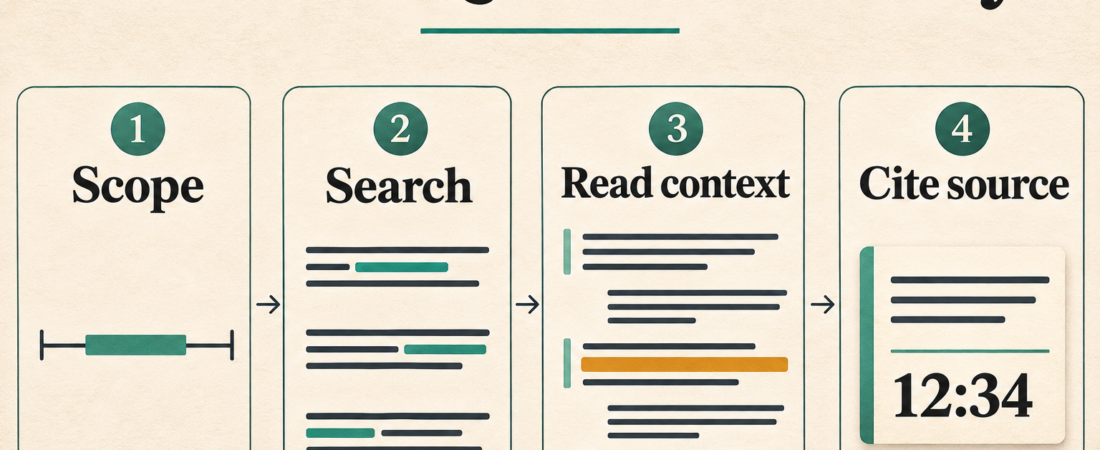
- Scope the question. Write the topic, relevant shows or people, and a publication window. For example, search discussions of GPU financing published October 1–31, 2026. State what would count as relevant: a financing mechanism, a named risk, or a disagreement. Keep background commentary outside the initial shortlist.
- Connect and inspect. Follow the official MCP setup guide, connect the hosted endpoint, and sign in. Load
arcmira_describebefore constructing a program; use its current arguments and response fields. Begin with a smallarcmira.searchrequest througharcmira_execute_read. Resolve names before applying ID filters. - Read the exchange. For each promising passage, inspect the question before it and the answer after it. Check whether the speaker is making a prediction, quoting someone else, or rejecting the proposition. Keep the exact passage intact; put your interpretation in a separate field. If attribution is unavailable, say so instead of assigning a name from context alone.
- Check coverage. The pinned upstream procedure distinguishes returned publication dates from index freshness. For channel coverage, inspect
arcmira.statusandchannel.search_indexed_through. An empty search establishes no matches for that query and window; it does not establish that nobody discussed the topic. - Package the evidence. Record the passage, show or episode, speaker when identified, publication date, timestamped source URL, and context note. Open the recording at the cited position before editorial approval. Keep a separate verification column for claims that need disclosures, documentation, or another primary source.
| Stage | Retain | Review question |
|---|---|---|
| Scope | Question and dates | What counts as relevant? |
| Search | Passage and source | Is this the intended topic? |
| Context | Surrounding exchange | Does the excerpt preserve meaning? |
| Cite | Attribution and timestamp | Can a reviewer replay it? |
When two sources disagree, keep both passages in the packet. Compare their dates, definitions, and assumptions before writing a synthesis. For example, a speaker discussing signed financing commitments may be answering a different question from someone discussing expected capacity. Keep that distinction visible so a later summary does not turn two qualified statements into an invented consensus.
Recommended ASE skills
Start with Arcmira transcript search for indexed discovery and its budget guardrails. Copying skill instructions does not connect the hosted service; complete upstream setup separately.
These four companions are separate paths with their own setup, not an automatic Arcmira integration:
- YouTube Transcript API fits caption retrieval when you already know the video.
- WhisperX fits local transcription and timing work on an available recording.
- yt-dlp belongs in a separate, authorized source-acquisition step when a media file is needed.
- Summarize is a later briefing option after you preserve the quotations and source links.
What to watch
Consult current plans and usage before a larger job. Reads share an account balance; plan restrictions can limit freshness and pagination. Do not interpret an account gate as an absence of relevant material. Record the limitation alongside your findings.
Before a Premium read that could start transcription, call the free arcmira.quote(videoIdOrUrl). Compare the quoted whole-video usage and any on-demand amount with the account budget and the user’s tighter authorization. If it exceeds either boundary or falls outside permission, stop and ask. A configured spending cap does not authorize every purchase beneath it.
Recurring monitoring requires agreement on what to track, delivery destination, and frequency before a write. Alerts consume credits. A one-off research request does not imply consent to recurring delivery; this walkthrough creates no monitors.
FAQ
Does Arcmira cover every podcast?
No completeness assumption is justified. Report the searched scope and available coverage evidence. If a known episode is missing, record the gap rather than substituting an unrelated source.
Can I publish a transcript excerpt immediately?
First replay the cited moment and inspect context. Preserve source attribution and distinguish editorial interpretation from exact words. Transcription can mishear names or numbers.
What should the first handoff contain?
A scoped question, explicit dates, a small shortlist of passages, replay links, and open verification questions. Ask the reviewer which passage warrants deeper research before expanding the search.