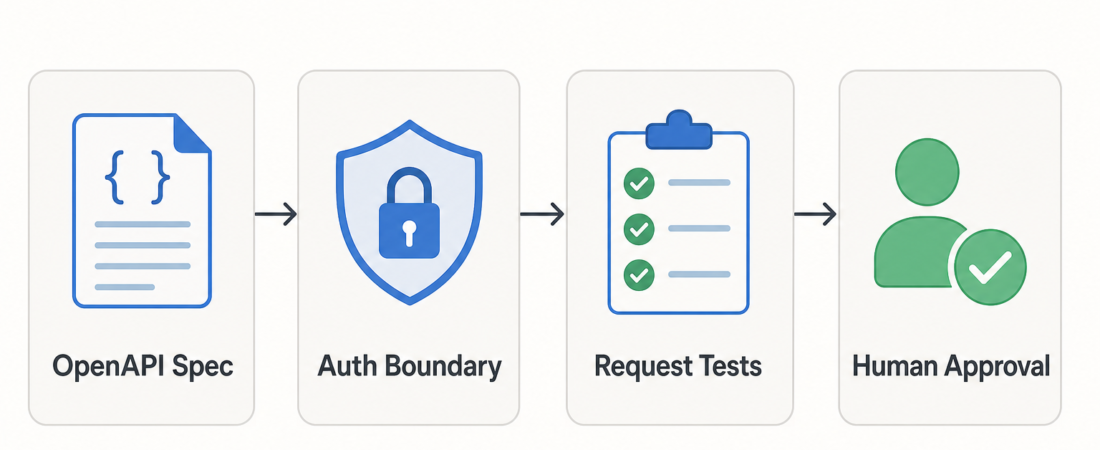
REST API Review Skills Before You Let Agents Call Production
- OpenAPI Speccontract shape
- Auth Boundarywho can call what
- Request Testsrepeatable checks
- Human Approvalproduction release
Letting an agent call a REST API is not the same as letting it read docs or draft sample code. A production API can change records, leak data, trigger workflows, and turn a vague prompt into a real operational event. The right review packet is boring on purpose: it makes the API contract explicit, narrows the authentication boundary, proves common requests in a repeatable way, and leaves a human approval point before production access.
In Short
Before agents call production REST endpoints, review the API as a contract, not as a convenience layer. Start with the OpenAPI description, resolve remote references, validate the final bundled spec, run representative request files, and record the permission boundary that the agent is allowed to use.
This is not about slowing every agent workflow down. It is about preventing the messy failure mode where a team gives an agent a token, a base URL, and a prompt, then discovers too late that nobody checked pagination, destructive methods, tenant scoping, rate limits, or error handling.
Who this is for
This workflow fits platform teams, API owners, security reviewers, and operations leads who are preparing agent access to internal or customer-facing APIs. It is especially useful when an agent will call endpoints that create, update, delete, approve, export, or reconcile data.
It also helps teams that already have OpenAPI files but do not fully trust them yet. A stale spec can be worse than no spec because it gives reviewers false confidence. The goal is to make the spec, test requests, and permission notes agree before the agent receives production credentials.
Starter workflow
1. Write down the agent job. Define the smallest useful task in plain language: for example, “draft a renewal packet from read-only customer and invoice endpoints” or “open a support ticket after a failed provisioning check.” If the task needs only read access, that should be visible before anyone discusses write scopes.
2. Review the API contract. Use the REST API design review skill to check versioning, request and response schemas, authentication expectations, idempotency, error states, and contract clarity. The OpenAPI Specification defines the common structure for describing HTTP APIs, but the review still needs human judgment around business impact and unsafe operations.
3. Resolve and bundle the spec. If the API description is split across files or remote references, use Prance for resolving and validating OpenAPI specs, then use swagger-cli to bundle and validate the publishable spec. Review the bundled output, not only the source fragments, because that is what client generators, gateway layers, and agent tools are most likely to consume.
4. Build request examples. Create a small set of .http or .rest files for happy paths, expected failures, pagination, retries, and permission-denied cases. Run them with httpYac request files with variables, hooks, and assertions so the checks can run locally or in CI. Keep production secrets out of the files; use environment variables or secret stores controlled by the team.
5. Put the approval boundary in writing. Record which methods, paths, tenants, and data classes the agent may use. Note which calls require human approval, which calls are read-only, and which calls are never allowed. RFC 9110 is a useful source for HTTP semantics, but your business rules decide what is safe in your environment.
Recommended ASE skills
Start with these skills in order:
- Review REST API designs before implementation for versioning, security, and contract clarity
- Resolve and validate OpenAPI specs with remote refs before client generation or review with Prance
- Bundle and validate OpenAPI files into one publishable spec with swagger-cli
- Run .http and .rest request files with variables, hooks, and assertions during local or CI checks with httpYac
What to watch
Spec drift. If the OpenAPI file says one thing and the server does another, the agent will inherit that confusion. Add a lightweight check that fails when documented schemas, required fields, or response codes no longer match the live service.
Over-broad tokens. A token that can do everything is not a production integration strategy. Prefer scoped credentials, environment-specific access, short-lived tokens where available, and explicit separation between read-only and write-capable workflows.
Ambiguous destructive calls. DELETE, bulk update, refund, send, approve, and export actions deserve extra review even when the HTTP method looks ordinary. Require idempotency keys or confirmation gates where duplicate execution would hurt.
Unreviewed generated clients. Client generation can save time, but it does not replace contract review. Check auth injection, retry behavior, timeout defaults, serialization, and logging before exposing a generated client to an agent.
FAQ
Do we need OpenAPI before any agent can call an API?
For production access, a maintained contract is the safer default. A tiny internal API can start with documented request files, but teams should still capture paths, methods, schemas, error states, and permission rules before granting real credentials.
Should agents get direct production tokens?
Usually no. Put the agent behind a narrower integration surface when possible: a gateway, a task-specific service account, or a reviewed tool that exposes only approved operations.
How many request tests are enough?
Enough to cover the agent’s actual job, not the entire API. Include the main happy path, the most likely malformed input, permission denial, rate-limit or retry behavior, and any destructive or irreversible call.
Where should official claims come from?
Use the OpenAPI Specification for contract structure, Swagger documentation for bundling and validation behavior, and RFC 9110 for HTTP semantics. Treat vendor docs as source material, but record your own approval decisions separately.