An OpenAPI Client Regeneration Packet for Agent-Written Integrations
Agent-written integrations move quickly, but generated clients still need a disciplined release packet. The risk is rarely the generator alone. It is the chain around it: unresolved OpenAPI references, unreviewed breaking changes, stale SDK examples, copied credentials in test fixtures, and documentation that no longer matches production behavior. Treat client regeneration as a small delivery workflow, not a one-command chore.
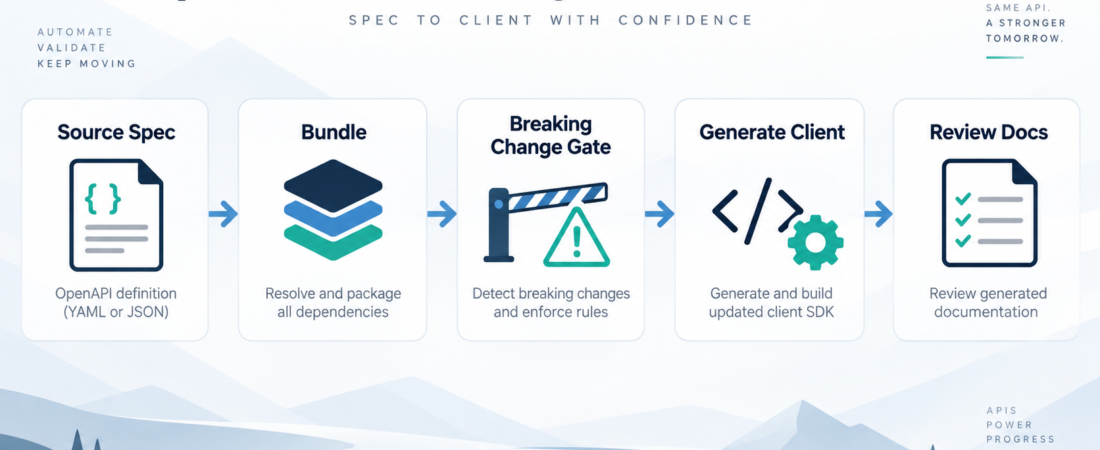
This packet gives operators a practical way to bundle specs, resolve remote references, detect contract drift, regenerate clients, and review API references before code reaches users. It uses the queue topic’s OpenAPI focus directly: integration, contract, regeneration, and review.
One resolved spec
Breaking change gate
Typed clients
Docs and examples
In Short
OpenAPI is the contract layer for many HTTP integrations, and the OpenAPI Specification defines how paths, operations, schemas, parameters, responses, and security requirements are described. That contract is valuable only when the generated client comes from the right spec and the review catches meaningful changes before the integration ships.
A good regeneration packet has five artifacts: the canonical source spec, a bundled and validated spec, a breaking-change report, the generated client diff, and a short review note that links code changes back to contract changes. Keep these together in the pull request. If an agent generated the client, require the agent to show the exact command, generator version, config file, and spec input it used.
Who this is for
This workflow is for teams that let agents update SDKs, API clients, typed request builders, API references, or integration examples. It fits platform teams, internal tooling teams, developer experience teams, and product engineering groups that depend on OpenAPI files from multiple services.
It is especially useful when a repository has more than one downstream consumer. A small schema change may look harmless in the service repo but break a generated TypeScript SDK, a Python client, a mobile integration, or public API documentation. The packet makes that blast radius visible enough for a reviewer to decide quickly.
Starter workflow
Start with the contract source. Record whether the OpenAPI file came from the service repo, a published endpoint, an artifact registry, or a documentation platform. If the spec uses remote references, bundle it into one reviewable file before generation. A bundled spec removes ambiguity about which referenced schema version the generator actually saw.
Next, validate the bundled output against the current OpenAPI Specification version your team supports. Validation should fail the run for malformed schemas, unresolved references, duplicate operation identifiers, missing response shapes, or generator-incompatible constructs. Do this before client generation so the agent cannot hide contract problems inside a large regenerated diff.
Then run a breaking-change check against the previously accepted bundled spec. Treat removed paths, removed response fields, narrowed enum values, changed required fields, renamed parameters, and incompatible authentication changes as review blockers unless there is an approved migration note. Additive fields and new endpoints still need review, but they are usually lower-risk.
After that, regenerate clients from a checked-in config. The config should pin package names, output paths, naming behavior, templates, and any serialization options. OpenAPI Generator, Orval, and similar tools can produce very different diffs when defaults change, so reviewers need the config file and generator version in the packet.
Finally, review the public or internal reference. Scalar and other API reference tools are useful because they expose whether the generated docs still explain authentication, examples, and response shapes clearly. The goal is not pretty documentation; it is making sure a user can call the API represented by the regenerated client.
Recommended ASE skills
Use these ASE skills first because they match the queue brief and cover the workflow from contract preparation to pull request gate:
- Bundle and validate OpenAPI files into one publishable spec with swagger-cli for producing a single reviewable spec artifact.
- Resolve and validate OpenAPI specs with remote refs before client generation or review with Prance when references cross files or URLs.
- OpenAPI Generator API Client and Server Stub Tooling for repeatable client and stub generation.
- Orval OpenAPI Client Regeneration Skill for Typed SDKs when TypeScript clients and typed request layers are the main output.
- Scalar OpenAPI Reference and API Client Platform for reviewing the API reference that consumers will read.
- Gate pull requests on OpenAPI breaking changes to keep incompatible contract changes from sliding through review.
What to watch
Watch for generator churn. A regenerated client can change hundreds of files because of formatting, ordering, template, or dependency changes. If the packet cannot separate mechanical churn from contract-driven changes, reviewers will miss the important parts. Pin the generator version and run formatting as a separate step when possible.
Watch for hidden authentication drift. The OpenAPI security section can change while examples and generated helpers still assume the old header, token scope, or OAuth flow. Check the generated client against the vendor or internal docs before merging.
Watch for mismatched release timing. If the service contract is ahead of production, an agent may regenerate a client that calls endpoints users cannot reach yet. Store the source URL, commit hash, or artifact version in the packet so the reviewer knows what environment the client represents.
FAQ
Should agents regenerate clients automatically on every spec change?
They can prepare the pull request automatically, but merging should still require a contract review. Regeneration is low judgment; accepting a breaking change is not.
Is bundling required if the source spec already validates?
Bundling is still worth doing when references are remote or spread across files. It gives reviewers one artifact and makes later diffs easier to reproduce.
What belongs in the pull request description?
Include the source spec, bundled spec path, validation command, breaking-change result, generator command, generated output paths, and any manual reference review notes.
Which official docs should reviewers use?
Use the OpenAPI Specification for contract semantics, OpenAPI Generator or Orval documentation for generation behavior, and Scalar documentation when API reference behavior is part of the release.