An MCP Security Review Playbook for GRC and Platform Teams
MCP servers make agent systems useful because they give models a controlled way to reach tools, data, and business workflows. That same control plane is also where security, GRC, and platform teams need sharper review habits. A server can look harmless in a demo and still expose sensitive data, unsafe commands, ambiguous tool descriptions, vulnerable dependencies, or permissions that are too broad for the job.
| Review stage | Evidence to collect | Gate before rollout |
|---|---|---|
| Source and scope | Repository, tool list, data paths, maintainer signals | Known owner and bounded purpose |
| Security scan | MCP findings, dependency findings, container findings | No unresolved high-risk path |
| Agent behavior | Prompt-injection tests, tool-call logs, deny rules | Human review point for risky actions |
In Short
Treat an MCP server like a small integration product, not like a plugin you install and forget. The review should answer five questions: who maintains it, what tools it exposes, what data it can reach, how it behaves under adversarial prompts, and what stops an agent from turning a narrow task into an unsafe action.
The official repositories for DefenseClaw, MCP Scanner, AgentDojo, Semgrep, and Trivy are useful anchors because they focus the review on concrete controls: governance over skills and tool calls, MCP-specific findings, agent defense testing, supply-chain rules, and vulnerability scanning. The result should be a short approval packet that a GRC reviewer, platform owner, and application team can all read without reconstructing the test run from chat logs.
Who this is for
This playbook is for teams that are starting to connect agents to internal systems through MCP and need a repeatable review before wider rollout. The immediate audience is usually platform engineering, security engineering, GRC, and the application owner who wants the agent workflow in production.
It is also useful when a business team brings a promising MCP server to a platform team and asks for approval. Instead of debating the idea in the abstract, reviewers can ask for a fixed evidence pack: source, install path, tool manifest, allowed data, scan output, attack simulation notes, and rollback plan.
Starter workflow
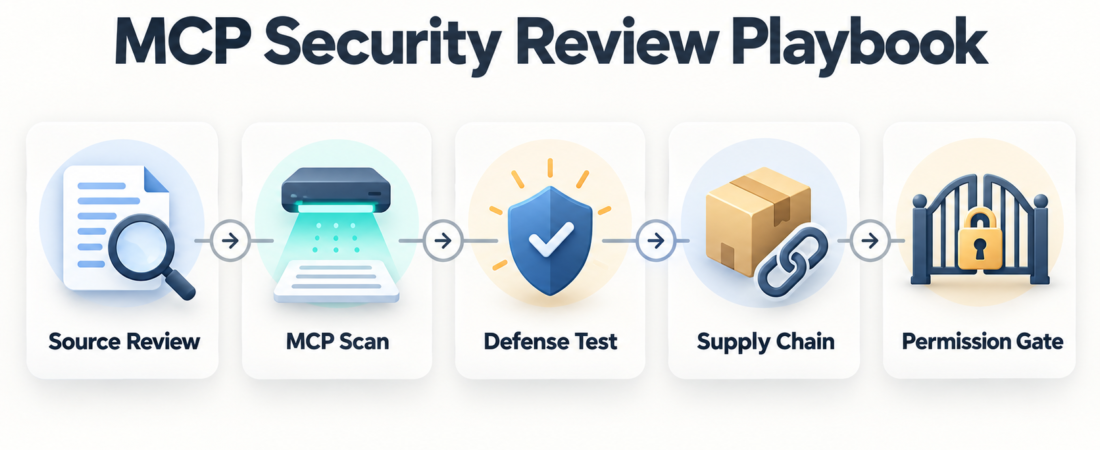
Start with source and scope. Confirm the exact repository, package, or deployment artifact being reviewed. Read the tool names and descriptions as if they are part of the access policy. Vague tool names, broad file access, shell execution, write access to production systems, or hidden network reach should push the server into a higher review tier.
Next, run an MCP-specific scan. The goal is not to declare the server good or bad from one tool result. The goal is to surface findings that change the rollout decision: unsafe tool descriptions, exposed secrets, risky transports, confusing authentication boundaries, or permissions that are broader than the use case requires.
Then test agent behavior. Use adversarial tasks and prompt-injection cases to see whether the agent calls tools when it should refuse, leaks context into tool arguments, or follows untrusted instructions from retrieved content. Keep the test prompts, tool-call traces, and expected refusal behavior in the review packet.
After that, scan the ordinary software supply chain. Semgrep rules can catch unsafe code patterns and dependency risks in source review. Trivy can check container images and filesystem artifacts for known vulnerabilities. These are not MCP-only controls, but they matter because MCP servers are still software services that get deployed, updated, and attacked.
Finally, set the permission gate. A production rollout should define who can enable the server, which agent or workspace may call it, which tools are disabled by default, which actions need human approval, how logs are retained, and how the team rolls back access if a finding appears after launch.
Recommended ASE skills
Use the required skills in this order when building the review packet.
- Govern agent skills, MCP servers, prompts, and tool calls with DefenseClaw for the control layer: policies, tool-call governance, and rollout boundaries.
- Scan MCP servers for security findings before connecting them to agents with MCP Scanner for the MCP-specific inspection step.
- Stress-test agent defenses with AgentDojo for attack-style tests that check whether the agent resists unsafe instructions.
- Semgrep Supply Chain Rule Pack Runner for source and dependency review using Semgrep’s rule-driven analysis model.
- Trivy Container Image Vulnerability Scanner for container, filesystem, and vulnerability checks before the MCP service is promoted.
Those five links cover the full path: govern the agent surface, scan the MCP server, stress-test agent behavior, inspect source patterns, and check deployable artifacts. If a team cannot produce evidence from each layer, the rollout is not ready for broad access.
What to watch
Watch for review drift. MCP server approval can become stale quickly when tools are added, descriptions change, dependencies update, or a workflow moves from read-only analysis to write actions. Tie approval to a version, commit, image digest, or deployment artifact rather than a general server name.
Also watch for false comfort from scan results. A clean vulnerability scan does not prove the agent will behave safely, and a good prompt-injection test does not prove the dependencies are clean. Keep these checks separate in the packet so one passing result does not blur the remaining risk.
The most important human decision is the permission gate. For low-risk internal search, logging and owner approval may be enough. For systems that can alter tickets, cloud resources, customer records, finance data, or production infrastructure, require narrower scopes, dry-run modes, approval steps, and a documented rollback path.
FAQ
Should every MCP server go through the same review? No. Use the same intake questions, but scale the depth by access. A local read-only documentation server should not get the same review as a server that can write to production systems.
Do official repositories make a server safe? No. Official sources help reviewers confirm what they are evaluating and avoid vague claims. They do not replace source review, deployment review, or behavior testing.
Where should GRC fit into this workflow? GRC should own the evidence standard and approval record, not every technical test. Platform and security teams can run the scans and simulations; GRC should make sure the decision is traceable.
What is the minimum evidence packet? Include the reviewed source or artifact, tool list, data access summary, scan outputs, behavior test notes, permission gate, owner, approval date, and rollback path.