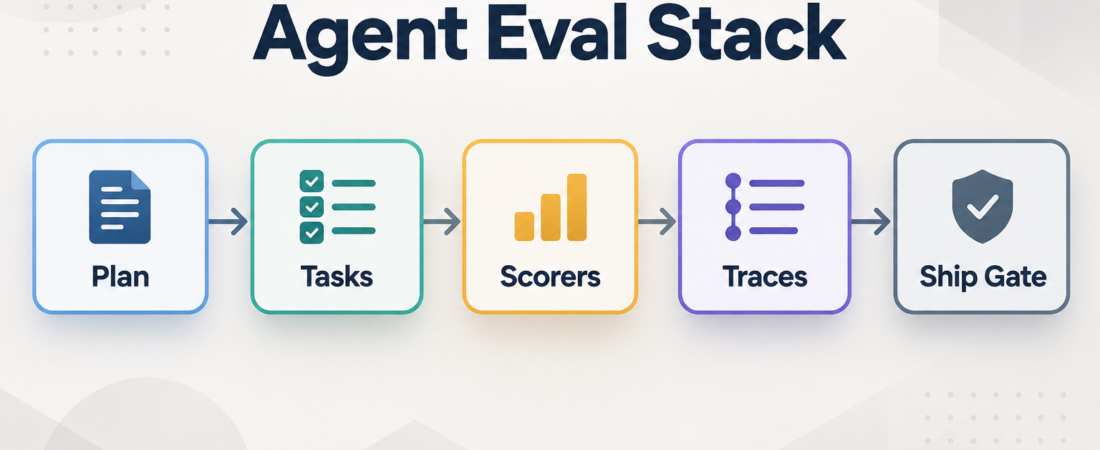
Kiln, Inspect AI, DeepEval, EvalScope, or Promptfoo: Choosing an Agent Eval Stack
Agent evaluations get messy when the team starts with a tool name instead of a release question. Kiln, Inspect AI, DeepEval, EvalScope, and Promptfoo all sit near the eval workflow, but they do not answer the same operating need. The better first move is to decide what must be repeatable before an agent change ships: task design, scorer behavior, trace review, regression checks, or a broader model benchmark.
| Need | Best first question | Review artifact |
|---|---|---|
| Design | What behavior should the agent prove? | Task set and expected outcomes |
| Score | Which failure mode matters most? | Metric, judge, or assertion |
| Ship | What blocks release? | Trace, regression, and approval packet |
In Short
Choose Kiln when you need an eval-building workspace around datasets, model behavior, and iteration. Choose Inspect AI when you need repeatable eval suites with scoring traces that can be reviewed like test evidence. Choose DeepEval when the product is an LLM app or agent and the team wants regression checks around metrics, traces, and evaluation cases. Choose EvalScope when the job is broader model or agent workflow evaluation. Choose Promptfoo when the immediate risk is prompt, RAG, or agent-output regression before a release.
The official repositories for these projects are the right starting point for claims about installation, supported workflows, and current capabilities. Treat marketplace pages as routing help, then verify operational details in the project source before wiring any evaluator into CI or production release rules.
Who this is for
This is for platform teams, AI product engineers, and technical leads who already have agent behavior worth testing but do not yet have a stable release gate. It is also for teams replacing ad hoc prompt review with a packet that another person can inspect: inputs, expected behavior, scorer logic, traces, failure examples, and the final decision.
If the team is still experimenting with the product idea, pick the tool that helps you design and compare examples quickly. If the product is already used by customers or internal operators, pick the tool that leaves the clearest audit trail when something fails. The evaluation stack should make bad releases harder, not simply produce a prettier report.
Decision path
Start with the release question. If the question is “did this agent still handle the known tasks after the prompt or model changed,” Promptfoo or DeepEval usually belongs near the front of the conversation. If the question is “can we inspect how each task was scored and reproduce the suite,” Inspect AI is a stronger first stop. If the question is “which model or workflow configuration should we adopt across a broader benchmark,” EvalScope may fit better.
Next, decide what a reviewer must see. For a production agent, a pass or fail label is rarely enough. Keep the task input, the agent output, the scoring method, the trace or transcript, and the human decision in one packet. That makes failures discussable: the reviewer can tell whether the agent failed the task, the scorer missed the point, or the test case no longer reflects the workflow.
Finally, place the gate at the right level. Local prompt checks catch cheap regressions. Pull request checks catch code and prompt changes before merge. Scheduled eval runs catch model, retrieval, or dependency drift. A mature stack often uses more than one tool, but each tool should have a job that the team can name.
Recommended ASE skills
Use Build and optimize agent eval workflows with Kiln when the work starts with constructing and iterating on evaluation examples. Use Run repeatable model and agent eval suites and inspect scoring traces with Inspect AI when repeatability and trace inspection are the main review needs.
For app-level regression checks, route through Regression test LLM apps and agents with metrics, traces, and eval suites using DeepEval. For broader model and workflow evaluation, use Evaluate agent and model workflows with EvalScope. For prompt, agent, and RAG output regression before shipping, use Regression-test prompts, agents, and RAG outputs before shipping changes.
What to watch
Watch for evaluator drift. A judge prompt, metric threshold, or test fixture can become stale just like application code. Store evaluator changes with the same review discipline as the agent changes they govern. Also watch for benchmark overreach. A broad benchmark can help compare configurations, but it may not prove that your support agent, coding agent, or research agent handles your actual workflow.
Be careful with release gates that no one can debug. If a failed run cannot show the input, output, score reason, and expected behavior, the team will route around it under pressure. The goal is a reviewable decision path: why the agent passed, why it failed, and who accepted the risk.
FAQ
Should one team standardize on one eval tool? Standardize the evidence packet first. One tool may cover most use cases, but prompt regression, trace-heavy suites, and broad model evaluation can have different review needs.
Where should official claims come from? Use each project’s official repository or documentation for installation, supported features, and current behavior. Do not rely on stale stars, download counts, or secondhand comparison posts for release decisions.
What is the smallest useful first gate? Pick ten to twenty representative tasks, define expected outcomes, run them before merge, and require a reviewer to inspect failures with the trace or scoring reason attached.