Judge0, SandboxFusion, OpenSandbox, or SandBase: Choosing a Code Sandbox
In Short
Choose a code sandbox by the execution contract your application needs. Judge0 fits code submissions through an HTTP API; SandboxFusion fits running and judging model-generated programs; OpenSandbox fits agent workspaces with commands, files, and lifecycle management. SandBase needs a separate check: its current CLI repository describes a model and API bridge through MCP, so verify an actual execution backend before treating it as a sandbox.
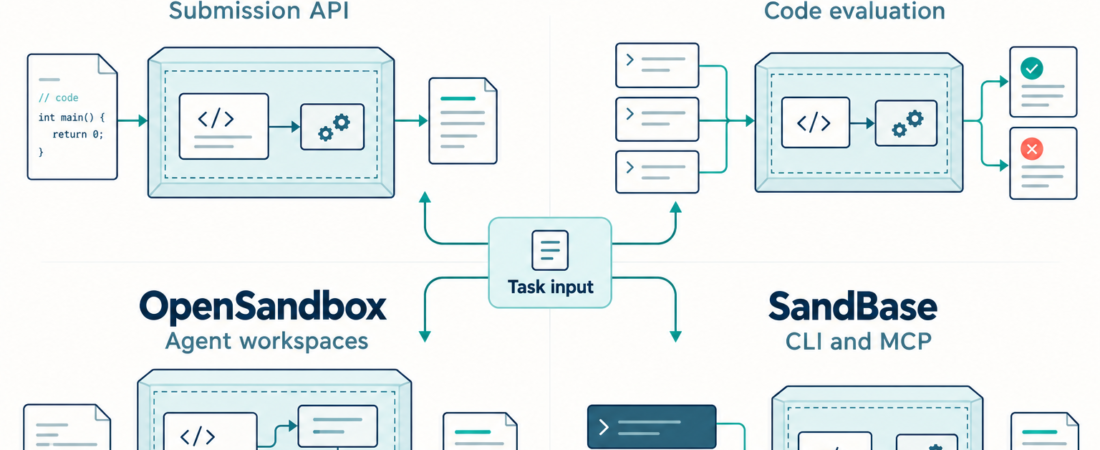
The decision path below is an editorial recommendation based on the linked official projects, not a benchmark ranking. Begin with one task, identify the interface and isolation requirements, and require a reproducible result before widening access.
Who this is for
This guide is for platform engineers, evaluation owners, and AI product teams integrating generated code into a service. A teaching application may need one submitted program and its output. An evaluation pipeline needs test cases and scoring. A coding agent may need a workspace across several commands. Those requirements lead to different integration choices.
Write down the required languages and versions, dependency policy, maximum runtime, network permissions, and expected artifacts before selecting a project. Language coverage on a project page does not establish that your deployment includes every compiler or package. Test the exact runtime image you intend to operate.
| Primary need | Inspect first | Prove in a pilot |
|---|---|---|
| Submit and run code | Judge0 | Language, limits, result fields |
| Judge generated programs | SandboxFusion | Tests, scoring, failure evidence |
| Maintain an agent workspace | OpenSandbox | Lifecycle, files, network boundary |
| Connect models and APIs | SandBase CLI/MCP | Backend capability and permissions |
Decision path
Start with Judge0 for a submission API. The official Judge0 repository documents HTTP JSON integration, multiple languages, multi-file programs, execution results, and configurable time and memory limits. This makes it a useful starting point when your application sends source code and receives a bounded result. Confirm supported language identifiers and resource settings against your installed version.
Start with SandboxFusion for code evaluation. Its official repository describes a code runner, several language runtimes, and online-judge support for evaluation datasets. Choose it when the core question is whether generated programs pass defined tests. Keep task identifiers, test versions, and execution failures separate from model-quality scores; an unavailable compiler should not silently become an incorrect-answer label.
Start with OpenSandbox for a workspace. The official OpenSandbox project documents command execution, file operations, Docker and Kubernetes deployment, and SDK, CLI, and MCP integration paths. This suits agents that need several operations within one environment. Review the chosen runtime and its network policy; MCP exposure is an access interface, not proof of a particular isolation mechanism.
Inspect SandBase’s backend before comparison. The official SandBase CLI repository currently emphasizes connecting clients to models and APIs through a local MCP bridge. That description does not establish a drop-in untrusted-code execution API. If your intended tool executes code, obtain its runtime, persistence, limits, and network documentation before putting it in the same acceptance test as the other candidates.
Run a small pilot with five fixtures: a correct program, a syntax error, a failing assertion, an infinite loop, and an attempted disallowed network request. Example pilot limits are 5 seconds and 256 MiB, adjusted to your workload. Record source, runtime identity, stdout, stderr, status, elapsed time, and cleanup evidence. Require every fixture to produce an explainable outcome before enabling larger batches.
Recommended ASE skills
- Run sandboxed multi-language code execution with Judge0: begin here for a code-submission integration; map the result into your application’s own record.
- Evaluate model-generated code with SandboxFusion: inspect this route when test execution belongs inside your evaluation pipeline.
- Give MCP agents disposable sandboxes with OpenSandbox: use this entry to inspect an agent-facing workspace workflow and its lifecycle requirements.
- SandBase MCP: compare the catalog entry with the current upstream CLI documentation and verify the specific backend operation you need.
- Evaluate agent and model workflows with EvalScope: consider the broader evaluation layer when execution results must feed repeatable model comparisons. Confirm the chosen benchmark’s sandbox configuration in upstream documentation.
What to watch
Review the isolation model of the deployed service: host permissions, container or VM boundary, mounted paths, process limits, credentials, and outbound access. Keep production secrets out of pilot environments. Give temporary workspaces a defined expiry, and test deletion after cancellation as well as successful completion.
Preserve failure evidence without copying sensitive inputs into unrestricted logs. Set retention and access rules for submitted code and outputs. Check concurrency separately from single-run correctness: a queue backlog, timeout, and assertion failure require different responses. Expand from the pilot only when an operator can reconstruct each outcome.
FAQ
Which option should a coding exercise app inspect first?
Judge0 is a sensible first inspection point for submission-shaped execution. Validate the actual language runtime, limits, and response handling against your exercises.
Does an MCP server provide isolation?
MCP provides a tool interface. The execution service and deployment configuration determine which resources code can reach and how environments are separated.
Can one sandbox serve both evaluations and agents?
Possibly, but test both contracts. Evaluation reproducibility and multi-step workspace persistence need separate acceptance criteria, quotas, and cleanup checks.
What should we do next?
Select the route matching your task, run the five-fixture pilot, and review the evidence with the operator who will maintain the service.