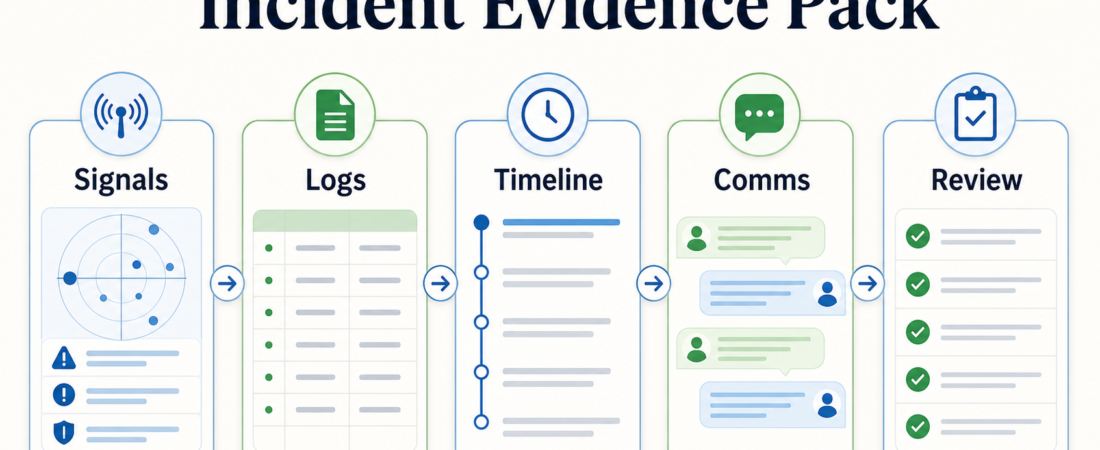
An Incident Evidence Pack for Small SRE Teams
Small SRE teams rarely lose time because they lack one more dashboard. They lose time because the useful evidence is scattered: alerts in one place, logs in another, deployment notes in a chat thread, and the first human summary in someone’s head. An incident evidence pack gives the team one reviewable packet before it asks an agent to explain, escalate, or draft remediation work.
| Packet part | What it captures | Review question |
|---|---|---|
| Signals | Alerts, synthetic failures, error spikes, saturation, recent deploys | What changed first? |
| Logs | Bounded excerpts with service, pod, trace, and time filters recorded | Can another engineer reproduce the query? |
| Review | Timeline, owner notes, customer impact, proposed next action | What still needs a human decision? |
In Short
An incident evidence pack is a short, source-backed bundle that an SRE team can hand to a human reviewer or agent before asking for analysis. It should include the alert that opened the issue, the time window, relevant logs, synthetic or monitoring evidence, escalation context, and the decisions already made. The goal is not a perfect postmortem. The goal is to make the next answer auditable.
That framing lines up with the public SRE guidance from Google, which treats incident response as a disciplined operational practice, not just a scramble around symptoms. It also fits vendor documentation from Datadog and PagerDuty: monitoring signals and escalation events are useful when they retain enough context for someone else to inspect later.
Who this is for
This workflow is for teams that have production responsibility but not a large platform group. You may have one on-call engineer, a shared rotation, and a few services that fail in familiar but stressful ways. You already use tools like logs, metrics, synthetics, cloud alarms, Kubernetes commands, and escalation pages, but the evidence often stays inside each tool.
It is also for teams testing agent-assisted operations. Before an agent proposes a cause or opens a follow-up issue, it needs bounded input. A packet gives it the right job: summarize the evidence, identify gaps, and draft next steps from known facts. It should not become the system of record, the final incident commander, or the only reviewer of customer impact.
Starter workflow
Start with the incident clock. Record the first alert time, the first customer-visible symptom if known, the first mitigation, and the point where impact ended or changed shape. Do not wait for certainty; mark unknowns clearly. A rough timeline with honest gaps is better than a polished timeline that hides uncertainty.
Next, collect signal evidence. Pull the alert, related synthetic failure, error-rate change, saturation metric, deployment event, or cloud alarm that shaped the response. Keep the source link or query, not just a screenshot. The SRE books emphasize learning from incidents; that learning depends on being able to revisit the evidence after the pressure drops.
Then gather logs with boundaries. Include the exact service, namespace, time range, severity filter, and request or trace identifiers. For Kubernetes incidents, keep commands narrow enough that another engineer can rerun them. For SaaS monitoring tools, preserve links to the filtered view when possible.
After that, add communication context. PagerDuty escalation notes, status updates, and handoff messages often explain why a team chose one mitigation over another. Include the decision, owner, and timestamp. Leave out personal speculation. The useful artifact is the operational fact pattern, not a transcript of stress.
Finally, ask for a review pass. A human should confirm impact, customer language, risky remediation ideas, and any action that touches production. An agent can help compress the packet, compare signals, and draft a follow-up issue, but the review owner decides what ships.
Recommended ASE skills
OpenSRE production incident investigation is the broadest starting point when the team wants help turning observability evidence into next remediation steps. Use it after the packet has a defined time window and source links.
Datadog Synthetics failure triage fits incidents where browser or API checks are the first visible signal. It can help sort false positives, dependency failures, and customer-facing regressions from the same synthetic alert stream.
AWS CloudWatch alarm triage belongs in the packet when alarms from AWS services shaped the response. Keep the alarm name, metric, threshold, region, and account context attached.
PagerDuty on-call escalation checker helps preserve escalation context: who was paged, when ownership changed, and whether the right responder path was used.
Stern Kubernetes log tailing is useful when the incident spans multiple pods. Use it with strict label selectors and recorded time bounds so the log excerpt does not become an unreviewable dump.
What to watch
Do not let the packet become a junk drawer. If every chart, chat message, and log line goes in, nobody will read it and an agent will summarize noise. Keep the first version small: trigger, timeline, top signals, representative logs, communication decisions, and open questions.
Also watch permissions. Incident evidence can include customer identifiers, internal architecture, credentials in logs, and security-sensitive traces. Redact before sharing outside the trusted response group. If an agent tool can call production systems, require explicit human review for destructive remediation and customer-facing updates.
The other risk is false precision. A clean packet can make a weak hypothesis feel finished. Label hypotheses as hypotheses, separate observed facts from inferred causes, and keep a section for evidence that contradicts the leading theory.
FAQ
Is this the same as a postmortem?
No. The evidence pack is built during or immediately after response so the team can reason from shared facts. A postmortem can use it later, but it usually adds causes, prevention work, and broader learning.
Should an agent write the incident summary?
It can draft one if the packet is bounded and source-backed. A human should still approve customer impact, root-cause language, remediation commitments, and anything that changes production.
How many tools should be in the first version?
Use the fewest that explain the event. For many small teams, that means one alerting source, one log source, one escalation record, and one timeline. Add more only when the incident needs it.
Official references: Google SRE, Datadog documentation, and PagerDuty developer documentation.