How to Build an Evidence Packet Before Trusting an Agent Workflow
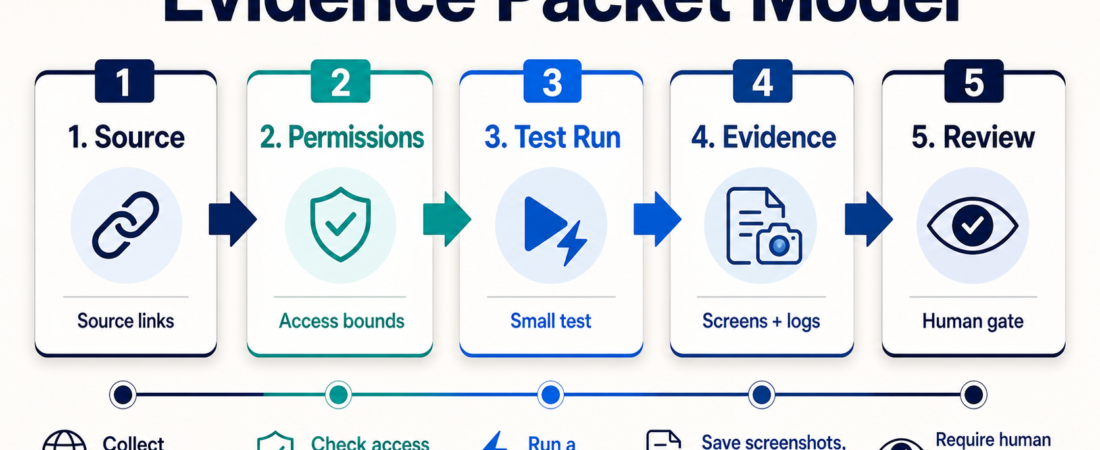
An agent workflow should earn trust before it gets more access. The practical way to do that is not another promise about autonomy. It is a small evidence packet: the source material, the permissions boundary, the test run, the artifacts, and the review decision in one place.
This matters because most workflow failures are not mysterious. The agent used stale context, touched data it should only read, skipped a failing path, produced an answer without sources, or left a human reviewer guessing. A packet makes those failure points visible before the workflow becomes routine.
| Packet item | Question it answers | Acceptable evidence |
|---|---|---|
| Source | What did the agent rely on? | Skill page, upstream docs, repo link, cited files, or retrieved documents |
| Permissions | What could the workflow read or change? | Read-only scope, sandbox notes, approval point, or blocked write path |
| Test run | Did it work on a small real case? | Steps run, inputs used, screenshots, logs, trace, query, or command output |
| Review | Who decides whether this is production-ready? | Reviewer note, accepted risk, open issues, rollback path, or next check |
In Short
Before trusting an agent workflow, ask it to produce a reviewable evidence packet. The packet should show what sources it used, what permissions it had, what small test it ran, what artifact it produced, and where a person approved or rejected the result. This is useful for browser QA, document intake, data analysis, support drafts, and release checks.
A good packet does not need to be long. It needs to make the workflow auditable. If the agent cannot show source evidence, access boundaries, and a repeatable test result, the team should treat the workflow as a draft, not an operating process.
Who this is for
This guide is for operators, technical leads, agencies, and small teams evaluating whether an agent skill is ready for repeated use. It is especially useful when the workflow touches customer data, production releases, financial records, regulated documents, or public-facing content.
It is not a replacement for formal risk review, security review, or compliance work. The evidence packet is the practical first artifact that helps those reviews become concrete. It turns “the agent seemed right” into “here is what it used, what it did, what it produced, and what still needs approval.”
Starter workflow
1. Pick one bounded workflow. Start with one repeatable task: browser release checks, support answer drafting, document intake, analytics lookup, or source-backed research. A broad goal like “automate operations” is too vague. A narrow goal like “run the checkout smoke test and attach screenshots” can be reviewed.
2. Capture the source layer. Every packet should name the source of truth. For skill selection, start from a live ASE skill page such as Checkly CLI Monitoring as Code, Playwright MCP Browser Automation, or Docling Document Parsing and Conversion Toolkit. For external standards, cite the relevant project docs or risk guidance, such as the NIST AI Risk Management Framework or the OWASP GenAI Security Project.
3. State the permission boundary. Write down whether the workflow is read-only, sandboxed, approval-gated, or allowed to make changes. A data workflow using PostgreSQL MCP Server should say whether queries are read-only. A release workflow using Trivy Security Scanner should say whether it can only report issues or also block a build.
4. Run one small case. Do not evaluate the workflow on a perfect demo. Use a real but low-risk case: one ticket, one document, one URL flow, one report, or one staging release. Keep the input and output together. For browser and release work, screenshots or logs matter. For research, citations matter. For data, the exact query matters.
5. Save the artifact and the decision. The output should be something a reviewer can inspect: a test summary, a trace, a document packet, a draft response, a diff, or an issue list. Then record the decision: approved for repeated use, approved only with limits, blocked, or needs another test. This is where tools such as LangSmith SDK for LLM Tracing and Evaluation, Logfire Python Observability SDK, Gatus Endpoint Monitoring, and Uptime Kuma can help keep evidence from disappearing after the first run.
Recommended ASE skills
| Use case | Start with | Evidence to keep |
|---|---|---|
| Browser or release smoke checks | Playwright MCP Browser Automation or Checkly CLI | Steps, screenshots, failed selectors, status codes, and blocking verdict |
| Security and supply-chain checks | Trivy Security Scanner | Scan target, severity list, ignored findings, and owner decision |
| Document intake | Docling or Paperless-ngx | Original file, extracted fields, uncertain sections, and review notes |
| Agent tracing and evaluation | LangSmith or Logfire | Trace ID, prompt/input, tool calls, output, and reviewer verdict |
What to watch
- No source trail. If the workflow cannot show where an answer came from, do not promote it beyond draft use.
- Unclear write access. A workflow that can change records, send messages, merge code, or publish content needs an explicit approval point.
- Only happy-path testing. One clean demo is not enough. Include at least one realistic edge case before production use.
- Evidence trapped in chat. Save logs, screenshots, traces, or output files somewhere the team can find later.
- No rejection path. A useful review process must allow “blocked” or “needs more evidence,” not just “approved.”
FAQ
Is an evidence packet the same as documentation?
No. Documentation explains how the workflow is supposed to work. The packet proves what happened in a specific test or review run.
How much evidence is enough?
Enough to let a reviewer replay the decision. For a low-risk draft workflow, that may be source links and an output sample. For release, data, or customer-facing work, keep logs, screenshots, traces, and an approval note.
Should every agent workflow need human approval?
Not forever, but every new workflow should start with human review. Remove or reduce review only after the evidence shows the workflow is repeatable, bounded, and recoverable.
What is the fastest first packet to build?
Pick a read-only workflow. A browser smoke check, document extraction sample, or source-grounded research brief can usually produce useful evidence without granting write access.