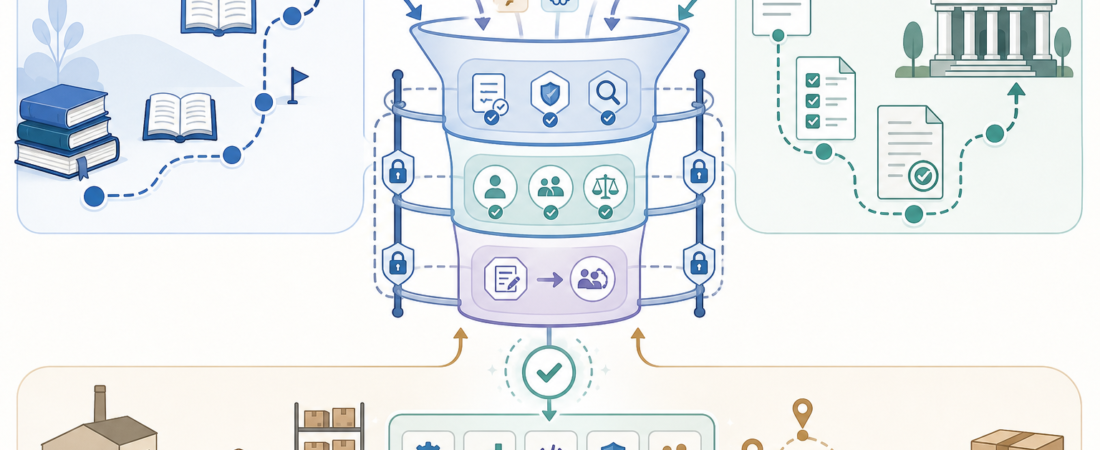
Education, Public Sector, and Supply Chain: Which Industry Skill Collections Should ASE Build Next?
Agent Skill Exchange already has strong coverage for media operations, finance, ecommerce, legal ops, healthcare documentation, product analytics, DevRel, support, and real estate workflows. The next question is not “what vertical sounds exciting?” It is which industry collection has enough repeatable operator work, source-backed skills, and clear safety boundaries to deserve a dedicated section.
| Candidate collection | Strong workflow evidence | Boundary to state clearly |
|---|---|---|
| Education | Course generation, research support, accessibility media, evaluation | Learning support, not credentialing or student judgment |
| Public sector | Forms, records, procurement packets, audits, citizen service routing | Administrative assistance, not policy decisions |
| Supply chain | Inventory sync, vendor invoices, warehouse data, package risk, operations evidence | Reviewable planning, not autonomous purchasing or routing |
The three obvious candidates are education, public sector, and supply chain. Each has real demand for agentic workflows. Each also has a different failure mode. Education can drift into vague tutoring claims. Public sector can become a junk drawer for every document workflow with a government label. Supply chain can overpromise operational autonomy in places where approvals, contracts, and physical constraints matter. The right answer is not simply “build all three.” The right answer is to rank them by collection quality.
What Makes a Vertical Worth Building?
ASE’s industry-fit rule is deliberately practical: a vertical collection should have domain objects, workflow depth, risk boundaries, domain-native integrations, or enough inventory to produce useful starter stacks. A page should help an operator answer, “Which skills should I combine for this work, and where should a human review the result?” If the answer is just “summarize text in this industry,” the collection is not ready.
This matters because agent skill marketplaces can get noisy quickly. A generic OCR skill can support a school office, a city records team, or a warehouse receiving dock, but that does not make it an education, public sector, or supply chain skill by itself. The vertical fit comes from the surrounding workflow: what document is being processed, what evidence must be retained, which system receives the output, and what decision is explicitly left to a human.
The most useful new collection should therefore meet five tests: it has repeated work, source-backed tools, a natural review packet, clear “not for” language, and enough existing ASE skill pages to make discovery better on day one.
Education: Promising, but Easy to Overstate
Education has a strong case when framed around learning operations rather than automated teaching. There is already useful inventory around course material generation, research workflows, accessibility media, and evaluation. A good education collection would help instructors, instructional designers, bootcamp teams, and internal enablement teams turn existing material into reviewable learning assets.
The best anchor is Codebase to Course, which turns a codebase into an interactive onboarding course. That is a concrete education workflow because it has a domain object, source material, learner path, and a reviewable output. It is not a generic “teach me anything” promise. It is closer to documentation, onboarding, and curriculum packaging.
Education could also draw from Local Deep Research for source-gathering assignments, Hugging Face Transformers for model-backed experimentation, and Coqui TTS for accessible audio material. These are not “education skills” by name, but they become education-relevant when attached to a responsible workflow: gather sources, prepare draft material, generate alternate formats, and review before use.
The boundary has to be firm. An education collection should not imply grading autonomy, credential decisions, student surveillance, or professional diagnosis of learning needs. It should focus on content preparation, accessibility support, onboarding, research assistance, and practice material that a human educator can review. That is still valuable. It is just not a fantasy of replacing teachers with a chat loop.
Public Sector: High Value, Highest Governance Burden
Public sector workflows are a tempting next collection because the operational surface is huge: records requests, public forms, procurement documents, accessibility checks, budget packets, grant reporting, inspection notes, and citizen service routing. The work is often document-heavy and evidence-heavy, which is exactly where agent skills can help.
The challenge is that “government” is not one workflow. A city clerk, procurement analyst, transit planner, public health office, and agency IT team all have different risk profiles. ASE should only build a public sector collection if it can avoid turning the page into a pile of generic document and compliance tools.
A cautious first version could center on administrative evidence workflows. For example, vendor PDF invoice extraction supports procurement packet preparation. DocuSign contract routing fits signature workflow support when approval remains outside the agent. CloudQuery inventory sync can help IT and audit teams assemble reviewable asset records. OpenAPI spec compliance checking belongs in public digital services where API contracts need review before release.
Public sector also needs evaluation discipline. A skill like Inspect AI evaluation suites is a good fit because agencies should be able to inspect scoring traces and repeat tests before adopting an agent-assisted workflow. That is a healthier story than “AI for government services.” It says: define the task, measure the result, keep an audit trail, and do not automate decisions that require authority.
If ASE builds this collection, the copy should be unusually explicit: administrative assistance, records preparation, routing, evidence assembly, and technical QA are in scope. Eligibility decisions, enforcement decisions, benefits determinations, legal conclusions, and policy recommendations are not skill-page promises. A public sector collection can be useful only if it is boring in the right places.
Supply Chain: The Most Workflow-Ready Candidate
Supply chain may be the strongest near-term candidate because the workflows are concrete and the existing ASE inventory is easier to connect. Operators care about inventory, vendors, orders, invoices, warehouse data, package risk, and exception handling. Those are domain objects, not vibes.
There are already several relevant skill pages. Shopify Admin workflows through MCP and WooCommerce REST Inventory Sync cover commerce-side inventory and order operations. vendor invoice extraction connects receiving, accounting, and procurement evidence. SQLMesh warehouse change previews and SchemaCrawler database inventory help data teams keep operational reporting trustworthy.
Supply chain also has a second meaning that matters to software and AI teams: package and dependency supply chain risk. ASE already has NPM Package Supply Chain Auditor, Semgrep Supply Chain Rule Pack Runner, and Heisenberg Supply Chain Health Checker. A strong collection could separate physical operations workflows from software supply chain workflows while still showing the shared pattern: inspect inputs, detect exceptions, produce evidence, and require review before action.
The boundary is important here too. A supply chain collection should not suggest autonomous purchasing, supplier approval, safety-critical routing, customs decisions, or production scheduling without human review. The useful agent is an operations analyst: it gathers evidence, flags inconsistencies, previews downstream impact, and prepares a decision packet.
Recommended Build Order
If ASE is choosing one collection to build next, supply chain should go first. It has the clearest domain objects, the most concrete existing skill inventory, and a natural split between commerce operations, warehouse data, vendor documents, and software supply chain risk. It can become useful quickly without pretending to solve the entire field.
Education should come second, but only with a narrow “learning operations” frame. The strongest version would cover onboarding courses, source-backed research packets, accessibility media, lab support, and evaluation workflows. That collection should be written for teams that create learning material, not for replacing instruction.
Public sector should be third unless ASE commits to a sharper taxonomy from the start. It has major value, but it needs the most careful governance language and probably benefits from sub-collections later: procurement and grants, digital services QA, records and forms, civic IT audits, and public communications review.
The shared lesson is simple: vertical collections should not be built because an industry is large. They should be built when the marketplace can make operators better at a repeatable job while keeping evidence, boundaries, and human responsibility visible. That is where ASE can be more useful than another generic AI tools directory.