DuckDB, Metabase, or Pandas: Picking a First Data Skill
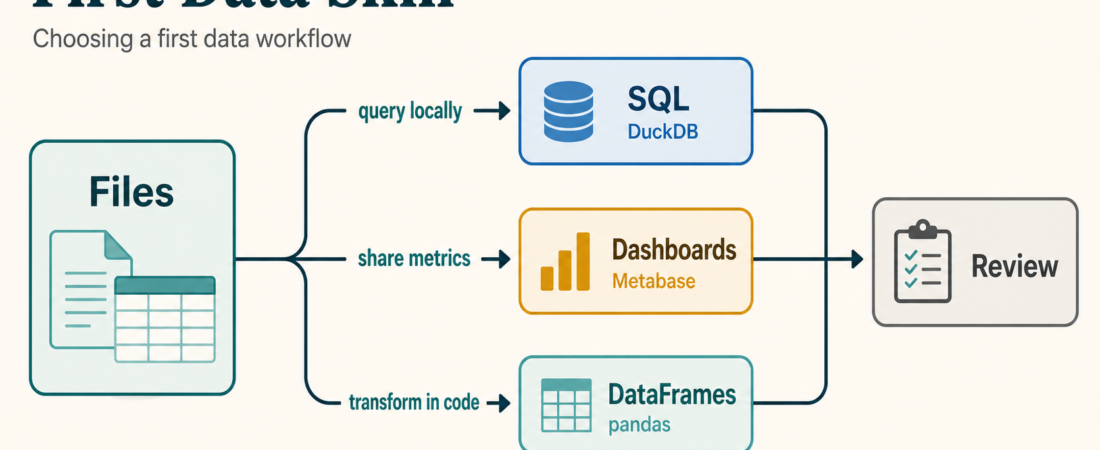
A first data skill should match the work you need to repeat. DuckDB, Metabase, and pandas all sit near the same operator problem: someone has data, needs an answer, and wants an agent workflow that does not turn into a brittle one-off script. They are not interchangeable, though. DuckDB is strongest for local files and SQL questions. Metabase is strongest for shared reporting and dashboard review. pandas is strongest for dataframe transformation in code.
| Starting point | Best first skill | Evidence to keep |
|---|---|---|
| CSV, Parquet, logs, exports | DuckDB for local SQL analysis | Query, input file list, result sample |
| Shared metrics and recurring questions | Metabase for governed dashboards | Dashboard link, filter values, reviewer notes |
| Messy transformation logic | pandas for dataframe pipelines | Notebook or script diff, row counts, tests |
In Short
Use DuckDB first when the operator needs fast SQL over files or embedded analytical queries. The DuckDB documentation emphasizes client APIs, SQL, and data import/export, including CSV and other file-oriented workflows. That makes it a good starting point when the work is, “inspect these exports and explain what changed.”
Use Metabase first when the answer needs to become a shared question, chart, or dashboard. The Metabase documentation describes an open source business intelligence and embedded analytics tool that connects to a data stack and helps people query, visualize, and dashboard data. That matters when the real need is repeatable visibility for a team, not just one analyst’s local answer.
Use pandas first when the operator needs code-level dataframe transformation. The pandas documentation describes pandas as an open source Python library for high-performance, easy-to-use data structures and data analysis tools. It is the better first choice when the work includes derived columns, joins, reshaping, time series handling, or repeatable cleaning logic.
Who this is for
This guide is for operators, analytics leads, platform teams, and founders who want to add a first data skill to an agent workflow without pretending every data problem is the same problem. It fits small teams with exports, product data, support data, finance reports, operational databases, and recurring questions that need reviewable answers.
It is also for teams deciding where human review should live: the query and inputs for DuckDB, the dashboard and filters for Metabase, or the transformation code and row-level assumptions for pandas.
Decision path
Start with the shape of the input. If the data arrives as CSV, Parquet, JSON, log extracts, or local files, choose a DuckDB-shaped workflow. The goal is to let the agent ask SQL questions against bounded inputs, keep the query visible, and return a result another person can reproduce.
If the data already lives in a database and the same metric keeps coming up in meetings, choose a Metabase-shaped workflow. The agent can frame questions, find dashboards, explain filters, or prepare review notes, but the durable artifact should be a shared BI surface.
If the input needs transformation before anyone can trust it, choose a pandas-shaped workflow. When columns need normalization, joins, date parsing, flags, or enrichment, the agent should produce code or a notebook instead of hiding the logic in prose.
Then decide where failure should stop. DuckDB should stop at missing files, invalid SQL, schema mismatch, or suspicious result size. Metabase should stop at missing permissions, unclear metric definitions, stale dashboard context, or unverifiable filters. pandas should stop at failing tests, unexpected nulls, changed row counts, or unexplained transformation logic.
Finally, decide what the handoff looks like. A local SQL workflow should hand off the query and result sample. A dashboard workflow should hand off the dashboard link, filters, and notes. A dataframe workflow should hand off the script, test output, and before/after counts. The best first data skill is the one your team will actually review.
Recommended ASE skills
Use the required queue skills first. Add database and semantic-context skills only when the workflow needs broader data access or governed context.
- DuckDB SQL Analytics Agent for local analytical questions over bounded files where SQL is the review surface.
- Metabase open source business intelligence and embedded analytics when the answer needs to become a dashboard, saved question, or shared reporting surface.
- pandas DataFrame pipeline orchestrator when the operator needs repeatable dataframe cleaning, joins, reshaping, or enrichment in Python.
- Query operational databases from MCP clients with DBHub when the agent needs a controlled route into operational databases instead of file-only analysis.
- Query Postgres databases through read-only MCP workflows with PGMCP when read-only Postgres access is the right safety boundary.
- Give agents governed semantic data context with Wren Engine when metric definitions and semantic context matter more than raw query access.
The stack can stay small: one primary skill, one read-only access skill, and one review checklist. Add more only when the handoff becomes clearer.
What to watch
Watch for agents that answer with numbers but do not show the route. Require the SQL, dashboard context, or transformation code that produced the answer.
Watch for stale definitions. “Active user,” “revenue,” “open ticket,” and “conversion” can mean different things across teams. The agent has to name the definition it used.
Watch for accidental write access. A first data skill should usually be read-only unless the job is explicitly about writing a transformed artifact to a safe location.
Watch for pandas workflows that become invisible notebooks. If a dataframe pipeline matters, keep enough code and tests for a reviewer to rerun it.
FAQ
Which one should a small team try first?
If the team mostly has files and ad hoc questions, start with DuckDB. If the team mostly argues over recurring metrics, start with Metabase. If the team mostly cleans and reshapes data before analysis, start with pandas.
Can an agent use more than one of these?
Yes, but do not start there. A mature workflow may use pandas for cleanup, DuckDB for analytical queries, and Metabase for dashboards. The first implementation should still have one primary review surface.
What is the minimum evidence packet?
Keep the input source, tool used, exact query or transformation, output sample, row counts when relevant, and reviewer note. That is enough for another operator to challenge the result instead of trusting a summary.
Should agents query production databases directly?
Only through a bounded, read-only path with clear permissions and logging. For a first data skill, file exports or read-only replicas are usually easier to review than broad production credentials.