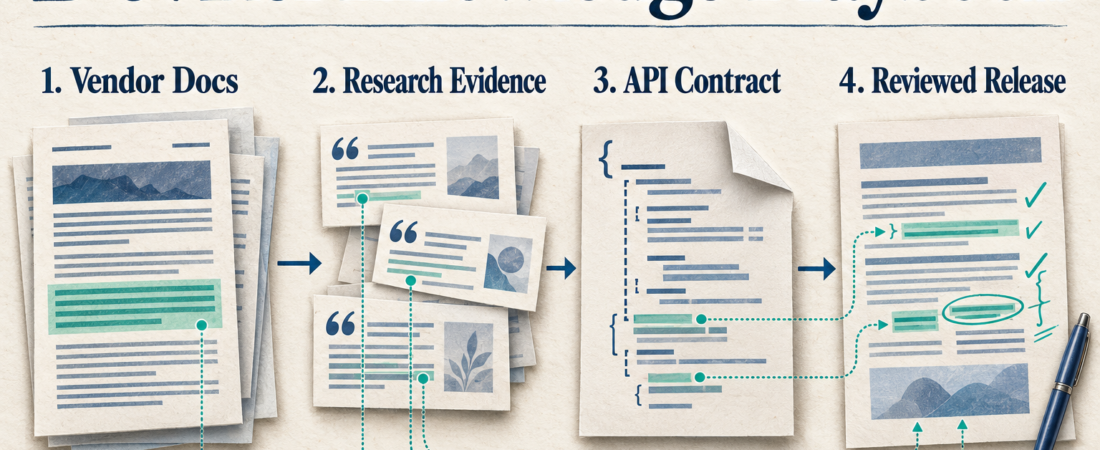
A DevRel Knowledge Automation Playbook for Docs and Research Teams
In Short
A useful DevRel knowledge automation workflow produces an evidence packet before it produces a public answer. Start with vendor docs, separate research findings from product guarantees, validate the API contract, and review every outward-facing claim against its source. NotebookLM artifacts and MCP retrieval can help organize that work; the release decision still needs an accountable owner.
This playbook proposes a small pilot: one developer question, one API example, and one reviewer. The deliverable is a checked documentation update with source links, a validated OpenAPI bundle, and an explicit list of unresolved questions. These are proposed operating practices, not results from a tested deployment.
Who this is for
This is for developer advocates, technical writers, and research teams preparing tutorials, SDK migration notes, or technical explainers. It fits situations where an answer draws on several kinds of evidence and each kind supports a different claim.
For example, a team explaining a retrieval feature may need Microsoft configuration guidance, a paper describing an evaluation method, and its own endpoint contract. A research result cannot establish a vendor feature guarantee. A valid schema cannot prove that an example succeeds against the deployed service. Keeping those distinctions visible makes review faster.
Starter workflow
- Define the question and acceptance check. Write the exact developer question, intended audience, product version, and destination page. Choose one runnable example and identify who can verify it in a permitted test environment. Create an evidence ledger with columns for claim, source URL, version or retrieval date, supporting passage, and reviewer decision.
- Retrieve authoritative documentation. The Microsoft Learn MCP repository documents semantic search, full-page fetching, and official code-sample search. Search for the narrow configuration issue, then fetch the actual page before drafting. Record applicable versions and prerequisites alongside the passage; a search snippet alone may omit the qualification that changes the answer.
- Read the relevant research section. The arXiv MCP server supports paper discovery and bounded local paper reads. Save the paper identifier and version, inspect methods and limitations, and record which passages were actually read. If a response is truncated, continue retrieval before making a full-paper claim. Label conclusions as research evidence rather than supported product behavior.
- Prepare a cited synthesis. Collect the approved sources into a notebook or a plain research document. Ask for an answer with supporting passages and unresolved disagreements. The NotebookLM automation route needs a separate provenance check: the
rafaelmenesesm/notebooklm-mcprepository returned HTTP 404 on October 22, 2026. Use the maintainer documentation linked below to assess the cataloged implementation, or keep this step manual. Never infer an API call from another similarly named project. - Validate the contract and review the release. Bundle the split OpenAPI definition and validate the resulting artifact. Compare paths, required parameters, authentication descriptions, and response examples with the prose. Have the reviewer open each source, inspect the example’s actual test result, and approve the exact revision. Hold unsupported statements for follow-up instead of smoothing over conflicting evidence.
| Evidence stage | Review artifact | Release check |
|---|---|---|
| Vendor docs | Versioned source ledger | Claim matches passage |
| Research | Paper section and limitations | Scope remains explicit |
| API contract | Validated OpenAPI bundle | Example matches contract |
| Release review | Approved revision | Open questions resolved or disclosed |
Recommended ASE skills
- Microsoft Learn MCP Server: use for Microsoft documentation grounding. Keep fetched page links in the ledger so reviewers can inspect the full context.
- Search and analyze arXiv papers through MCP workflows: use for literature triage, then read the relevant sections before summarizing a finding.
- NotebookLM Studio generation and cited research batches: consider for repeatable synthesis. Its cataloged implementation points to maintainer REST documentation; treat this as third-party integration documentation, not a Google-supported API promise. Recheck source identity before installation.
- Bundle and validate OpenAPI files with swagger-cli: fits an existing Swagger 2.0 or OpenAPI 3.0 pipeline. The upstream repository is archived and deprecated, so assess migration before adopting it for new work.
- Connect agents to OpenRAG knowledge bases over MCP: consider when the reviewed corpus must support repeated queries. OpenRAG’s documentation describes its built-in HTTP MCP endpoint and API-key authentication; preserve source scope and confirm ingestion before relying on retrieval.
What to watch
Keep retrieved content as evidence rather than executable instructions. Exclude credentials and unpublished customer material from shared notebooks. For protected corpora, test retrieval with the intended reader’s access and confirm that unrelated documents stay outside the result set.
Log failed fetches, missing citations, incomplete ingestion, and schema errors. A generated report or presentation is another derivative artifact: review its statements and citations independently. If the source disappears or the implementation changes, pause that automation step and retain a manual ledger. Recheck evidence whenever the documented product version changes.
FAQ
Do we need all five skills?
No. Start with source retrieval and contract validation. Add notebook synthesis or a persistent knowledge base when repeated work justifies the setup and review cost.
Does an OpenAPI validation pass prove the tutorial works?
No. It checks the definition within the validator’s supported scope. Run the example separately against an authorized test environment and retain its result.
What should block publication?
An unsupported central claim, inaccessible evidence, or an unverified example presented as working. Publish only the supported scope, with limitations explicit and an owner for follow-up.