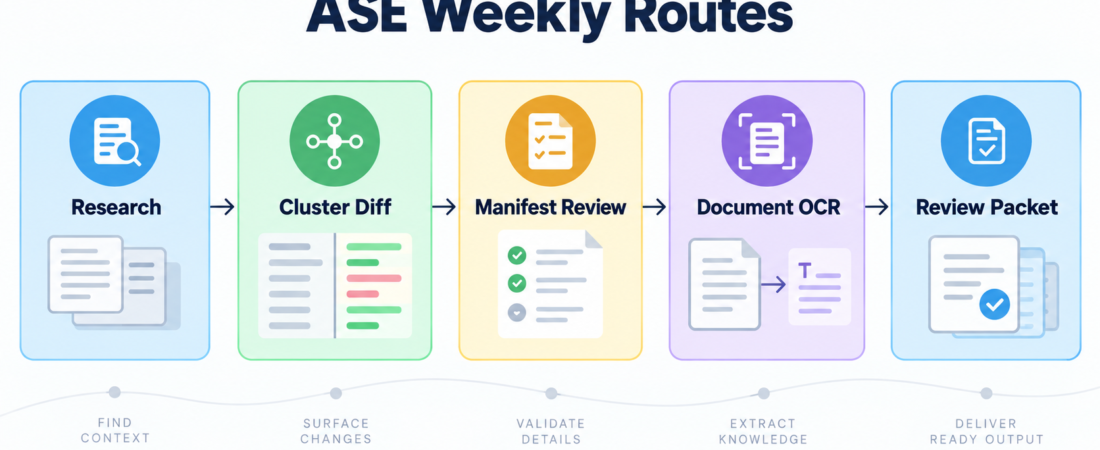
ASE Weekly Changelog: NotebookLM, Kubernetes, and Document Review Routes
Agent Skill Exchange has been adding more operator-facing routes for teams that need agents to work from evidence, not loose intent. This week’s useful pattern is not one tool category. It is a handoff path: research context, infrastructure review, document extraction, and a final review packet that a human can inspect before anything production-facing changes.
The queue topic for this post is deliberately narrow: NotebookLM-style research automation, Kubernetes deployment review, and document review routes. The common thread is bounded context. Each skill should make a messy input easier to inspect, cite, diff, or replay.
collect cited context
surface changes
validate details
extract knowledge
deliver evidence
In Short
Use this route when an agent needs better source material before it writes, changes, or recommends anything. Start with a research batch when the question depends on citations. Move to Kubernetes diffing when the task touches cluster configuration. Add document extraction when source files are PDFs, scans, tables, or mixed office material. End with a review packet that records what was read, what changed, what remains uncertain, and what a person still needs to approve.
This is also a good reminder of how ASE changelog posts should be read. They are not popularity rankings, install demands, or claims about broad market leadership. They are pointers to specific workflow routes that recently became easier to assemble from the catalog and safer to explain to an operator.
Who this is for
This post is for small platform, research, security, and operations teams that already use agents for drafts or checks, but do not want them improvising across production data. The reader likely has a concrete queue of work: summarize a source set, review a Kubernetes change, compare generated manifests, extract evidence from vendor PDFs, or prepare a handoff for another reviewer.
It is especially relevant when the source material is split across several formats. A research note might cite web and uploaded material. A cluster change might include environment-specific overlays. A document review might combine machine-readable text, tables, and scanned pages. In each case, the safer workflow is to make the intermediate evidence visible instead of asking the agent for a final answer immediately.
Starter workflow
Begin with the question the operator actually needs answered. For a research route, that might be: which sources support this release note, and which claims still need review? The ASE skill Automate NotebookLM Studio generation and cited research batches with notebooklm-mcp is the first fit when the job is cited Q&A, batch research, or generating reviewable source-grounded artifacts.
For Kubernetes work, separate generation from review. Let one step assemble the target state, then make the diff the object of discussion. The ASE skill Deploy and diff environment-specific Kubernetes targets from one declarative project with Kluctl belongs here because the operator can inspect environment-specific changes before deploy or promotion. If the task moves from config review into incident evidence, pair it with Tail multi-pod Kubernetes logs by label during incidents with Stern so runtime signals are gathered without hopping pod by pod.
For document-heavy work, choose the parser by the source shape. The required route for this topic is Convert complex PDFs and document images into agent-ready Markdown with OCRFlux, which fits layout-aware OCR, tables, and cross-page structure. When PDFs are more direct, Prepare agent-ready PDF and document extraction with PyMuPDF may be the lighter first pass. If scanned pages, formulas, and tables dominate, Parse agent-ready PDFs and document images with MonkeyOCR is another route to compare.
Close the workflow by writing down four things: sources used, transformations performed, outputs created, and decisions left for a person. That final packet is the difference between useful automation and an unreviewable answer.
Recommended ASE skills
- Automate NotebookLM Studio generation and cited research batches with notebooklm-mcp for cited research batches and source-grounded Studio outputs.
- Deploy and diff environment-specific Kubernetes targets from one declarative project with Kluctl for multi-environment Kubernetes review before promotion.
- Convert complex PDFs and document images into agent-ready Markdown with OCRFlux for layout-aware OCR and document-to-Markdown extraction.
- Prepare agent-ready PDF and document extraction with PyMuPDF for direct PDF text, layout, table, image, Markdown, or JSON extraction.
- Parse agent-ready PDFs and document images with MonkeyOCR for scanned pages, formulas, tables, and structured text output.
- Tail multi-pod Kubernetes logs by label during incidents with Stern for evidence gathering when deployment review turns into runtime investigation.
What to watch
Watch for over-broad prompts. “Review this system” is too large. “Compare this environment diff against the intended release note and list unresolved risks” is much easier to check. The smaller prompt creates better evidence and fewer false decisions.
Watch document boundaries. OCR output can look authoritative even when tables, headers, footnotes, or page order were misread. Keep the original file linked in the packet, preserve page references when possible, and ask the agent to mark uncertain extraction rather than smoothing it over.
Watch Kubernetes permissions. A diff is a review artifact; a deploy is an action. Keep those separate unless the workflow has explicit approval, rollback notes, and environment targeting. The safer habit is to let agents prepare evidence and let humans own the final production decision.
FAQ
Is this a replacement for a full platform workflow?
No. Treat it as a starter route for a bounded review packet. It can sit beside CI, GitOps, incident management, and document systems without pretending to replace them.
Why group NotebookLM, Kubernetes, and document OCR together?
They share an operator problem: agents need better context before they act. Research batches, cluster diffs, and parsed documents all turn raw input into evidence that can be inspected.
How many skills should a team start with?
Start with one route and one review habit. For example, use a document extraction skill plus a packet template, or a Kubernetes diff skill plus an approval checklist. Add more only when the handoff stays readable.
What should the final packet include?
Include source links, extracted or generated artifacts, the exact agent prompt, key findings, unresolved questions, and the human decision needed next. If that packet is hard to read, the workflow is too large.