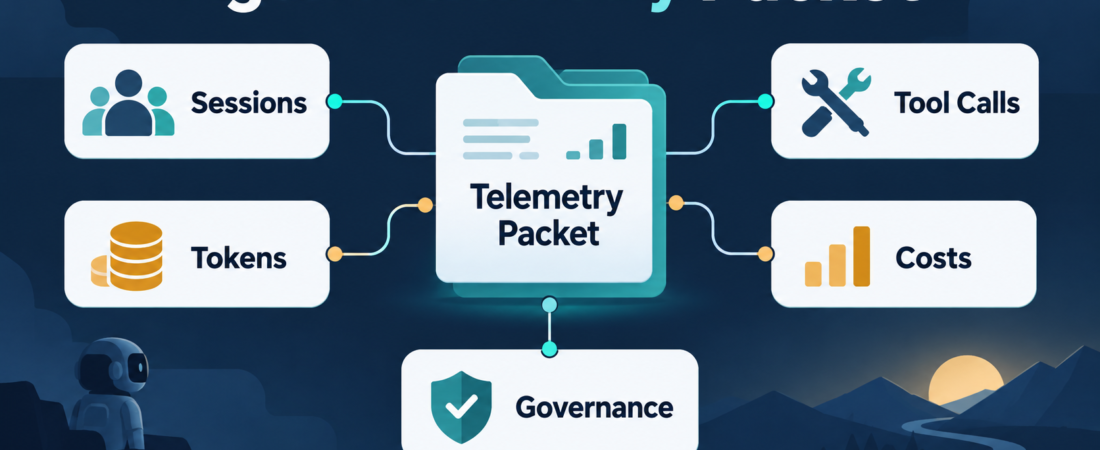
An Agent Telemetry Packet Before Scaling Local Coding Sessions
Scaling coding agents across a team should not start with a bigger budget or looser approval rule. It should start with a telemetry packet: the small bundle of evidence that shows what local agents are doing, what they cost, where they fail, and which work still needs human review.
| Packet part | Question it answers | Evidence to keep |
|---|---|---|
| Sessions | Which runs are becoming routine? | Agent, repo, task type, duration, outcome |
| Tokens and costs | Where is spend actually going? | Model, token totals, rate limits, daily burn |
| Governance | Where should expansion pause? | Permission boundary, review point, rollback note |
In Short
A telemetry packet is not a surveillance program. It is a compact operating record for local coding-agent work: session history, token usage, tool calls, cost signals, and governance notes. The goal is to answer a practical question before rollout: can this team explain what agents are doing well enough to fund, support, and constrain them?
OpenTelemetry docs describe telemetry as signals such as traces, metrics, and logs that help operators understand system behavior. That framing maps cleanly to agent operations. A coding-agent session has a trace-like story, a cost profile, tool-call events, and an outcome. Before usage spreads across more repositories and people, those signals should become visible enough for a lead to spot waste, risky permissions, repeated failures, and work that still needs a person in the loop.
Who this is for
This workflow is for engineering managers, platform leads, staff engineers, and agency operators who already have people using Claude Code, Codex, Cursor, OpenCode, OpenClaw, Gemini, or similar local coding agents. It also fits a small team preparing to move from a few trusted early adopters to a broader internal rollout.
It is less useful if the team has not yet tried local coding agents on real work. In that case, start with a small pilot, keep the work low-risk, and capture enough notes to compare what happened. Telemetry becomes valuable once there are repeated sessions to compare.
Starter workflow
1. Define the session record. Each agent run should have a minimum record: who started it, which repository or project it touched, the intended task, start and end time, model or agent used, outcome, and whether human review was required. Keep this lightweight. A record that people will actually maintain beats a perfect schema that never gets filled in.
2. Capture token and cost signals. The packet should show enough token and cost detail to separate normal usage from drift. Look for sessions with unusually high context, repeated retries, expensive model choices on routine work, or rate-limit pressure. Avoid stale public claims about tool pricing; use the team’s own logs and the vendor billing source for real decisions.
3. Review tool-call behavior. Local coding agents can read files, edit code, run tests, call MCP servers, browse context, and sometimes touch external systems. The packet should separate ordinary development actions from actions that need a stricter boundary, such as production credentials, database writes, cloud changes, or package publication.
4. Compare outcomes by task type. Group sessions by the work they attempted: bug fix, test repair, dependency update, refactor, documentation, data migration, release prep. Scaling is easier when the team can see which task types are low-friction and which ones keep burning tokens without producing reviewable changes.
5. Add a governance note before expansion. Before giving more people access, write down the current rule: where agents may run, what they may modify, what commands are blocked, what must be reviewed, and how to stop or roll back bad work. The NIST AI Risk Management Framework emphasizes governance, mapping, measuring, and managing AI risks; for local coding agents, those verbs translate into concrete operating boundaries.
Recommended ASE skills
Start with the queue’s required telemetry and governance skills, then add one spend-focused companion if the live data shows cost drift.
- Monitor local agent sessions and costs with ClawMetry for a local view across sessions, token spend, tool calls, alerts, and governance.
- Monitor local coding-agent sessions and token usage with Loongsuite Pilot when the team needs local telemetry across multiple coding agents and session traces.
- Harden Claude Code plans with claudex-loop when risky tasks need intent locking, plan stress tests, and cross-review before approval.
- Constrain coding-agent over-defense with HERO to keep fixes proportionate and stop review packets from turning into overbuilt safety theater.
- Track AI coding-agent token usage with TokenTracker when the immediate question is token usage, cost, and rate-limit behavior across local coding tools.
For teams standardizing a history review habit, agentsview can help inspect local coding-agent histories before resuming or turning a pattern into a team workflow.
What to watch
Do not confuse more telemetry with better judgment. A packet should help humans decide, not bury them in charts. If a field does not change a funding, safety, review, or rollout decision, remove it.
Keep private code and prompts private. Session records can contain sensitive repository names, customer terms, credentials, snippets, or incident context. Store only what the team needs, and treat raw logs as internal operational data.
Watch for hidden permission expansion. A coding agent that begins as a local helper can become a production actor through shell commands, cloud CLIs, API keys, browser sessions, or MCP servers. The packet should make those boundaries visible.
Separate evaluation from blame. The point is to learn where agent work is worth scaling. Bad sessions are useful if they reveal missing tests, unclear tickets, weak rollback paths, or tasks that still belong with senior engineers.
FAQ
How much telemetry is enough for a pilot?
For a small pilot, capture session count, task type, model or agent, token or cost signal, tool-call category, outcome, and review result. Add detail only when a rollout decision needs it.
Should this use OpenTelemetry directly?
Use OpenTelemetry conventions when they fit your stack, especially if traces, metrics, and logs already flow through that system. Do not force every local agent tool into a tracing platform before you know which questions the team needs answered.
What is the first red flag?
The clearest red flag is repeated expensive sessions with unclear outcomes. The second is tool access that expands faster than review rules.
When is the team ready to scale?
Scale when common task types have understandable costs, reviewable outputs, known failure modes, and written boundaries for commands, credentials, repositories, and human approval.