The Agent Skill Stack for a Lean Finance Ops Team
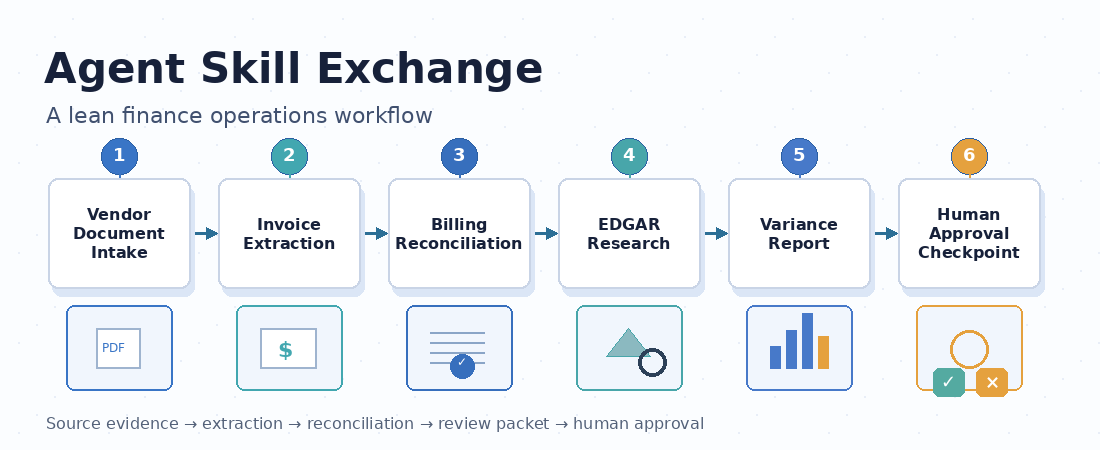
A lean finance ops team does not need an autonomous finance agent making decisions in the dark. It needs a disciplined workflow that turns messy source material into reviewable evidence: vendor PDFs, usage records, payment processor exports, filing references, reconciliation notes, and a clean handoff for the person who owns the financial action.
| Stage | Agent skill job | Human checkpoint |
|---|---|---|
| 1. Intake | Collect vendor PDFs, receipts, statements, and source URLs | Confirm source system and period |
| 2. Extract | Pull invoice fields, tables, payment terms, and confidence notes | Review low-confidence fields |
| 3. Reconcile | Match invoices, usage, payouts, and ledger records | Approve exceptions and adjustments |
| 4. Report | Package variances, filing references, and unresolved questions | Decide payment, close, or escalation |
That distinction matters. Finance workflows touch cash, reporting, compliance, customer trust, and vendor relationships. A useful agent should reduce the time spent finding, extracting, comparing, and packaging information. It should not silently approve payments, invent missing values, or blur the line between operational support and financial judgment.
This stack is built for small teams that have grown past spreadsheet-only finance ops but are not ready for a heavy automation program. The goal is not to replace QuickBooks, NetSuite, Stripe, the data warehouse, or the controller. The goal is to connect the repetitive evidence work around those systems so the team can review exceptions faster and close with fewer loose ends.
Start with the source packet, not the summary
The first skill in a finance ops workflow should create a source packet. That packet may include vendor invoices, payment receipts, purchase orders, CSV exports, usage reports, customer billing snapshots, contract references, and links back to the system where each item came from. If the agent cannot point back to source material, the rest of the workflow becomes fragile.
For document-heavy intake, ASE has several useful building blocks. Paperless-ngx Document OCR and Archive Management System is a good fit when a team needs searchable document intake and archive discipline. OCRmyPDF Searchable PDF OCR Pipeline helps when scanned PDFs need an OCR layer before downstream extraction. pdfplumber Python PDF Text and Table Extraction Library is useful when the document is already machine-readable but tables and line items need careful parsing.
The operating rule is simple: never let the agent summarize a finance document until it has captured the provenance. A good intake output includes file name, source URL or system, upload time, document date, vendor name if known, period covered, and any extraction warnings. This gives reviewers a trail to follow when a number looks wrong.
Extract invoices into reviewable records
Invoice extraction is the obvious early win for a lean finance team. It is repetitive, document-shaped, and full of small fields that can slow down close: vendor name, invoice number, issue date, due date, tax, currency, payment terms, line items, purchase order references, and remittance instructions.
The ASE skill Extract invoice fields from vendor PDFs into structured records fits this stage directly. The right output is not a polished paragraph. It is a structured record with confidence markers and source snippets. The agent should make uncertainty visible: a blurred due date, a line item split across pages, a mismatch between invoice total and line-item sum, or a currency symbol that could be ambiguous.
This is where many teams over-automate too early. A useful first version does not need to post bills automatically. It can create a review queue: clean fields for high-confidence invoices, flagged fields for review, duplicate candidates, and a note when remittance details changed from the last known vendor record. The workflow saves time without creating a new approval risk.
Reconcile billing, usage, and cash movement
Once intake and extraction are stable, the next job is reconciliation. Lean teams often have several partial truths: invoices in the accounting system, usage in the product or metering platform, payments in Stripe, deposits in the bank, and customer context in a CRM. The agent’s job is to align those records into an exception list.
For usage-based businesses, OpenMeter Usage Metering and Billing Platform can sit near the usage side of the workflow. For payment and revenue operations, ASE includes Stripe Reporting Agent, Stripe MCP Server, and Stripe Agent Toolkit for AI Payment Integration. For accounting-side checks, QuickBooks Online Invoice Reconciliation Agent is the kind of skill that belongs in the exception workflow rather than a blind autopilot.
A practical reconciliation run should answer five questions. Which invoices match expected usage or contract terms? Which payments settled, failed, or partially settled? Which customers have usage without a matching invoice? Which invoices have no supporting usage, purchase order, or approval record? Which differences are material enough to escalate?
The output should be a variance table, not a verdict. Put each exception in a row with the source records, expected value, observed value, difference, likely reason, and recommended next human action. That makes the agent useful to finance ops without pretending it can own the ledger.
Use EDGAR research as supporting context
Finance teams sometimes need public-company context around customers, vendors, competitors, or market signals. The SEC EDGAR database is the canonical source for U.S. company filings, but raw filings can be tedious to search and cite. Agent skills can help by finding filings, extracting relevant sections, and linking every claim back to source documents.
ASE has two relevant skills here: SEC EDGAR Financial Filing Parser and SEC EDGAR Filing Scraper & Analyzer. In a lean finance ops stack, these should be used for research support, not investment advice. Good tasks include pulling a company’s latest 10-K link, extracting revenue recognition language for internal context, finding risk-factor changes, or preparing a cited packet for an analyst to review.
The boundary is important. The agent can help locate and package filing evidence. It should not tell the business whether to invest, lend, acquire, or approve credit. That decision belongs to people with the right mandate, context, and controls.
Turn every run into a decision packet
The strongest finance ops agents do not end with chat output. They end with a packet that a reviewer can use. That packet should include extracted records, reconciliation tables, source links, unresolved questions, low-confidence fields, and a clear list of recommended human actions.
This mirrors the document workflow pattern covered in From PDF to Decision Packet. The packet is valuable because it separates evidence from judgment. The agent can say, “These three invoices differ from expected usage by more than 5%,” or “This vendor’s bank details changed from the previous invoice.” It should not say, “Pay this immediately” without review.
For teams handling regulated or high-risk work, the assistance boundary is also consistent with Agent Skills for Regulated Work. Finance operations can benefit from automation, but approvals, policy exceptions, write-offs, and external reporting need explicit ownership.
A practical first implementation
A lean team can pilot this stack in four phases. First, collect ten to twenty recent vendor invoices and run them through OCR and field extraction. Measure whether the agent captures the fields reviewers actually need, and record the cases where it fails. Second, connect one reconciliation surface, such as Stripe exports against invoices or usage data against billing records. Keep the output read-only and exception-focused.
Third, add a packet template. Every run should produce the same sections: source files, extracted records, match results, exceptions, unresolved questions, and approval checklist. Fourth, define escalation rules. Examples: new vendor payment details, invoice total above threshold, missing purchase order, tax mismatch, duplicate invoice number, usage variance above threshold, or any source document the agent cannot parse confidently.
This is enough to create meaningful leverage without creating hidden financial authority. The team gets faster intake, cleaner reconciliation, and better audit trails. The reviewer still owns payment decisions, accounting treatment, customer follow-up, and external reporting.
What still needs human review
Even a strong finance ops stack should pause for several categories of work. Humans should review new vendor onboarding, changed bank details, approval-policy exceptions, revenue-recognition questions, tax treatment, material variances, write-offs, refunds, credits, and anything that affects external reporting. The agent should also escalate when source data conflicts or when a required system is unavailable.
The best result is a calmer close process. Finance ops gets fewer mystery documents, fewer manual lookups, and a clearer list of exceptions. The agent handles the repetitive evidence work. The finance team keeps control of decisions, approvals, and accountability.
That is the right shape for lean finance automation: not a black box that moves money, but a review engine that makes every number easier to trace.