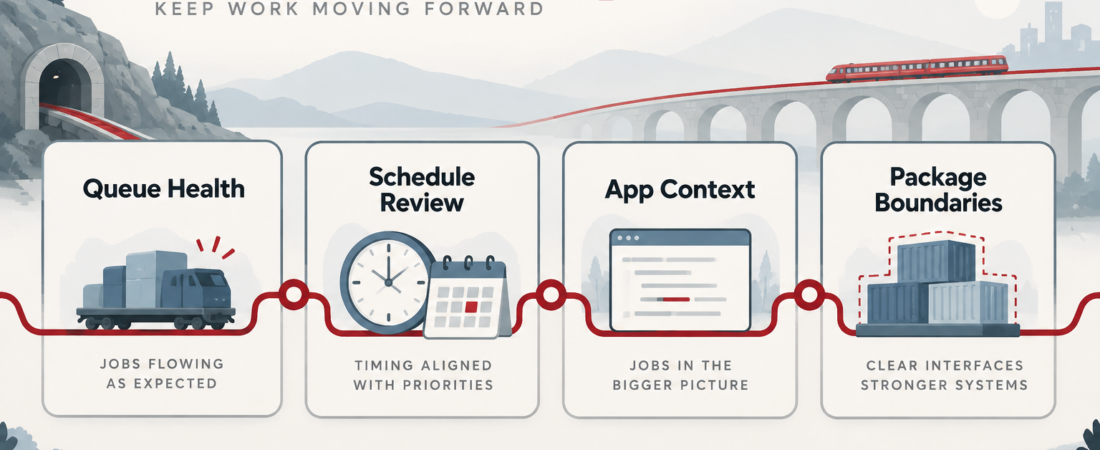
An Active Job Operations Playbook for Rails Teams
Rails teams often notice job problems only after customers feel them: a retry storm, a stuck mailer, a scheduled task that quietly stopped, or a background workflow that no one wants to discard without context. Active Job gives Rails a common interface for background work, and the Rails guide is clear that adapters decide how jobs are queued and performed. That means operations still need a practical packet before an agent retries, cancels, changes, or explains job behavior.
This playbook keeps the packet small. It connects queue health, schedule review, app context, and package boundaries so Rails teams can act on background work without turning every incident into a code archaeology session.
| Playbook step | Evidence to collect | Decision it supports |
|---|---|---|
| Queue health | Failures, retries, latency, and stuck jobs | Retry, pause, discard, or investigate |
| Schedule review | Recurring job timing and recent changes | Keep, shift, or disable a schedule |
| App context | Models, routes, associations, and job call sites | Change code with enough Rails context |
| Package boundaries | Owned domains and dependency violations | Fix the right package instead of spreading coupling |
In Short
Do not let an agent operate Rails background jobs from an error line alone. Start with queue state, then check whether the work was scheduled intentionally, then provide enough Rails app context to explain the code path, and only then decide whether a retry, discard, patch, or owner handoff is appropriate.
The official Rails Active Job guide should be the baseline for how jobs are defined and routed through adapters. Mission Control Jobs adds a Rails-aligned operations surface for Active Job queues. Sidekiq Scheduler covers recurring Sidekiq jobs. Packwerk helps monolith teams keep domain boundaries visible when job code crosses packages.
Who this is for
This is for Rails teams that already use Active Job, Sidekiq, or scheduled background work and are starting to let coding agents help with operations, maintenance, or incident follow-up. It is especially useful when the team has more jobs than one person can keep in their head.
It also fits Rails monoliths where background jobs touch several domains: billing, notifications, imports, reporting, fulfillment, or customer communications. In that setting, the risk is rarely just a failed job. The risk is that a well-intended fix changes the wrong domain boundary, retries work with stale assumptions, or hides a scheduling problem under a one-off patch.
Starter workflow
Begin with queue inspection. Use Operate Rails Active Job queues with Mission Control Jobs to review failed, pending, and recurring job behavior from an Active Job-aware surface. The first question is not “can we retry this?” It is “what state is the queue in, and what evidence explains the failure?”
Next, separate ad hoc job failures from scheduled work. Use Run scheduled Ruby agent jobs with Sidekiq Scheduler when recurring jobs are involved. Compare the configured schedule with deploy timing, recent config changes, and downstream availability. A job that fails every hour may need a schedule change, dependency fix, or feature-owner review rather than repeated retries.
Then give the agent Rails context before it proposes code. Use Give Rails coding agents live app context with rails-ai-context to expose the relevant routes, models, associations, jobs, and call sites. This helps the agent distinguish a queue symptom from the application behavior that produced it.
Finally, check ownership. Use Enforce package boundaries inside a Rails monolith before coupling spreads with Packwerk when the fix crosses domains. If a billing job reaches into notifications or a reporting job mutates fulfillment state, the operations packet should name that boundary before the branch changes it.
Recommended ASE skills
The core stack starts with Mission Control Jobs for queue operations because it keeps the work tied to Rails Active Job concepts. Pair it with Sidekiq Scheduler when the failed or delayed work comes from a recurring schedule. Those two skills answer whether the job is unhealthy, mistimed, or blocked by a dependency.
Add rails-ai-context before asking an agent to edit code. It gives the repair step enough Rails structure to avoid shallow fixes. Add Packwerk when the application is a monolith with package ownership rules. Together, the stack supports a careful path: inspect the queue, understand the schedule, load app context, then respect package boundaries.
If your Rails team also operates non-Rails background work, keep Trigger.dev TypeScript Background Jobs Platform as a comparison point for job visibility, retries, and run history. Do not mix the stacks casually; use it to clarify which operational evidence your Rails packet should still capture.
What to watch
Watch for retries that make the incident harder to understand. If the job is not idempotent, retrying can duplicate emails, payments, imports, or state transitions. The packet should say what makes retry acceptable, not just that the queue UI exposes a retry button.
Watch for scheduled jobs that are treated like ordinary failures. Sidekiq Scheduler configuration is part of the operational surface. A bad cadence, missing dependency window, or environment mismatch can look like a code problem when it is really a schedule problem.
Also watch for cross-package fixes that solve the symptom by weakening boundaries. Packwerk is useful because job code often sits near domain edges. If the clean fix belongs in another package, hand it off clearly instead of teaching the agent to route around the boundary.
FAQ
Is this only for Sidekiq teams?
No. Active Job is the Rails abstraction, while Sidekiq is one common adapter and scheduler ecosystem. Use the Sidekiq Scheduler part only when recurring Sidekiq jobs are part of the system.
Should agents be allowed to discard failed jobs?
Only with explicit criteria. Discard is safest when the job is obsolete, duplicated, or known to be unrecoverable. For customer-visible workflows, require a human review or a domain owner decision before discard.
What belongs in the handoff packet?
Include the affected job class, queue state, last failure, retry history, schedule source if relevant, linked Rails context, package owner, and the recommended next action. Keep it short enough for the owner to verify quickly.