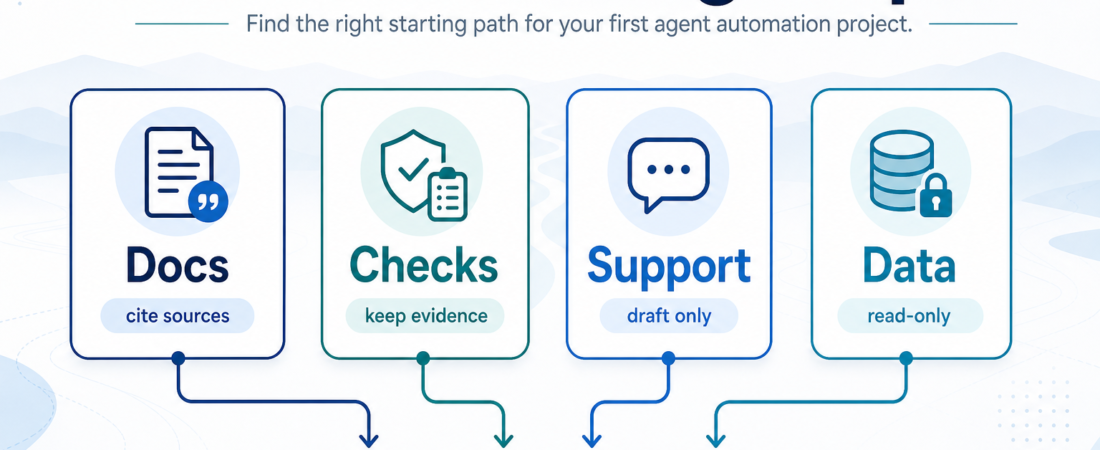
A Skill Routing Map for Teams Starting With Agent Automation
Most teams do not need a giant agent platform on day one. They need a first useful route through the catalog: a task that happens often, a skill that can help without taking over the business, and a review point where a human can see what changed.
The mistake is starting with the most impressive demo. A better first move is to classify the job: reading documents, checking a release, triaging support, touching code, or querying data. Each route has different risk, setup work, and evidence requirements.
| Starting job | Best first route | Review evidence |
|---|---|---|
| Too much knowledge scattered across docs | Document-grounded retrieval before autonomous answering | Sources cited, answer boundaries stated, escalation path visible |
| Releases break in browser flows | Browser or smoke-test checks before deploy | Steps run, screenshots or logs kept, failures block release |
| Support tickets need faster triage | Classification and draft replies with human approval | Ticket reason, source links, confidence, owner handoff |
| Product data questions keep repeating | Read-only analytics or SQL exploration | Query shown, dataset named, no write access granted |
In Short
Start agent automation with a routing decision, not a tool preference. The safest first skill is usually the one that reads, checks, summarizes, or drafts while leaving approval with a person. That makes the output easy to inspect and keeps the first win tied to a real operator problem.
A practical routing map has four questions. What job repeats often enough to matter? What access does the skill need? What evidence proves the result is usable? Where does human review happen?
If a proposed first project cannot answer those questions, it is probably too broad. Narrow it until the agent can produce a packet, check result, draft, comparison, or report that a person can review in minutes.
Who this is for
This guide is for small teams, agencies, operators, and technical leads who are starting with agent skills but do not yet have a formal platform engineering function.
It is not for teams trying to replace an existing production automation system in one pass. If you already have mature CI, data governance, support routing, and release approvals, use skills to improve one weak step at a time.
Decision path
1. Start with a read or check task. First-time automation should avoid irreversible actions. Good candidates include summarizing sources, testing a user flow, checking documentation, drafting a ticket response, or building a repeatable query.
2. Match the task to the source of truth. Document questions need retrieval. Release confidence needs browser, API, or smoke-test evidence. Support routing needs ticket context and citations. Data questions need read-only access.
3. Require a visible artifact. The first agent workflow should leave something behind: cited sources, a test log, a screenshot, a diff summary, a SQL query, or a decision packet.
4. Put the human checkpoint in the workflow. A support draft can be approved before sending. A browser test can block deploy. A research brief can show citations. A data answer can show the exact query.
5. Expand only after the first route is boring. Once the team can run the route, inspect the evidence, and handle failures without drama, add the next adjacent step.
Recommended ASE skills
Use these as starting points, not as a universal starter pack.
- Build document-grounded agent context workflows with RAGFlow for teams that need answers tied to internal docs, policies, or knowledge bases.
- Summarize URLs, files, podcasts, and YouTube sources into agent-ready briefs with Summarize when the first job is turning scattered sources into a reviewable brief.
- Drive token-efficient browser testing from coding agents with Playwright CLI when a team needs browser evidence before shipping a web change.
- Add executable smoke tests for shell scripts and CLIs before refactors ship when release confidence depends on quick repeatable command checks.
- Study customer-service triage and handoff patterns with the OpenAI CS agents demo for support teams designing safer ticket routing and escalation behavior.
- DuckDB SQL Analytics Agent when operators need local, inspectable analysis before connecting an agent to broader product data.
- Preserve agent session context with Claude Mem when repeated agent work keeps losing project decisions and handoff context.
What to watch
Over-broad first projects. “Automate research,” “automate support,” or “automate QA” is too vague. Route the first project to one output.
Write access too early. For a first route, prefer read-only access and draft outputs unless the team already has strong approvals around the destination system.
Missing source boundaries. If the source set is stale, incomplete, or unclear, fix that before asking the agent to sound confident.
No failure language. Good workflows say what should happen when the skill is uncertain: stop, ask for review, attach evidence, or escalate.
FAQ
Should a team start with one skill or a full stack?
Start with one route. A stack becomes useful after the team understands where the first skill creates evidence and where it fails.
What is the lowest-risk first agent automation project?
Usually a read-only summarization, retrieval, or check workflow. The agent gathers context or runs a test, then a person decides what to do with the result.
How many skill links should a routing guide include?
Enough to make the route actionable without turning the post into a directory dump. Five or more relevant links keeps workflow-style posts concrete.
When should a team move from drafts to actions?
After the draft or check route is repeatable, evidence is reviewable, and the team knows how to undo or block a bad result.