A Practical Stack for Turning Messy Documents Into Review Packets
Messy document work rarely fails because a team lacks one clever parser. It usually fails because the workflow jumps from raw files straight to a summary, with no durable record of what was read, what was extracted, what was uncertain, and who reviewed the result.
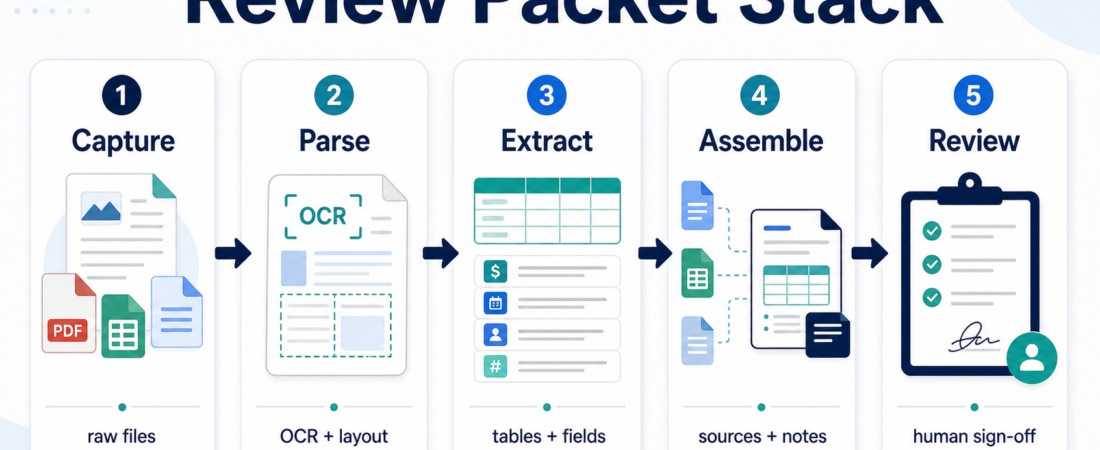
A review packet is the better target. Instead of asking an agent to “handle these PDFs,” ask it to produce a package a person can inspect: source files, OCR output, extracted fields, table notes, exceptions, citations, and a short recommendation. The stack below is built for that kind of bounded document workflow.
| Stage | Main job | Review artifact |
|---|---|---|
| Capture | Collect files and preserve originals | Source inventory |
| Parse | Run OCR, layout, and markdown conversion | Readable text with page references |
| Extract | Pull tables, fields, clauses, or entities | Structured facts plus confidence notes |
| Assemble | Group evidence around the decision | Packet with source links and open questions |
| Review | Route exceptions to a human owner | Approval, rejection, or follow-up list |
In Short
- For messy documents, optimize for a review packet, not a one-shot answer.
- Use OCR and parsing skills to make sources readable before asking for extraction.
- Separate extraction from judgment: agents can prepare evidence, but people should approve risky conclusions.
- Keep originals, page references, failed parses, and unresolved questions in the packet.
- Start with one narrow document type before scaling across legal, healthcare, finance, or operations workflows.
Who this is for
This guide is for operators who receive mixed PDFs, scans, forms, exports, emails, tables, or signed documents and need a repeatable way to turn them into something reviewable. That could mean a finance team preparing invoice evidence, a legal ops team assembling contract notes, a healthcare documentation team organizing intake files, or a real estate ops team checking transaction paperwork.
It is not a case for autonomous legal, clinical, financial, or compliance decisions. The useful promise is narrower: collect the evidence, normalize the text, extract the facts, show uncertainty, and make human review faster.
Starter workflow
1. Capture originals before transforming anything. Put the source files in a stable folder or archive, give each file a durable ID, and record where it came from. If the workflow starts with email attachments, cloud folders, or exported ZIP files, keep that source trail. A later reviewer should be able to open the exact original, not just the agent’s cleaned copy.
2. Make the documents readable. Scanned PDFs and phone photos need OCR before an agent can reason over them. A tool like Tesseract OCR Engine for Image-to-Text Workflows fits simple image-to-text conversion. For PDFs that should become searchable while preserving the document shell, OCRmyPDF Searchable PDF OCR Pipeline is often the better first pass.
3. Parse layout before extracting facts. Many document mistakes come from ignoring layout: headers get mixed into clauses, footnotes become body text, and tables flatten into nonsense. Use document conversion skills such as Docling Document Parsing and Conversion Toolkit, MarkItDown Document-to-Markdown Converter by Microsoft, or Unstructured Document ETL Toolkit to produce cleaner text and structure before extraction. Their official docs are useful references too: Docling, MarkItDown, and Unstructured.
4. Extract fields and tables as a separate step. Do not hide extraction inside the final summary. If the packet needs invoice totals, renewal dates, names, signatures, line items, or policy clauses, output those as structured rows first. For table-heavy PDFs, pdfplumber Python PDF Text and Table Extraction Library or Camelot Advanced PDF Table Intelligence can be useful starting points.
5. Assemble the packet around a decision. The final output should not be “summary of documents.” It should answer a bounded operator question: Is this invoice ready for approval? Which contract clauses need legal review? Which intake forms are missing required fields? Each answer should include source references, extracted evidence, open questions, and a recommendation label such as ready, blocked, or needs review.
6. Route exceptions instead of smoothing them over. Failed OCR, missing pages, conflicting dates, low-confidence table extraction, and unclear signatures should stay visible. If a workflow includes signatures or review handoff, a skill such as DocuSeal Open Source Document Signing and PDF Form Platform can sit after the evidence packet, not before it.
Recommended ASE skills
| Need | Start with | Use when |
|---|---|---|
| OCR for scanned files | Tesseract OCR Engine | You need plain text from images or simple scans. |
| Searchable PDFs | OCRmyPDF Pipeline | You want OCR while keeping a PDF-shaped artifact. |
| Document conversion | Docling Toolkit | You need layout-aware parsing before extraction. |
| Markdown handoff | MarkItDown | You want lightweight document-to-markdown conversion. |
| ETL pipeline | Unstructured Document ETL | You need a broader ingestion pipeline for mixed documents. |
| Tables | pdfplumber | You need inspectable text and table extraction from PDFs. |
| Archive and retrieval | Paperless-ngx | You need a source archive, not just a transient parse. |
What to watch
- Page references: A packet without page, file, or row references is hard to audit.
- Silent parse failures: Blank pages, rotated scans, handwriting, and merged table cells should be flagged.
- Regulated boundaries: In legal, healthcare, finance, and real estate workflows, keep the agent in evidence-prep mode unless a qualified reviewer approves the next step.
- Overbroad prompts: “Summarize this folder” is weaker than “prepare an invoice approval packet with missing fields and source citations.”
FAQ
Should one skill handle the whole document workflow?
Usually no. A safer stack separates capture, OCR, parsing, extraction, packet assembly, and review. That makes failures easier to inspect and replace.
What is the minimum useful review packet?
Include the original file list, extracted facts, source references, unresolved questions, and a clear review status. Anything less tends to become a summary, not an operational artifact.
Can this replace legal, clinical, or financial review?
No. It can reduce document preparation work, but the final judgment belongs with the accountable reviewer, especially in regulated or high-risk contexts.
Where should an ASE reader browse next?
Start with the broader ASE skill catalog, then narrow by document parsing, OCR, archive search, or the relevant industry collection.