A Postgres Migration Lock Review Before Schema Changes Reach Production
In Short
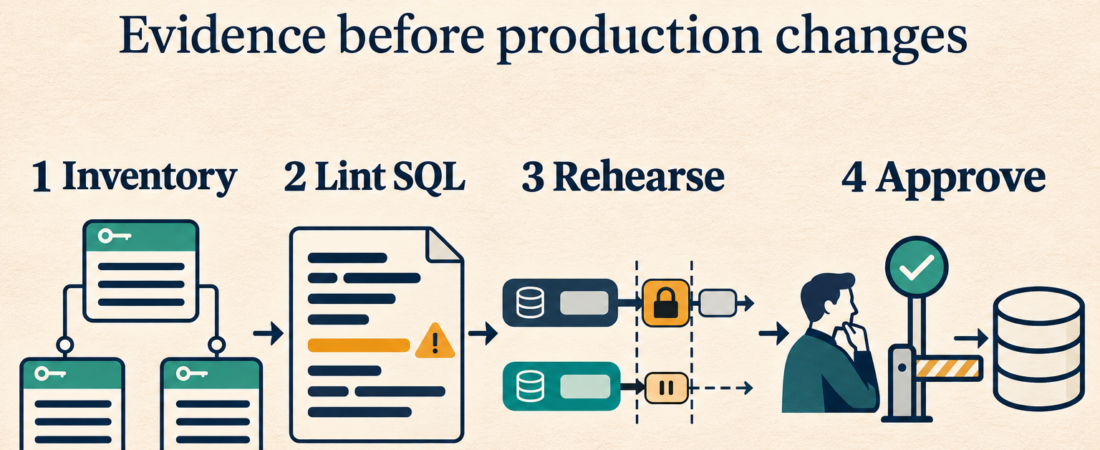
A Postgres migration lock review should produce evidence about what a schema change can block, how it behaves under contention, and who may authorize execution. Start with a schema inventory, lint the proposed SQL, then rehearse the exact migration in staging. A clean lint report is one input to that decision; it cannot establish production readiness by itself.
This workflow ends with a review packet and an explicit operator decision. It addresses schema changes rather than tuning an individual slow query. The example is a proposed customer-reference constraint on an orders table that already serves application traffic.
Who this is for
This is for application engineers, database operators, and coding-agent maintainers preparing a migration pull request. It fits teams that can inspect schema metadata and run a representative staging environment but reserve production changes for an accountable operator.
Before starting, name the target database, PostgreSQL version, migration runner, application release, and reviewer. Use a metadata-only account for inventory where feasible. Keep connection secrets outside the packet and avoid copying customer rows into review artifacts. If the agent cannot access staging, label rehearsal evidence as missing and hand the packet to someone who can.
Starter workflow
- Freeze the candidate. Record the migration filename, commit, checksum, and intended outcome. For our orders example, list the referencing column, referenced key, and expected handling of existing invalid values. Write acceptance criteria before modifying SQL so the review cannot quietly change scope.
- Inventory the affected objects. SchemaCrawler documents tables, constraints, indexes, and other schema objects, with outputs suitable for comparison. Export a focused inventory of orders, customers, related constraints, and dependent objects. Ask the reviewer to confirm application dependencies separately; metadata alone does not capture every client assumption.
- Lint the exact SQL. Squawk’s documented rules cover foreign-key validation hazards, index creation, and transaction placement. Run the installed, pinned version against the candidate and save its version, configuration, command, output, and exit status. The official CLI documentation shows file-based linting. Explain each finding and any suppression in the review.
- Review the proposed sequence. Read the relevant Supabase Postgres guidance for schema design, indexing, concurrency, and RLS. For this example, ask whether adding and validating the constraint should be separate reviewed steps. Check application-role behavior after the change as a distinct acceptance criterion.
- Rehearse contention, then hand off. On disposable staging data, run the unchanged candidate through the actual migration runner while a second session exercises representative traffic. Save timing and lock observations. Repeat with a deliberately held transaction under an agreed test plan. Ask the operator to approve the final SQL, execution window, monitoring, and stop conditions.
| Review stage | Evidence to retain | Decision |
|---|---|---|
| Inventory | Schema snapshot and dependency notes | Is the affected scope understood? |
| Lint SQL | Pinned tool output and reviewed findings | Does the sequence need revision? |
| Rehearse | Lock waits, elapsed time, application checks | Are staging results acceptable? |
| Approve | Named operator and stop conditions | Authorize, revise, or defer |
Use squawk migrations/20261103_orders_customer_fk.sql as an illustrative lint command after installing your approved version. This inspects a local file; it is not an instruction to apply the migration. Preserve the original report when revising SQL so reviewers can trace why the sequence changed.
For staging observations, use a small record with fields for run ID, dataset description, concurrent workload, migration checksum, wait duration, total duration, application errors, and operator notes. A result from an empty database should remain clearly distinguishable from a representative workload trial. Do not invent a universal acceptable duration: the service owner sets that threshold.
Recommended ASE skills
- SchemaCrawler schema inventory: start here to prepare the object inventory and reviewable documentation.
- Squawk migration linting: inspect the proposed SQL and bring findings into the migration review.
- Supabase Postgres Best Practices: organize the indexing, locking, and access-policy questions that need human review.
- pg-aiguide reference workflow: an optional companion when the reviewer needs a documentation lookup before revising SQL.
- Data Peek guarded database access: consider this optional connection route if it matches your existing access controls; keep this task limited to approved inspection.
What to watch
PostgreSQL’s locking documentation explains that commands acquire lock modes with different conflicts, and that outstanding locks can be inspected through pg_locks. Review the target version’s behavior rather than treating all DDL as equivalent. Measure acquisition waits separately from execution duration.
- Record transaction boundaries imposed by the runner, including any difference from a manual rehearsal.
- Require an owner-approved waiting limit, cancellation procedure, and escalation contact.
- Test application roles and RLS expectations independently of migration completion.
- Document recovery and forward-fix options; do not assume every schema change has a harmless reversal.
FAQ
Does passing Squawk mean a migration is safe?
No. Retain the lint result alongside schema context and staging evidence. Approval should account for the actual runner, workload, access rules, and operational limits.
Can an agent apply the approved migration?
This workflow stops at the review packet. Execution requires the operator’s explicit authorization through the team’s established change process.
What if staging cannot reproduce the production workload?
List the gap, describe what was tested, and let the operator decide whether more evidence is required. Missing evidence should stay visible in the final handoff.