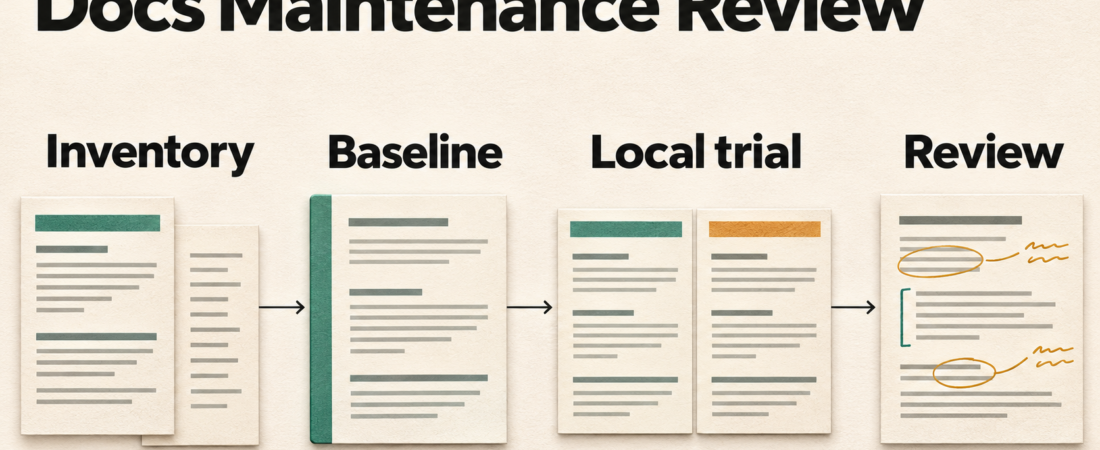
Material for MkDocs Maintenance Horizon: What Existing Docs Teams Should Verify
In Short
Existing documentation teams should treat the Material for MkDocs maintenance horizon as a reason to inventory and test their publishing setup. As checked on November 8, 2026, the official Material for MkDocs site announces end of life on May 5, 2027, says critical maintenance continues through that date, and identifies Zensical as its successor. This is an upstream ecosystem notice, not an ASE release announcement.
Those statements establish a planning horizon. They do not establish that your extensions, custom templates, search behavior, or versioned URLs will survive a change unchanged. Start by recording the working system, then run a small local compatibility trial with explicit acceptance criteria.
Who this is for
This article is for docs maintainers, DevRel engineers, and platform teams already shipping a Material for MkDocs site. It is especially relevant when older release guides remain public or a documentation agent proposes configuration changes. A clean build is useful evidence, but readers also need to find the correct guide, follow its links, and recognize which product version it describes.
Assign one owner to the review. Keep the current deployment path available while you gather evidence. Teams that recently prepared a versioned documentation handoff can reuse its URL inventory and release notes as the starting packet.
Starter workflow
- Capture the baseline. Record the source commit, Python version, dependency constraints, build command, and deployment settings. Save the current generated output separately from the experiment. List plugins, Markdown extensions, theme overrides, extra JavaScript, and CSS. Give each customization an owner and a representative page so nobody has to guess why it exists.
- Choose a small sample. As a proposed trial size, select 6 pages: the home page, a deeply nested guide, a code-heavy reference, an extension-heavy page, a current release guide, and an older release guide. Record their URLs and important anchors. Add 3 search queries with expected destinations and 2 navigation journeys that reflect actual reader tasks.
- Map version behavior. Read the official mike documentation alongside your configuration. It describes generating separate versions into a Git branch and maintaining aliases. Capture your actual version directories, alias targets, default landing behavior, and canonical settings. Treat those as acceptance criteria for the experiment; do not assume a successor reproduces them automatically.
- Build an isolated candidate. Use a separate checkout and environment. Follow the candidate’s current official setup instructions and write down every configuration edit. Start with the chosen pages and avoid changing their content at the same time. Keep deployment credentials outside the trial so a successful local build cannot silently become a production release.
- Compare the reader experience. Open both outputs locally. Check search destinations, sidebar ordering, section anchors, code rendering, keyboard access, and narrow-screen navigation. Test direct visits to older release URLs. Classify each difference as acceptable, repairable, or blocking, and attach a screenshot or exact URL to each finding.
- Make a bounded decision. Produce a short record containing the baseline commit, candidate version, passing checks, blockers, estimated repair work, and next review date. Continue maintaining the existing site if the sample exposes unresolved gaps. Schedule wider validation only after the owner accepts the evidence.
| Review stage | Evidence to keep | Stop condition |
|---|---|---|
| Inventory | Dependencies, extensions, overrides | Unowned customization |
| Baseline | Saved output and version URL map | Current build cannot be reproduced |
| Local trial | Sample pages and comparison notes | Missing content or broken navigation |
| Review | Decision, owner, next check date | Compatibility remains unverified |
Recommended ASE skills
Use the required skills as separate steps in the review, with outputs that another maintainer can inspect:
- Build documentation with Material for MkDocs: use this route to organize the existing configuration, local preview, and static output. Its role here is to establish the baseline rather than certify a different toolchain.
- Publish versioned documentation with mike: use this route when documenting release directories and aliases. Keep proposed alias changes in the review packet until older release links have been checked.
- Verify Markdown links with markdown-link-check: use this route for a repeatable source-link pass. Follow it with rendered-page checks, since a source scan alone does not establish correct navigation, search, or version selection.
- Verify local pages with Playwright: use this route to make the sample navigation journeys repeatable and retain browser evidence for review.
- Vale for technical documentation: keep editorial checks as a separate baseline report. Avoid folding prose cleanup into the compatibility trial, where it could obscure rendering differences.
For the wider editorial process, the DevRel knowledge automation playbook provides a related handoff route. Keep the compatibility decision attached to the repository, where future contributors can find it.
What to watch
Recheck the upstream notice before setting a rollout date. A maintenance deadline does not explain the condition of your individual site. Watch for undocumented plugins, fragile overrides, search results pointing to the wrong release, and redirects that land successfully but show different content. Record transient link-check failures separately from reproducible failures so exceptions remain reviewable.
Avoid combining a generator change with a domain move or broad content rewrite. Those extra variables make failures harder to attribute. The immediate deliverable is a reproducible baseline and an honest compatibility record; a production migration needs its own review and rollback plan.
FAQ
Must we migrate immediately?
The announced horizon warrants planning. Set your schedule from the verified notice, your maintenance needs, and the trial findings. Do not turn an announcement into an untested emergency deployment.
Does successor mean every plugin is compatible?
No project-specific result follows from that label. Test the extensions and customizations you actually use, and mark unsupported or untested behavior explicitly.
Should we rebuild every older release during the trial?
Start by preserving existing artifacts and checking their public URLs. Test representative older guides in isolation before proposing any historical rebuild or alias change.