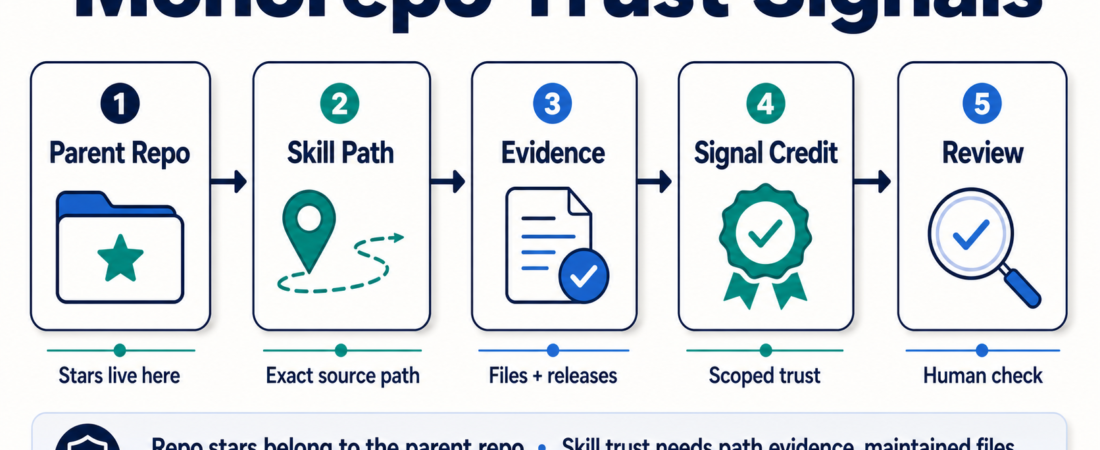
How ASE Should Handle Monorepo Skills Without Inflating Trust Signals
Monorepos create a real measurement problem for skill marketplaces. A skill can live inside a large repository with thousands of stars, years of history, and many active maintainers, while the actual agent-facing file is a small subdirectory that only a few people touch. If a marketplace gives the skill full credit for the parent repository, it can make a narrow integration look more battle-tested than it is.
ASE should not hide parent-repo signals. They are useful. But they should be labeled as parent context, not skill-level proof. The better rule is simple: credit the source that actually backs the skill, then explain when a metric belongs to the repository, the package, the subdirectory, or ASE’s own review process.
| Source shape | What ASE should show | What it should not imply |
|---|---|---|
| Whole repo equals the skill | Repo stars, source URL, maintainer, and review status can all point at the same project. | Do not add extra caveats unless the metadata is stale or unclear. |
| Skill lives in a subdirectory | Show the exact path, parent repo signal, and evidence that the path is maintained. | Do not treat parent stars as direct adoption of the skill path. |
| Generated wrapper around a larger project | Credit the upstream project and label the wrapper as ASE interpretation. | Do not imply the upstream authors endorsed the agent skill. |
| Composite workflow | List component sources or leave source fields blank until a precise source exists. | Do not force one repo to represent a multi-tool workflow. |
In Short
A monorepo skill should get credit for the evidence that actually supports it. Parent repository stars can be shown as a context signal, but they should not be treated as direct proof that the specific skill path is popular, maintained, secure, or production-ready.
The cleanest marketplace pattern is a layered trust model:
- Parent repo signal: broad project reputation, stars, license, activity, and issue history.
- Path-level evidence: the exact directory or file set that the skill depends on.
- Package or release evidence: the published artifact operators actually install, when one exists.
- ASE review evidence: source alignment, metadata quality, category fit, and security review.
This matters because operators use marketplace cards to decide what deserves attention. If a small agent skill inherits the full glow of a famous parent repository, the marketplace stops helping and starts flattening context. The fix is not to suppress signals. It is to make each signal explain what it measures.
The Parent-Repo Star Problem
GitHub stars are repository-level signals. GitHub’s own repository model treats a repository as the unit that stores project files, history, collaboration, and metadata. In a monorepo, that unit can contain many packages, examples, apps, SDKs, docs, and experiments under one roof. A star on the repository does not say which subdirectory the user values.
That is fine on GitHub because GitHub is not claiming each folder has its own reputation. It becomes a problem when a marketplace turns one folder into a separate skill page. A skill for a niche CLI helper inside a 70,000-star monorepo should not appear equivalent to a standalone 70,000-star tool where the whole repository exists for that one tool.
There are three common failure modes:
- Inflated popularity: parent stars make a small skill look more widely adopted than it is.
- Inflated maintenance confidence: parent activity hides the fact that the relevant path has not changed in months.
- Inflated endorsement: a generated skill page can look like an official upstream integration even when it is only a marketplace interpretation.
ASE already has the right philosophy in its metadata practice: blank is better than wrong. The same standard should apply to monorepos. A parent signal is better than silence when it is labeled honestly, but worse than silence when it is presented as path-level proof.
The Source-Aligned Rule
The source-aligned rule is the core rule: a trust signal should attach to the smallest source unit that can honestly support it.
For a standalone repository, that usually means the repo. For a published package, it may mean the package registry plus the repo behind it. For a monorepo skill, it usually means the exact GitHub path and the parent repo around it. For a composite workflow, there may be no single source unit at all.
ASE should therefore store and render source fields with a difference between these concepts:
- Canonical source URL: the best link for the specific skill, ideally an exact subdirectory when the skill depends on one.
- Parent repository URL: the broader repo that contains the path.
- Signal scope: whether stars, forks, releases, and activity describe the parent repo, a package, or a skill path.
- Review scope: what ASE actually reviewed, such as the skill page, source alignment, category fit, or security posture.
This is close to the reasoning behind source alignment as a ranking signal. The goal is not to make pages look richer. The goal is to help operators distinguish a well-sourced skill from a page with attractive but loosely attached metadata.
A Practical Handling Model
ASE can handle monorepo skills without overbuilding the UI. The useful operator-facing model has four states.
State 1: exact standalone source. The skill maps cleanly to one repository or package. Show normal source metadata. This is the easiest case.
State 2: exact monorepo path. The skill maps to a stable subdirectory inside a parent repo. Show the path as the source, show parent repo stars as parent context, and avoid phrasing that implies the path itself earned those stars.
State 3: inferred wrapper. The skill describes how to use an upstream tool with an agent, but the skill page is not itself maintained by the upstream project. Show the upstream source, but label ASE’s page as a marketplace guide or operator wrapper. This is common for tools like security scanners, CI helpers, and repo automation utilities.
State 4: composite workflow. The skill represents a pattern that pulls from several tools or documents. In that case, ASE should not force a fake canonical repo. It can link component sources in the body while keeping structured source fields empty or scoped to the component that is actually being represented.
This model also gives editors a consistent way to handle live examples. A repo automation skill such as Run Claude Code inside GitHub Actions should make it clear which project, action, or workflow file backs the skill. A supply-chain skill such as SafeDep Vet can carry repo-level context, but operators still need to know what ASE reviewed and what the upstream tool itself claims.
What Operators Should Look For
When an operator reads a monorepo-backed skill page, the first question should be: does the source link land close enough to the thing I am being asked to trust?
A good page should answer that without making the operator investigate from scratch. It should link to the exact directory or file when that is the meaningful source. It should avoid generic homepage links when a deeper link exists. It should make package names, repo names, and marketplace names easy to tell apart.
The second question is whether the signal matches the job. Stars are useful for broad discovery, but they are weak evidence for safety. For safety-sensitive workflows, a skill page should lean more on review status, source clarity, and operational fit. Skills like Claude Code Security Review, Ratchet for pinned CI actions, and SWE-agent for issue-to-code workflows are not interchangeable just because they all touch repositories. Their trust evidence should follow their actual operating surface.
The third question is whether the page distinguishes adoption from suitability. A heavily starred parent repository can still be a poor fit for a regulated environment, a restricted CI runner, or a team that needs read-only operation. That is why ASE’s broader metadata quality rule matters. Missing context should stay missing until it can be backed by source evidence.
What ASE Should Display
The best display pattern is compact and explicit. A monorepo-backed skill page should not need a long warning banner. It needs better labels.
- Source: exact path or package page when available.
- Parent repo: broader GitHub repository when the source is a path.
- Stars: parent repository stars, labeled as parent repo stars.
- Last source check: when ASE last verified that the path still exists and matches the page.
- Review status: ASE’s own review signal, separate from upstream popularity.
That keeps the page useful for scanning while protecting trust. It also helps comparison pages and ranking modules. If Browse Skills sorts by popularity, monorepo-backed skills should not silently outrank standalone projects because they borrowed the parent repo’s reputation without scope labels.
External references should stay modest. A link to GitHub’s repository documentation can explain the unit of measurement, but ASE does not need to turn every page into a lecture about monorepos. The marketplace should do the interpretation once and make the result visible.
FAQ
Should ASE hide stars for monorepo skills?
No. Hiding useful context would make pages less informative. ASE should show stars when they are source-backed, but label them as parent repository stars when the skill maps to a subdirectory.
Is a monorepo skill less trustworthy than a standalone skill?
Not automatically. Some monorepos are maintained with excellent discipline. The issue is not trustworthiness; it is scope. A parent repo signal needs path-level context before it can support a specific skill page.
What should happen when the exact source path is unclear?
ASE should leave the precise source field blank or use a clearly scoped parent link until the exact path is verified. Guessing creates more harm than an empty field.
How should operators use monorepo-backed skills?
Treat parent repo stars as discovery context, then check the exact source path, last update, review status, and fit for your environment before adding the skill to a production agent.
For background on how GitHub defines repositories, see GitHub’s repository documentation. For ASE’s broader stance, start with source alignment and metadata quality.