The Agent Skill Stack for Product Launch Readiness
A product launch rarely fails because one person forgot to run a test. It fails because the launch evidence is scattered. Feature flag rules live in one system, analytics baselines in another, smoke tests in CI, API checks in a collection, session replays in a product tool, and rollback notes in someone’s head. By the time the team asks, “Are we ready?”, the answer is often a feeling instead of a packet of evidence.
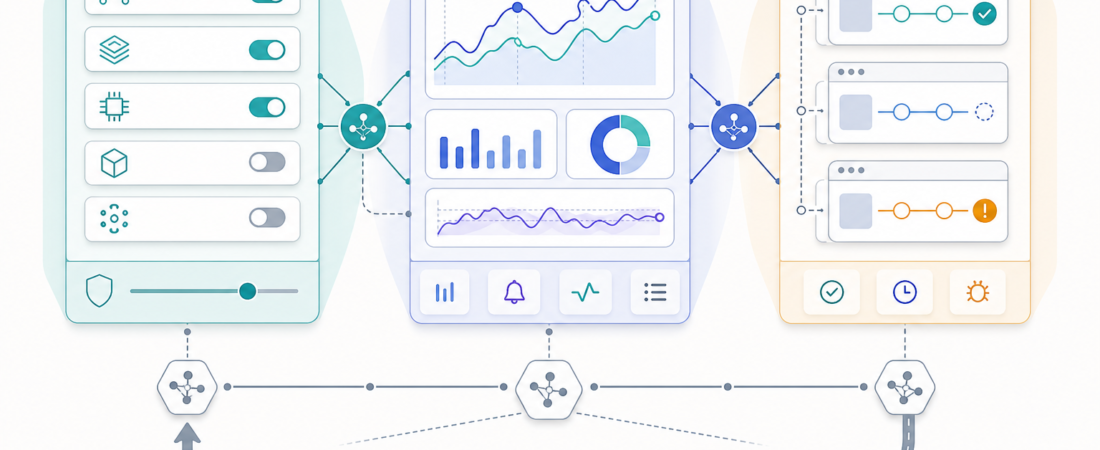
| Launch layer | What the agent gathers | Decision output |
|---|---|---|
| Control | Flag rules, cohorts, kill switch, owner | Who will see the change, and how exposure can stop |
| Observe | Analytics baselines, replay samples, errors, latency | What normal looks like, and what drift matters |
| Verify | Browser smoke tests, API checks, links, rollback notes | A launch packet with pass/fail evidence and review points |
That is where agent skills are useful. The right launch agent does not “ship the feature” or declare victory from a green build. It assembles a launch-readiness packet: what changed, who will see it, which checks passed, what signals should be watched, what still needs a human decision, and how to roll back if the early data looks wrong. Agent Skill Exchange has enough concrete product analytics and verification skills to make that packet repeatable.
Start with the launch question, not the tool list
A good launch workflow begins with a narrow question: what evidence would make a product lead, engineer, support owner, and growth operator comfortable increasing exposure? That question keeps the agent from becoming a dashboard tourist. It should collect the signals that match the release risk.
For a minor copy change, readiness may mean link checks, screenshots, and analytics event confirmation. For a new onboarding flow, readiness should include feature flag targeting, browser smoke tests, API checks, session replay review, support escalation notes, and a rollback plan. For a paid conversion experiment, the packet should also include baseline conversion, sample-size expectations, event instrumentation, and a clear rule for pausing the rollout.
The stack below is designed around that larger class of launches: user-facing product changes where the team needs controlled exposure and evidence before scaling up.
Layer 1: control exposure with flags
The first layer is release control. If a launch cannot be limited, observed, and reversed, the rest of the workflow is already weaker than it should be. Feature flags give the agent something concrete to inspect: target rules, percentage rollout, environments, dependencies, owners, and the kill switch.
For teams using LaunchDarkly, ASE includes Design and verify LaunchDarkly feature-flag targeting and rollout changes with MCP safety checks. A launch-readiness agent can use a skill like this to turn flag configuration into reviewable evidence: which segment is included, which environment is active, whether prerequisites match the launch plan, and whether the fallback behavior is documented.
For teams that combine flags and analytics in the same product workflow, PostHog Product Analytics and Feature Flags SDK is another useful reference point. It connects the exposure layer to measurement, which matters because the launch question is rarely “is the flag on?” The better question is “can we tell what happened after the flag changed?”
The output of this layer should be short and factual: flag name, owner, environment, target cohort, rollout percentage, prerequisite flags, expected fallback, and stop condition. If any of those are missing, the agent should mark the packet incomplete rather than filling the gap with guesswork.
Layer 2: establish analytics baselines
Before a rollout starts, the team needs a baseline. Otherwise, the first hour of post-launch data becomes a debate about whether the metric was already noisy. The agent should capture current values for the few metrics that matter to the change: activation, checkout completion, error rate, page speed, retention proxy, search success, or whatever the product actually affects.
PostHog can cover event-level launch analytics and feature exposure. Privacy-friendly analytics skills such as Plausible Analytics Privacy-First Web Analytics Platform, Umami Privacy-Focused Web Analytics Platform, and GoatCounter Privacy-First Web Analytics Platform are better fits when the launch question is traffic, referral, campaign, or top-level behavior rather than product-event depth.
The agent’s job is not to invent KPIs. It should read the launch brief, map each expected behavior change to an existing metric, and note where instrumentation is missing. Missing instrumentation is a valid readiness finding. It is better to say “we cannot measure onboarding step two” before release than to discover it after traffic is already exposed.
Layer 3: inspect real user behavior with replay
Dashboards show that something changed; session replay often explains how. For launch readiness, replay is most useful in two moments. Before launch, the team can inspect recent sessions for existing friction. After launch, it can sample exposed sessions against the expected path.
ASE includes OpenReplay Self-Hosted Session Replay and Product Analytics Platform and Browser Session Replay Analyzer. A practical agent workflow can pull a small sample, tag moments where users abandon or hesitate, and include links or timestamps in the launch packet. The human reviewer still decides whether the behavior is acceptable. The agent simply makes the evidence easier to inspect.
This layer needs privacy discipline. A readiness packet should avoid copying sensitive session details into a broad report. It should summarize patterns, include minimal references for authorized reviewers, and respect whatever retention and access controls the team already uses.
Layer 4: run browser smoke tests against the critical path
Once exposure and measurement are clear, the launch needs direct verification. Browser smoke tests should cover the path a real user will take: landing page, login or account state, main feature interaction, confirmation state, and any edge state that commonly breaks. The point is not exhaustive coverage. The point is fast evidence that the launch path is not obviously broken.
For browser automation, ASE has several options. Microsoft Playwright MCP, Playwright Cross-Browser Testing and Automation Framework, and Verify local web apps with Playwright scripts and managed dev servers all fit different operating models. Teams that already standardize on Cypress can use Cypress End-to-End and Component Testing Framework.
The readiness packet should include the exact routes tested, browser or viewport coverage, screenshots or traces where available, and a short failure summary. A failure is not always a launch blocker, but it must be visible. “Smoke test failed on mobile Safari at payment confirmation” is actionable. “QA needs another look” is not.
Layer 5: verify API contracts and performance assumptions
Many product launches fail below the UI. A frontend can render while an API silently changes shape, a third-party dependency times out, or a new endpoint works for one user and collapses under a realistic traffic pattern. A launch-readiness agent should therefore include API checks and lightweight performance probes when the change depends on backend behavior.
For direct HTTP checks, Hurl Declarative HTTP Request Runner and Tester, Bruno Git-Native API Client for Testing and Exploration, and HTTPie CLI API Testing and Debugging Client give an agent concrete ways to exercise endpoints and capture responses. For schema-sensitive workflows, Gate pull requests on OpenAPI breaking changes and Generate adversarial API test cases from an OpenAPI or GraphQL schema help catch contract risk before it becomes a frontend incident.
For load and latency, launch teams can use k6 Load Testing and Performance Benchmarking Tool, Vegeta HTTP load testing, or Locust distributed load testing. The agent should state the profile, duration, environment, and observed thresholds so the team can judge whether the evidence is strong enough.
Layer 6: watch errors, incidents, and rollback notes
The final layer is operational readiness. A launch packet should answer: what alert will tell us the rollout is hurting users, who owns the response, and what exact action reverses exposure? This is where product analytics and product verification meet incident response.
Error and observability skills such as Sentry MCP Server for Error Tracking and Performance, Sentry Issue Spike Detection Agent, Datadog Synthetics Failure Triage Skill, and OpenSRE incident investigation can help an agent summarize what changed after rollout. The key is to wire these signals to the launch hypothesis. A generic error dashboard is useful; an error dashboard filtered to the flagged cohort is better.
The rollback section should be explicit enough for a tired on-call engineer: flag to disable, config to revert, migration risk, cache or queue considerations, owner, communication channel, and verification step after rollback. If rollback has never been tested, the packet should say that plainly.
A practical launch-readiness packet
When these layers are combined, the agent’s final output should look less like a status update and more like a release artifact. A useful packet has seven sections: launch summary, exposure plan, analytics baseline, replay/sample review, browser verification, API and performance checks, and rollback/monitoring notes. Each section should include evidence links and a pass, fail, or needs-review marker.
That structure also keeps humans in the right place. The agent can collect the evidence, compare it to the checklist, and identify missing pieces. The product lead still decides whether a soft warning is acceptable. Engineering still owns the rollback mechanics. Support still decides whether customer-facing messaging is ready. The launch agent makes that review faster because the evidence is already organized.
The most valuable result is not a perfect green report. It is a reliable readiness ritual. Every product team has launched something with a hidden assumption: the flag targets the right cohort, the event is firing, the mobile path still works, the API handles the new request, the rollback is obvious. A launch-readiness skill stack turns those assumptions into things the team can inspect before users do.
Where ASE fits
Agent Skill Exchange is useful here because launch readiness is not one category. It crosses product analytics, feature flags, browser automation, API testing, observability, and incident response. A single “launch bot” that hides those pieces behind a confident summary is risky. A composed skill stack is more honest: each skill does a bounded job, and the final packet shows where the evidence came from.
For teams building their first launch agent, start small. Pick one upcoming release, add feature flag review, one analytics baseline, one browser smoke path, one API check, and one rollback note. Run that packet before launch and again after the first exposure window. Once the team trusts the packet, expand coverage to session replay, load probes, error triage, and support readiness.
The goal is not to slow launches down. It is to make faster launches less dependent on memory and optimism. Product teams move better when their agents gather evidence, state uncertainty, and leave the final call with the people responsible for the outcome.