Skill Spotlight: Judge0 for Reviewable Code Execution Sandboxes
When an agent can write code, the next question is not just whether the code looks right. The question is where it runs, what it can touch, how the result is captured, and who can review the evidence before that output becomes part of a production workflow. That is the practical place for Judge0-style execution sandboxes.
Run sandboxed multi-language code execution with Judge0 is useful when a team needs a self-hostable HTTP API for compiling and running untrusted or model-generated code across many languages with structured results. The official Judge0 project describes itself as an open-source online code execution system. In agent work, that matters because execution becomes a bounded service, not an informal shell command hidden inside a chat transcript.
In Short
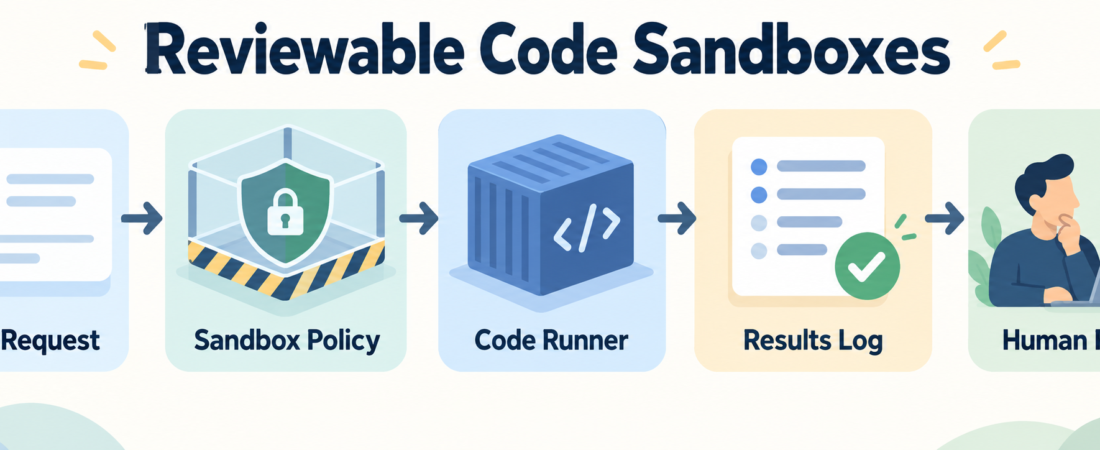
Use Judge0 when you want code execution to be an inspected step in the workflow: inputs go in, policy decides what is allowed, the runner returns structured output, and reviewers can see enough evidence to approve, reject, or retry. Do not treat it as a magic safety layer. It is one component in a larger operating model that still needs resource limits, language choices, logging, queue controls, and human review for high-risk tasks.
- Agent request: capture the prompt, files, language, and expected output.
- Sandbox policy: decide allowed languages, time, memory, network, and file access.
- Code runner: execute in an isolated service instead of a production shell.
- Results log: preserve stdout, stderr, exit status, runtime, and artifacts.
- Human review: approve only the output that has clear provenance.
Who this is for
This spotlight is for platform teams, eval builders, internal tools teams, and security-minded operators who let agents generate snippets, tests, data transforms, SQL helpers, or small programs. It is also for teams moving from ad hoc local execution toward a shared service that can be watched and governed.
Judge0 is most relevant when code execution is frequent enough that “run it locally and paste the result back” has become brittle. A common example is an agent that writes small functions, runs test cases, and returns a result packet. Another is a review assistant that needs to check generated code in several languages without granting shell access to the main application host.
Starter workflow
Start with the narrowest job. Pick one language family, one class of input, and one output format. For example, allow Python or JavaScript snippets that solve benchmark-style tasks, run against known tests, and return stdout, stderr, exit status, and timing. Keep network access off unless the use case clearly needs it. Put hard limits on execution time and memory. Store the original request and the exact code that ran, because those two records are what make the result reviewable later.
Next, separate “the code ran” from “the result is acceptable.” A sandbox can tell you that a snippet compiled, timed out, failed tests, or printed output. It cannot tell you by itself whether the task was appropriate, whether the prompt asked for something unsafe, or whether the result should update a customer-facing system. That decision belongs in a policy and review layer above the runner.
Finally, define the handoff packet. A good packet includes the prompt, language, code, dependency assumptions, limits applied, stdout, stderr, exit code, runtime, test results, and a reviewer note. If the work later causes an incident, this packet should explain what happened without relying on someone’s memory.
Recommended ASE skills
Start with the queued skill: Run sandboxed multi-language code execution with Judge0. Use it when the workflow needs a self-hostable execution API with structured results and a clear service boundary.
Add Evaluate model-generated code execution with SandboxFusion when the goal is closer to judging model-generated code across controlled sandbox tasks. Its ASE record is framed around evaluation and benchmark-style execution, which is a different job from simply offering a runner endpoint.
Use Give MCP agents disposable code execution sandboxes with OpenSandbox MCP when MCP-capable agents need disposable Docker or Kubernetes-backed runtimes, command execution, and file operations through a tool interface.
For adjacent operating models, compare Run agent-generated code in local microVM sandboxes with Microsandbox and Provision secure disposable development sandboxes for AI-generated code with Daytona. Those are useful reference points when the question shifts from a multi-language code runner to full development environments or stronger isolation boundaries.
What to watch
Watch the gap between sandboxed execution and production authority. A restricted runner still needs input filtering, dependency controls, rate limits, resource quotas, and audit logs. Treat generated code as untrusted until it has passed review. Be careful with secrets, mounted files, outbound network access, package installation, and long-running jobs. These are usually where a tidy sandbox story becomes an operations problem.
Also watch evidence quality. If reviewers only see a green check, they cannot make a serious call. If they see the code, limits, tests, logs, and failure modes, they can judge whether the run is meaningful. The goal is not just to execute code. The goal is to make execution small, attributable, repeatable, and easy to reject.
FAQ
Is Judge0 enough to run arbitrary agent code safely?
No. It can be part of a safer execution path, but arbitrary code still needs isolation, resource limits, dependency rules, logging, and review.
When should I choose SandboxFusion instead?
Choose SandboxFusion when the work is primarily evaluation of model-generated code across controlled tasks, not just providing a reusable code execution API.
When does OpenSandbox MCP fit better?
Use OpenSandbox MCP when the agent already works through MCP and needs disposable runtime tools such as sandbox creation, command execution, and file operations.
What is the first production gate to add?
Require a result packet before any downstream action: prompt, code, limits, stdout, stderr, exit status, runtime, and reviewer approval.