An Official Statistics Comparability Check Before Combining Regional Series
In Short
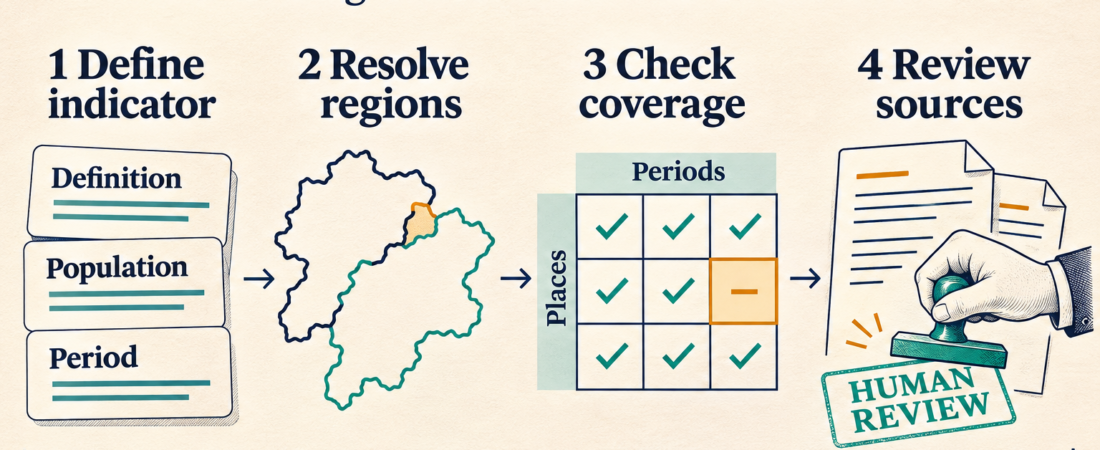
Before combining regional series, check whether the figures measure the same thing, for the same geographic level and statistical period. Matching CSV columns cannot establish statistical comparability. Use Invokely to discover and retain official statistics, qsv to inspect a documented local extract, and DuckDB to check keys and coverage. A reviewer then accepts or rejects the proposed comparison.
This workflow builds on the November 11 ASE addition, Invokely Statistics. Its pinned source skill instructs users to discover identifiers, preserve citations and comparability warnings, and keep projections separate. The stages below are manually connected; this article supplies neither an export connector nor automatic statistical harmonization.
| Stage | Evidence to retain | Stop condition |
|---|---|---|
| Define and resolve | Indicator definition, unit, place code and level | Different concepts or boundaries |
| Snapshot and inspect | Original response, citations, local field map | Missing metadata or duplicate keys |
| Check coverage | Expected place-period grid and unmatched rows | Unexplained omissions |
| Review comparison | Accepted definitions, exceptions and reviewer decision | Unresolved comparability warning |
Who this is for
This is for analysts and agent operators preparing a regional briefing, research table, or planning report. It suits a small comparison where someone can inspect every source note. Start with two regions and two annual periods as a deliberately bounded trial; those are workflow choices, not provider limits.
For example, a request for “regional unemployment” needs a definition before retrieval. Survey unemployment and registered unemployment should not become interchangeable merely because both outputs contain percentages. Likewise, a city and its surrounding province answer different geographic questions. Write the intended population, boundary level, measure, and period into an acceptance note first.
Use the recurring CSV drift workflow when the problem is changing export structure. Use the notebook rerun packet for execution reproducibility. Here, the decision is whether regional figures belong together at all.
Starter workflow
- Discover the measure and places. Read the connected tools’ current schemas. Use
search_indicatorsto inspect the definition and unit, thenresolve_placefor ambiguous names or levels. Keep the returned identifiers and official codes. Check that the chosen indicator actually covers each requested geography; broad country coverage does not guarantee every regional series. - Request a bounded interval. For
get_series, specifyfrom,to, and the selectedfrequency. For a comparison, specify its period. The current Invokely documentation describes source notes, gaps, status flags, andcomparableresults. Retain them alongside each value. Request projections only when needed and store them apart from observations. This is a proposed procedure; no authenticated statistical retrieval was performed for this article. - Freeze the evidence. Save the bounded response and request parameters locally with a retrieval timestamp. Maintain a citation ledger connecting each series to its agency, source URL, citation, unit, definition, period, frequency, and caveats. Manually produce a CSV and record the mapping from response fields to columns. Preserve missing values and their reasons; never substitute zero or carry a previous value forward.
- Inspect the local extract. Use the qsv CSV skill to examine inferred field types, empty cells, and repeated keys. The official qsv command reference documents
stats,frequency, andschema. Inspect duplicate combinations of place, indicator, period, and frequency before removing anything. A duplicate might represent a second source or vintage that needs its own column. - Check the proposed table. Use the DuckDB analytics skill with explicit identifier types. Keep place codes and period labels as strings so leading zeros and quarter labels survive. Compare the extract against a manually declared expected place-period grid. Report missing pairs and extra rows before joining, and retain both sides of every unmatched join.
For a small extract, the following SQL illustrates the loading and duplicate check. The column names are a local example contract, not Invokely response fields. Document blank-value handling before converting values to numeric types. DuckDB’s CSV documentation describes explicit column types and the all_varchar import option.
CREATE TABLE observations AS
SELECT * FROM read_csv('observations.csv', all_varchar = true);
SELECT place_id, indicator_id, period, frequency, count(*) AS n
FROM observations
GROUP BY place_id, indicator_id, period, frequency
HAVING count(*) > 1;
Recommended ASE skills
- Invokely Statistics: discovery and source-aware retrieval. Read the Listed entry without treating listing as a security certification.
- Profile and clean CSV datasets with qsv: inspect the manually prepared extract while preserving the original snapshot.
- DuckDB SQL Analytics Agent: reproduce coverage, duplicate, and unmatched-row checks locally.
- csvkit Python CSV Utility Suite: an optional inspection alternative for teams already using csvkit. Its official documentation explains type inference; disable inference when preserving identifier strings.
- Great Expectations Data Validation Pipeline: an optional next step for recording accepted local checks as assertions. The official expectations guide defines assertions and suites. Encode agreed structural rules only; a passing suite cannot approve statistical comparability.
What to watch
Require a reviewer to accept definitions, boundaries, source choices, periods, and units before permitting regional comparisons. Record provisional figures, methodological breaks, different vintages, and unresolved warnings as exceptions. A clean join is insufficient evidence for a ranking or pooled average.
Access was rechecked against current documentation: MCP trial and account access differ, and REST data queries have separate plan requirements. Check current access conditions before scheduling work. Invokely’s terms also require compliance with the original publishers’ reuse conditions and attribution. Keep credentials outside snapshots.
FAQ
Does a comparable result approve the whole analysis?
No. Retain the service’s flag, then review whether the definitions and geographic boundaries fit your question. The analyst remains responsible for that decision.
What if one region lacks a period?
Keep the gap visible. Narrow the comparison with a documented reason or stop; do not fabricate a replacement observation.
What should the handoff contain?
Deliver the response snapshot, request record, citation ledger, local field map, reproducible checks, comparability exceptions, and dated reviewer decision. Combine series only after that packet supports the intended comparison.