Lunora, pgEdge Postgres MCP, or HolmesGPT: Choosing an Incident Investigation Entry Point
In Short
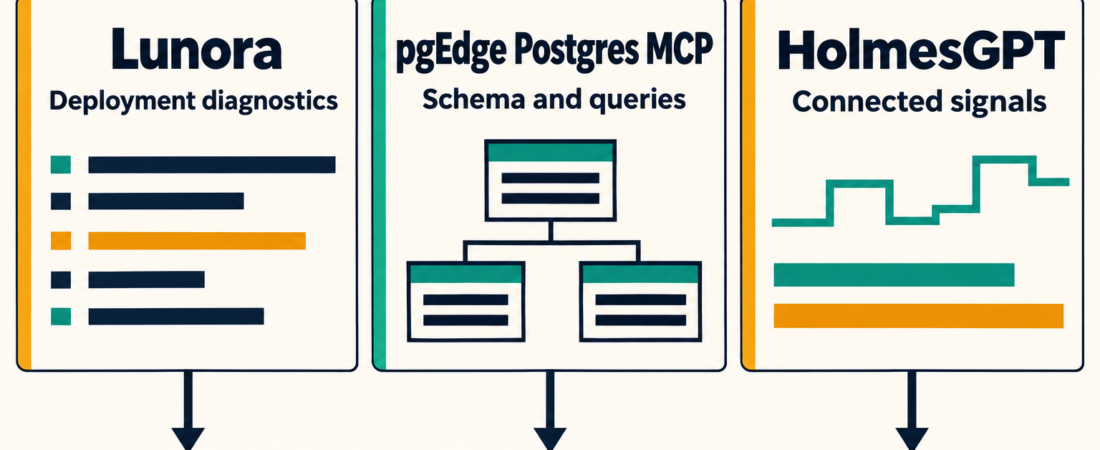
Choose your incident investigation entry point from the system you operate and the evidence you need. Lunora diagnostics fit an existing Lunora deployment. pgEdge Postgres MCP fits PostgreSQL schema and query inspection. HolmesGPT fits investigations across explicitly connected infrastructure signals. Each route needs its own setup and access review; these are platform-dependent alternatives.
Start with one diagnostic question and the narrowest useful access. The decision below helps you choose that first connection before collecting evidence. It does not require running production queries or promise an automatic root cause.
Who this is for
This guide is for on-call engineers and platform owners deciding where an agent should begin investigating a service problem. It is especially useful when an incident mentions several systems but nobody has agreed which evidence could resolve the first uncertainty.
For example, “requests slowed after deployment” could call for deployment diagnostics, database inspection, or a review of connected cluster signals. Pick the route with direct evidence for your question. Record missing coverage rather than widening credentials simply to make an agent sound more certain.
Decision path
| Entry point | Evidence fit | Prerequisite and boundary | Suggested handoff |
|---|---|---|---|
| Lunora | Deployment errors, logs, query insights, migration status | Existing deployment; privileged admin token; diagnostic opt-in | Shard, observed errors, pending migrations, unanswered questions |
| pgEdge Postgres MCP | PostgreSQL schema and approved query inspection | Configured connection; read-only settings; restricted database role | Database identity, schema findings, reviewed query proposal |
| HolmesGPT | Investigation across connected Kubernetes and cloud signals | LLM provider, selected toolsets, scoped integration credentials | Evidence references, timeline, hypotheses and gaps |
| Your first uncertainty | Start here if available |
|---|---|
| What changed inside this Lunora deployment? | Lunora diagnostics |
| What does this PostgreSQL schema or query explain? | pgEdge Postgres MCP |
| Which connected infrastructure signals align? | HolmesGPT |
| For every route | Scope → inspect → separate observations from hypotheses → hand off |
Choose Lunora when the deployment itself is the evidence source. The November 6 ASE candidate preserves @lunora/mcp@1.0.0-alpha.291. Its pinned package requires Node.js ^22.15.0 || >=24.11.0. Use an MCP client supporting stdio, with npx arguments ["-y", "--package=@lunora/mcp@1.0.0-alpha.291", "lunora-mcp"]. Supply the deployment URL and admin token through secret configuration.
Keep LUNORA_MCP_ALLOW_OBSERVABILITY=1 and explicitly set LUNORA_MCP_ALLOW_WRITES=0, LUNORA_MCP_ALLOW_AGENTS=0, and LUNORA_MCP_ALLOW_DATA_READS=0. The pinned Lunora documentation describes lunora_get_logs, lunora_get_issues, lunora_get_query_insights, and lunora_get_migration_status. Inspect the exposed tool list before use. The token remains privileged; the MCP configuration supplies the diagnostic boundary. Specify the shard when applicable.
Choose pgEdge when the uncertainty is in PostgreSQL. Its official tool reference documents get_schema_info and query_database. Begin with the relevant schema. Confirm the intended connection has allow_writes: false, then check database-role grants independently. Read-only transactions protect against modifications but still permit data disclosure and expensive reads. Propose a filtered, limited inspection for review before authorizing execution.
Choose HolmesGPT when evidence spans connected systems. First inventory the enabled integrations and their permissions. The namespace access guide documents namespaceScopedRBAC: true for restricting a Helm deployment to its own namespace. Other integrations still need their own credential review. Require the handoff to name inaccessible sources and label suspected causes as hypotheses until evidence supports them.
Use this scoped diagnostic question as a starting template: “For service [name], environment [name], and UTC window [start–end], inspect only [approved sources] for evidence explaining [specific symptom]. Return timestamps, observations, evidence references, missing coverage, and the next proposed check. Do not change resources or retrieve raw business records.” Replace every bracket before connecting the agent.
Recommended ASE skills
- Triage Lunora deployment errors and migration status: use for the bounded deployment route and its pinned setup.
- Query and inspect PostgreSQL through pgEdge MCP: use for database discovery after checking upstream configuration.
- Investigate connected signals with HolmesGPT: use when approved integrations cover the incident question.
- Inspect selected pod logs with Stern: an optional follow-up when a Kubernetes investigation identifies a specific workload.
- Review REST API contracts and security boundaries: a supporting review when uncertainty concerns a proposed API integration.
The last two are supporting checks, not prerequisites or automatically connected components. Start with the required skill matching your evidence surface.
What to watch
- Confirm actual exposed tools and effective permissions after configuration changes.
- Keep tokens out of prompts and handoffs; redact sensitive log content before sharing.
- Bound time ranges, database objects, namespaces, and result sizes.
- Treat unavailable evidence as a coverage gap, not proof that a subsystem is healthy.
- Require separate authorization for remediation, migrations, or wider data access.
FAQ
Does read-only inspection make an investigation harmless?
No. Reads can expose sensitive records or consume resources. Limit permissions, query cost, returned data, and what reaches the model provider.
Should a team connect all three tools?
Only when separate evidence needs justify each integration. Choose one entry point first and expand scope through an explicit review.
What counts as a useful first result?
A scoped handoff with observations, timestamps, evidence references, gaps, and a proposed next check. A clear unanswered question is more useful than an unsupported diagnosis.