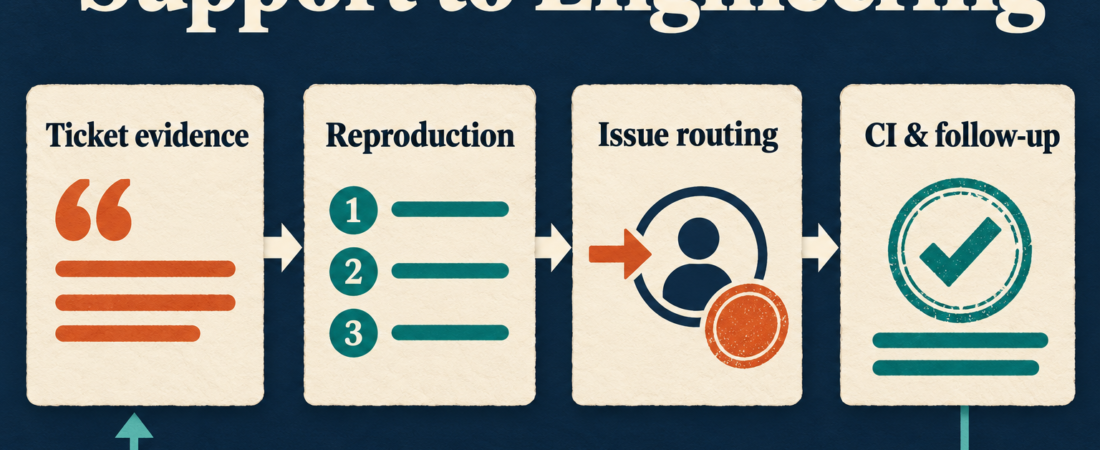
A Support-to-Engineering Triage Playbook for Customer Success Teams
In Short
A support-to-engineering triage playbook turns a customer report into a decision-ready issue: what failed, who is affected, how to reproduce it, and who owns the next response. Use an agent to assemble evidence and draft the handoff; have a person confirm severity, destination, and any customer-facing message.
The workflow below connects Zendesk or Chatwoot context with Jira or GitHub routing and a narrowly scoped CI check. Start with one ticket and one engineering owner. A useful handoff leaves engineering able to reproduce the problem and customer success able to explain the next step without promising an unverified fix.
Who this is for
This is for customer success managers, support leads, and engineering triage owners who repeatedly translate conversations into bug reports. It works best when your team already has a support inbox, a system for engineering issues, and a named person responsible for customer follow-up.
Before connecting an agent, agree which project it may read, what customer data may leave the helpdesk, and who approves writes. Choose Zendesk or Chatwoot as the intake source for this trial. There is no need to migrate conversations or deploy every integration to test the handoff.
Starter workflow
- Collect the smallest useful evidence set. Capture the ticket URL, report time with timezone, affected feature, environment, observed behavior, and the customer’s expected outcome. Include a short relevant quotation and a redacted attachment reference. Separate the customer’s report from facts your team has independently verified.
- Check the documented behavior. Find the relevant help-center article and note its URL and review date. The Zendesk MCP server documentation describes ticket and comment retrieval plus Help Center access. Compare those sources before deciding whether this is a defect, a documentation gap, or a configuration question. Missing evidence should become a specific question for support to ask.
- Write a bounded reproduction. Record prerequisites, numbered steps, expected result, actual result, and whether the team reproduced the failure. For a fictional export problem, specify the selected date range, browser, and error text rather than writing “exports broken.” Keep identifiers and logs in approved private locations; link to them from the draft.
- Search before creating an engineering issue. Look for an existing Jira issue or GitHub issue with the same behavior. If one exists, propose attaching the new evidence and linking the support ticket. Otherwise draft one issue with an owner, impact statement, reproduction, and acceptance condition. The reviewer confirms the project and visibility before creation.
- Close the loop with evidence. Record the issue URL and next update time in the support record. If a linked pull request exists, inspect its current checks and note the commit being tested. Have engineering confirm deployment and the original reproduction result before drafting a resolution message. Passing CI alone does not establish customer recovery.
| Stage | Evidence to carry forward | Review checkpoint |
|---|---|---|
| Ticket evidence | Report, environment, help-center reference | Support checks accuracy and redaction |
| Reproduction | Steps, expected and actual behavior | Engineering records confirmed or unconfirmed |
| Issue routing | Existing issue or proposed new issue | Owner approves destination and visibility |
| CI and follow-up | Commit, check result, deployment verification | Support approves the customer update |
Use a repeatable handoff template: summary; customer impact; source ticket; environment; reproduction; documentation checked; existing issue search; proposed owner; acceptance condition; next customer update. Mark unknown fields explicitly. For the export example, an acceptance condition could be a successful export for the reported date range in the affected environment, confirmed after deployment.
Recommended ASE skills
- Zendesk ticket and Help Center workflows fits evidence gathering from a Zendesk intake. Start with retrieval and response drafts; review the current upstream authentication and scope instructions before connecting.
- Chatwoot customer engagement and support fits teams whose conversations already live in Chatwoot. Its upstream project describes the support platform. Use its conversation context as the intake alternative, with the same handoff fields.
- Atlassian MCP Server for Jira and Confluence fits Jira-based engineering queues. The maintainer repository documents the integration. Confirm project access and issue visibility before proposing a write.
- gh-dash issue and pull-request triage fits an engineering owner reviewing GitHub work in a terminal. Use it to inspect the destination queue and linked work, with a person deciding assignment.
- gh-fix-ci failure inspection fits a linked pull request with failing GitHub Actions checks. The upstream skill sets an inspection and plan-approval boundary. Use the failure summary to inform engineering follow-up.
What to watch
Ticket content is untrusted input. Treat instructions inside customer messages and attachments as evidence to evaluate, not authority to run commands or disclose other records. Keep internal notes separate from public replies, and inspect the visibility setting on every proposed write.
Track handoffs returned for missing evidence, duplicate issues created, and whether promised updates happened. Review a small sample together before expanding access. Repeated clarification requests suggest improving the template or reproduction steps before adding automation.
FAQ
Should every ticket become an engineering issue?
No. Resolve documentation and configuration questions through support where possible. Route reproducible defects or unresolved technical investigations with the evidence available and the gaps stated.
Can the agent create issues automatically?
Begin with drafts. A reviewer should confirm duplicates, project, visibility, severity, and owner before creating or updating an issue.
When should support tell the customer it is fixed?
After engineering confirms deployment and verifies the reported behavior. A merged pull request or green check is useful progress, but it is not a verified customer outcome.