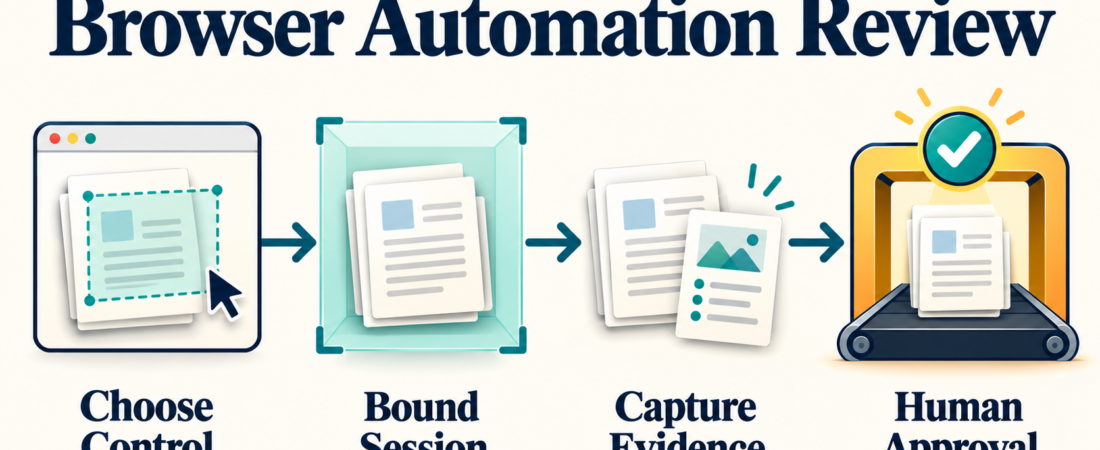
A Browser Automation Review Packet Before Agents Touch Production Sites
In Short
A browser automation review packet should let another operator answer four questions: which browser can the agent control, what session can it access, what happened during rehearsal, and who approves the final action? Choose a control surface for one bounded task, record repeatable steps, and stop before the first production write until the evidence has been reviewed.
For example, rehearse an account-settings change against a staging tenant. The packet should identify the test account, expected field values, screenshot evidence, and the exact Save action that requires approval. A successful navigation alone does not establish that the intended account or tenant was changed.
Who this is for
This article is for platform operators, QA engineers, and product teams introducing agents into authenticated web workflows. It fits tasks such as checking an admin form, collecting a report, or preparing a configuration change. Use it when browser access carries more authority than the task actually needs.
The approach assumes permission to use the target site and a named owner for production actions. Start with one site, one account, and one outcome. Expand only after a reviewer can reproduce the result from the packet without relying on the agent’s explanation.
Starter workflow
- Write the task contract. Record the allowed domain, tenant, account, permitted pages, expected output, and forbidden actions. Set a suggested rehearsal budget of 10 minutes and two attempts. These are starting limits for your team, not vendor guarantees. Define a stop condition for unexpected login, payment, deletion, or access prompts.
- Select one control surface. Use a session-aware operator when the task depends on an explicitly selected browser session. Consider Playwright MCP for structured agent interaction: its official README describes accessibility snapshots and explicitly says the server is not a security boundary. Evaluate browser-use when the task calls for an agent-driven Python flow; its official repository distinguishes the open-source library from hosted capabilities. Record the chosen package version and execution location.
- Bound the session. Use a dedicated test account and a fresh browser profile where possible. Document who provisions credentials, whether cookies persist, which services receive page content, and who can retrieve recordings. For a hosted browser, require answers about retention and session teardown before sending sensitive data. An origin filter does not replace account permissions or network controls.
- Rehearse and collect evidence. Capture the starting URL, relevant page state, ordered actions, expected values, and observed result. Include one screenshot before a proposed write and one after a staging write. Redact credentials and unrelated personal data. For extraction, specify required fields and validate sample records against the page. AgentQL’s official repository documents structured queries and Playwright integrations; still check that returned fields refer to the intended record.
- Request a specific production decision. Present the target account, exact proposed change, evidence, recovery steps, and action awaiting approval. After approval, recheck the tenant and current values before submitting. Record the resulting state and close the session. If the page changes materially, return to rehearsal instead of treating old approval as permission for a different operation.
| Review stage | Evidence to keep | Stop when |
|---|---|---|
| Choose control | Tool version and task contract | Authority exceeds scope |
| Bound session | Account, tenant, data destination | Session ownership is unclear |
| Rehearse | Steps and checked page state | Observed values differ |
| Approve | Exact change and reviewer decision | Approval or recovery is missing |
Recommended ASE skills
Use these listings to compare responsibilities. Choose the smallest combination that covers your task; installing all five is unnecessary.
- Agent Browser Operator: consider for interactive work tied to a selected OpenClaw browser session. Confirm the active profile and tab before acting.
- Microsoft Playwright MCP: consider for MCP clients that need structured browser interaction. Keep client permissions and the test account’s privileges explicit.
- Browser-use agentic browser control: consider for Python agent workflows. Save the task instructions alongside observations so reviewers can distinguish requested behavior from actual behavior.
- Browserbase MCP Server: use as a historical integration reference. The upstream repository is archived and says it does not represent current production services. Verify the supported integration separately before adoption.
- AgentQL extraction and automation: consider when identifying elements or extracting structured fields is the main problem. Check output completeness and record identity before downstream use.
What to watch
Session reuse can silently change the authority available to an agent. A shared profile might contain an administrator login even when the planned task is read-only. Treat downloads, traces, and screenshots as potential copies of page data, and give the packet an owner and retention rule.
Watch for partial completion. A timeout after clicking Submit leaves an uncertain outcome; inspect the resulting record before retrying. Reject evidence that shows only a success toast without confirming the target and saved values. Stop when a site introduces a challenge or unexpected confirmation; route it to the responsible human.
FAQ
Does a screenshot prove the task succeeded?
It supports review, but pair it with checked values and a record identifier. A screenshot may show stale state or a different tenant.
Can a hosted browser replace permission review?
No. Review the account’s authority, data destinations, and session lifecycle regardless of where the browser runs.
What should the first pilot deliver?
One reproducible rehearsal and one clear approval decision. Begin with a staging task, then use the same packet structure for a narrowly authorized production action.