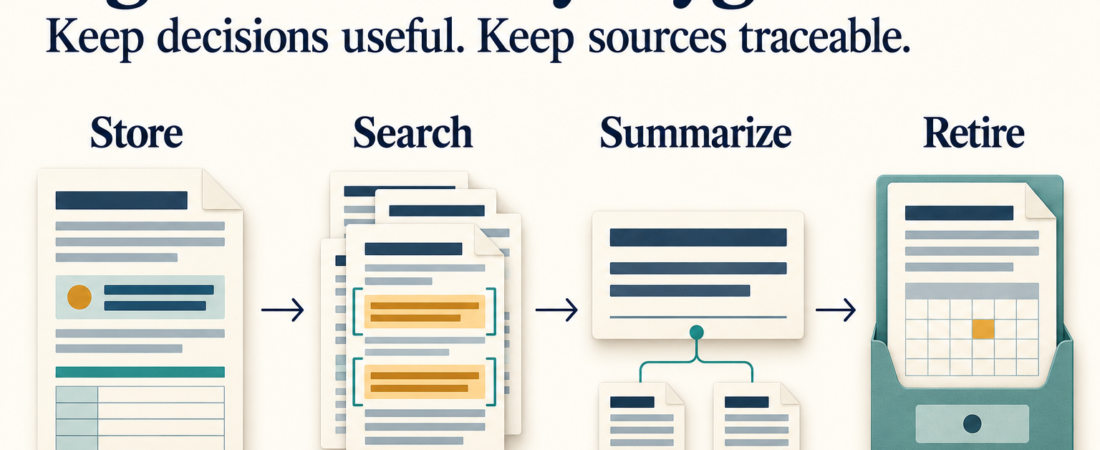
An Agent Memory Hygiene Packet Before Context Becomes a Liability
In Short
Agent memory hygiene means keeping useful decisions easy to retrieve while preventing stale assumptions, duplicated notes, and bulky tool output from becoming permanent context. Build a small review packet before adding another memory system: an inventory, a storage rule, a retrieval check, a source-linked summary, and a retirement list.
The goal is an agent that can explain why a remembered fact still applies. Start with one project and one recurring task. Store durable decisions, search supporting evidence when needed, summarize completed work, and retire superseded material from active recall. The workflow below is an operating proposal, not a claim that any memory product guarantees correct recall.
Who this is for
This article is for operators running coding assistants, research agents, or recurring automation across multiple sessions. It is especially useful when an agent repeats old advice, loads unrelated history, or treats an abandoned experiment as current policy. You need access to the memory files or service configuration and someone who can resolve conflicting decisions.
Use a disposable project copy for the first review. Avoid starting with a shared organizational store: a small corpus makes wrong retrievals easier to inspect and corrections easier to reverse.
Starter workflow
1. Inventory what the agent can recall
List the actual stores: repository notes, daily logs, conversation exports, indexed documents, and any connected memory service. Record an owner and the project scope for each. Separate authoritative instructions from observations and model-generated interpretations. A successful command yesterday is evidence about that run; it does not establish permission for every future run.
Sample 10 records before changing anything. For each, capture its source, last verification date, sensitivity, and whether another record contradicts it. These numbers are suggested starting bounds for a manageable review, not vendor limits.
2. Decide what deserves durable storage
Keep decisions that affect future work: an approved deployment target, a rejected approach with its reason, or a reproducible failure and repair. Leave raw logs in their original evidence location. Store a pointer and the relevant finding instead of copying an entire terminal transcript into permanent memory.
A minimal record can use these fields: statement, project, source, observed date, owner, review date, and supersedes. Mark uncertain observations explicitly. Keep credentials out of memory, and check where configured embedding or model providers receive content before indexing private material.
3. Search before adding context
Write five representative questions, such as “Which migration approach was approved?” and “What changed after the failed rollout?” Retrieve a bounded set of excerpts and open the underlying source before acting. Include one question whose answer is absent; the agent should report that gap rather than assemble an unsupported answer.
The official memsearch documentation describes Markdown as the source of truth and Milvus as a rebuildable index. That distinction is useful operationally: review the durable record separately from the retrieval layer. Search quality alone does not establish that the indexed claim remains current.
4. Summarize with an evidence trail
At a task boundary, write a short handoff containing the current objective, completed checks, unresolved questions, and next action. Link each material conclusion to a file, issue, or retained run artifact. Preserve failed checks and uncertainty when shortening the session.
For bulky output, context-mode documents execution and retrieval tools that limit what enters conversation context. Its security guidance also explains that execution inherits process filesystem access. Treat context reduction and execution isolation as separate concerns; review the host permissions before running code through an additional tool.
| Part | Keep | Review check |
|---|---|---|
| Store | Decision, owner, source, date | Does it affect future work? |
| Search | Relevant source excerpts | Does the source answer the question? |
| Summarize | Outcome, uncertainty, next action | Can another operator verify it? |
| Retire | Supersession and archive pointer | Is outdated advice absent from active recall? |
5. Retire, then repeat the retrieval check
Archive obsolete notes or mark them superseded using the store’s documented mechanism. Preserve recoverable history where required. Refresh the relevant index and repeat the same five questions. Check both that the new decision appears and that the old decision is no longer presented as current. Removing a paragraph from the prompt is insufficient if another index still retrieves it.
Recommended ASE skills
- memsearch: consider this route when existing Markdown and conversation history need searchable retrieval. Start with a project-scoped corpus.
- Basic Memory: consider this for Markdown project knowledge exposed to MCP clients. Its official repository distinguishes local and cloud routing; verify the selected project’s destination.
- AgentMemory: evaluate persistent coding-session recall against your test questions. Its official documentation describes provenance and supersession; verify those behaviors in your configured integration.
- context-mode: use the catalog route to review selective tool-output retrieval before loading large artifacts into a conversation.
- gbrain: consider graph-oriented memory when relationships matter. Review its maintainer documentation and retain citations when consolidating connected findings.
What to watch
Watch for summaries that erase uncertainty, duplicate records that appear to corroborate each other, and retrieval across the wrong project boundary. A memory entry is evidence to evaluate, not an instruction with automatic authority. Review automatic capture settings before enabling them on real work.
For the pilot, require all five questions to produce a source-supported answer or an explicit gap. Assign unresolved contradictions to an owner. Expand the corpus only after the retirement check succeeds.
FAQ
Should every conversation become memory?
No. Retain decisions and useful evidence pointers. Keep raw history separately when needed, with appropriate access and retention rules.
How often should memory be reviewed?
Review after major decisions and before recurring work relies on old assumptions. Set review dates according to how quickly the underlying facts change.
What is the smallest useful first step?
Audit 10 records in one project, resolve one contradiction, and rerun five retrieval questions. Save that packet as the baseline for the next review.