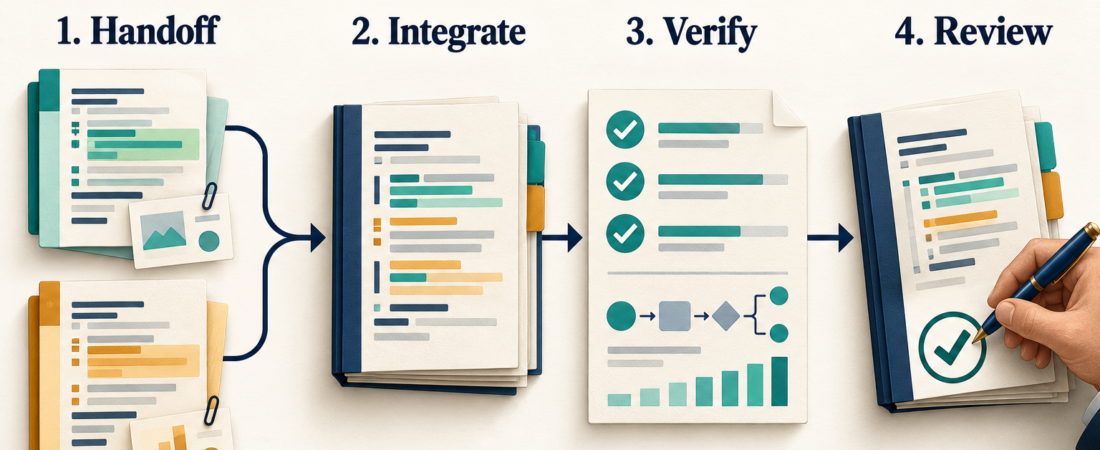
A Multi-Agent Coding Review Packet Before Parallel Work Merges
In Short
A multi-agent coding review packet connects parallel changes to one reviewable result: the integration commit, each worker’s handoff, test evidence, CI status, and unresolved review comments. Build it before merging so a reviewer can trace what changed, why it changed, and which checks cover the combined behavior.
Start with a small change split between two workers. Give each a bounded assignment, integrate their branches, and verify the combined tree. The workflow below is a suggested operating pattern; tooling supplies context and evidence, while the maintainer decides whether the result meets the repository’s acceptance criteria.
Who this is for
This is for maintainers coordinating coding agents across implementation, tests, and documentation. It is especially useful when one worker changes an interface that another consumes, or when work continues across sessions with different context.
Choose one integration owner who can explain the complete diff. A collection of successful worker summaries is insufficient evidence of compatibility. For example, an API worker might rename a response field while a UI worker still expects the old name. Both branches can pass isolated tests while the integrated application fails.
Starter workflow
- Record a shared starting point. Capture the base commit, acceptance criteria, affected interfaces, and paths assigned to each worker. Identify shared files such as lockfiles and schema definitions. If two assignments depend on the same contract, agree on that contract before implementation begins.
- Collect bounded handoffs. Ask each worker for its branch and commit, changed behavior, commands actually run, results, and remaining uncertainty. Separate completed work from proposed follow-ups. Storybloq’s official repository describes repo-local stories, handovers, and review records; these can preserve the evidence between sessions.
- Integrate under one owner. Use separate worktrees or equivalent isolation, then bring changes together deliberately. Record conflict resolutions and inspect semantic overlaps even when Git reports no conflict. Ruflo’s upstream documentation describes coordination tooling for coding-agent workflows. Treat coordination state as input to review, with explicit ownership for the resulting patch.
- Test skill triggers when instructions change. Prepare positive prompts that should invoke the skill, negative prompts that should not, and paraphrases that express the same intent. A suggested starting set is three cases in each group. Record expected and observed behavior, the instruction revision, and the client configuration. These cases test routing; application tests still need to cover the code.
- Verify the integrated commit. Run focused tests for changed interfaces and the repository’s required checks. Attach the commit SHA to every result. For a failure, capture the failing job, relevant log excerpt, reproduction command, and proposed fix. GitHub Actions documentation provides the official reference for repository workflows.
- Close the review loop. Map each actionable comment to a fix, an explanation, or an explicit deferred decision. Recheck affected behavior after fixes and confirm required checks cover the current head. Use GitHub’s pull request documentation for review and merge controls. Finish with a maintainer decision tied to that revision.
| Stage | Evidence carried forward | Review question |
|---|---|---|
| Handoff | Base SHA, worker commits, behavior changes | What did each worker finish? |
| Integrate | Combined SHA, conflict decisions | Do the interfaces agree? |
| Verify | Trigger cases, tests, CI job results | What passed on this revision? |
| Review | Comment dispositions, remaining risks | Is this revision ready to merge? |
Recommended ASE skills
- Storybloq handover and review workflows: consider this when decisions and unfinished work need to remain alongside the repository. Start with one story and a concise handoff.
- Ruflo coordination workflows: evaluate this for multiple coding workers. Define assignment boundaries and the integration owner before adding orchestration.
- cc-plugin-eval trigger evaluation listing: use this as a discovery lead for structured trigger testing. Its queued upstream repository returned 404 during preparation; verify availability and provenance before installing. Run the manual prompt matrix above if unavailable.
- gh-fix-ci: consult this route when a GitHub Actions failure needs an evidence-based diagnosis and repair plan. Preserve the failing run and distinguish infrastructure failures from regressions.
- gh-address-comments: consult this for organizing review feedback against the current branch. Inspect the proposed edits and track which comments they resolve.
What to watch
Watch for stale evidence: a green check from an earlier worker commit does not establish that the integrated head passes. Record skipped checks, unavailable dependencies, and access limits explicitly. A review packet should make uncertainty visible rather than turn an incomplete check into a success claim.
Keep credentials and customer data out of shared logs. Review new dependencies and workflow permissions whenever an agent changes setup files. If trigger tooling is unavailable, retain the manual cases and their results so another maintainer can repeat them.
FAQ
Does every worker need a separate pull request?
No. Separate branches or worktrees can feed one integration pull request. Choose the arrangement that makes ownership and dependencies easiest to inspect.
What belongs in the smallest useful packet?
Include the integration SHA, acceptance criteria, worker handoffs, test commands and results, CI links, and unresolved comments. Keep each item concise and traceable.
When should the team pause the merge?
Pause when shared contracts disagree, required checks fail, evidence targets an older revision, or review questions remain unanswered. Repair the packet and verify the affected behavior before deciding again.