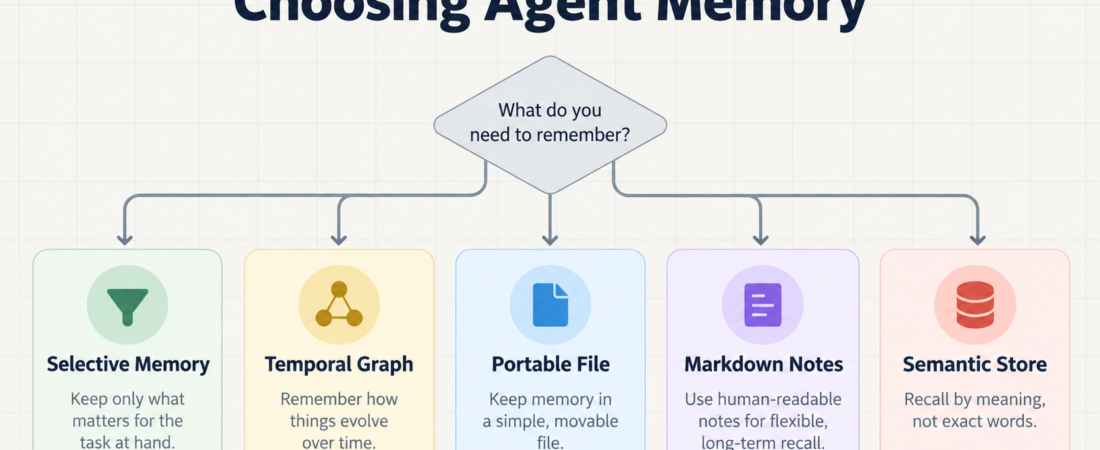
Mem0, Graphiti, Memvid, Basic Memory, or Memora: Choosing Agent Memory
Agent memory is not one problem. It is a routing decision about what should survive beyond the current chat, how fast it changes, who needs to inspect it, and whether future answers need provenance. The wrong memory layer can make an agent feel confident while quietly mixing old facts, private notes, and task context that should have expired.
| Memory shape | Best fit | Review question |
|---|---|---|
| Selective facts | Stable preferences, project facts, repeat instructions | Should this be recalled, or just kept in the task transcript? |
| Temporal graph | Facts that change, supersede, or need source lineage | Will the answer depend on when a fact was true? |
| Portable store | Local files, Markdown notes, or single-file recall | Can a human move, diff, and audit the memory later? |
In Short
Use Mem0 when the main job is selective long-term recall across chats. Use Graphiti when facts evolve and the agent needs temporal context rather than a flat note. Use Memvid when portability and single-file retrieval matter. Use Basic Memory when people and MCP clients should share readable Markdown project memory. Use Memora when you want persistent semantic memory with structured storage, graph relations, and source-backed digests.
The practical split is simple: choose the smallest memory surface that preserves the evidence a reviewer needs. If memory is only there to avoid repeating stable instructions, a selective store is enough. If memory must explain what changed, when it changed, and which source introduced the change, use a temporal or graph-backed system.
Who this is for
This guide is for teams adding memory to coding agents, research agents, support copilots, or internal operations assistants. It is especially useful when the agent will span more than one session, work across multiple tools, or answer with context that came from previous decisions.
It is not a benchmark ranking. The official repositories describe different memory models: Mem0 presents a memory layer for AI agents, Graphiti describes temporal context graphs with source provenance, Memvid packages memory into a portable single file, Basic Memory keeps knowledge in local Markdown for MCP clients, and Memora exposes persistent collective memory with semantic retrieval and graph relations. Those are different operating assumptions, not interchangeable feature checkboxes.
Decision path
Start with update cadence. If facts rarely change, selective memory is usually enough. A profile preference, a repo convention, or a standing project rule can be stored as a compact remembered fact. That points toward Mem0 for selective long-term agent memories.
Then ask whether time matters. If the agent needs to know that an integration was approved last week, reversed yesterday, and replaced today, flat memory becomes risky. Graphiti’s official repo frames it as temporal context graphs that track how facts change over time and maintain provenance to source data. That points toward Graphiti for evolving agent memory facts.
Next check portability. Some teams want memory that can travel with a project folder, be archived, or be handed to another environment without standing up a service. Memvid’s repo describes a single-file memory layer with retrieval and long-term memory without a database. That points toward Memvid for portable single-file agent memory.
Finally decide who edits the record. If humans and agents should share the same notes, Markdown is a useful contract. Basic Memory’s official docs emphasize local-first plain text, wikilinks, semantic search, and MCP-native access. That points toward Basic Memory for local Markdown project memory. If the memory layer needs structured storage, semantic retrieval, graph relations, and source-backed digests, consider Memora for persistent semantic memory.
Recommended ASE skills
Store selective long-term agent memories with Mem0 fits agents that need durable but filtered recall instead of replaying whole chats. Use it for stable preferences, recurring project context, and concise memory extraction.
Build temporal context graphs with Graphiti fits environments where facts change and the agent must preserve source lineage. Use it for customer histories, product decisions, or operations records that can be superseded.
Build portable single-file agent memory with Memvid fits teams that need memory to move as an artifact. Use it when a database would add more operational weight than the memory job deserves.
Give MCP clients local Markdown project memory with Basic Memory fits human-readable team context. Use it when agents should write notes that people can inspect, edit, and version alongside project work.
Give agents persistent semantic memory with Memora fits richer recall needs: source IDs, graph relations, topic digests, and structured storage. Use it when retrieval quality and review traces matter more than minimal setup.
What to watch
Memory is not permission. A memory layer can recall context, but it should not silently authorize actions. Keep approval, privacy, and tool access separate from remembered facts.
Staleness is the default risk. Any memory that can influence future action needs a way to expire, supersede, or cite its source. This is where temporal and graph-oriented systems earn their complexity.
Portability changes review habits. Markdown and single-file stores are easier to inspect and move, but they still need naming, retention, and cleanup rules. Service-backed memory can add better retrieval and linking, but the operating cost is real.
Do not store whole transcripts by reflex. Selective memory is usually safer than replaying everything. Store the claim, source, scope, and date when those fields will matter later.
FAQ
Should every agent have long-term memory?
No. One-off tasks, isolated code changes, and sensitive sessions often work better with no persistent memory. Add memory when future sessions need context that cannot be reliably reconstructed from the current task.
When is Graphiti worth the extra structure?
Use it when the order and source of facts matter. If the agent needs to answer with current facts while still respecting how those facts changed, temporal graph memory is a better fit than a flat note store.
Where do Basic Memory and Memvid differ?
Basic Memory centers human-readable Markdown and MCP client access. Memvid centers portable single-file memory packaging. Both can reduce service overhead, but they optimize for different review and deployment habits.
What is the safest first step?
Start with a narrow memory policy: what can be saved, who can inspect it, how it expires, and which source must be attached. Then choose the memory system that matches that policy.