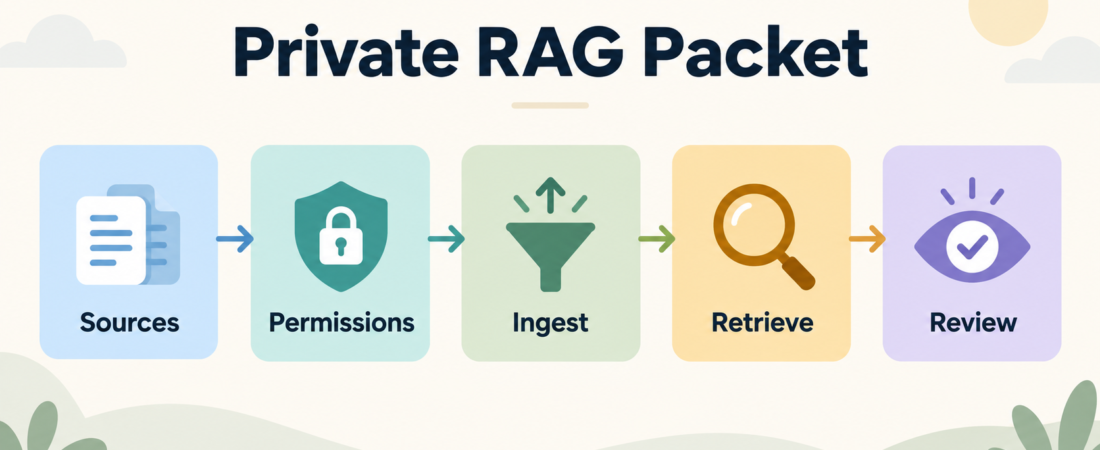
A Private RAG Workspace Packet Before Agents Touch Internal Knowledge
Private knowledge workspaces become risky when the team treats retrieval as a magic permission layer. A RAG system can find useful context, but it can also surface outdated documents, mix access scopes, drop citations, or give an agent more internal knowledge than the task requires. Before agents touch private knowledge, operators need a packet that proves the workspace is bounded, reviewable, and tied to the sources people actually trust.
| Packet part | Question it answers | Review evidence |
|---|---|---|
| Sources | Which documents are allowed? | Approved collections, owners, freshness notes |
| Permissions | Who can retrieve what? | User, team, workspace, and tool scopes |
| Retrieval | Can answers be checked? | Citations, trace samples, rejected queries |
In Short
A private RAG workspace packet is the operating checklist for giving agents access to internal knowledge without pretending retrieval solves governance by itself. It should name the document sources, owners, permission model, ingestion path, retrieval behavior, citation standard, MCP or skill boundary, and human review rule before the agent starts answering questions or taking action.
The queue item points at five useful routes: Yuxi for private deployable agent and RAG workspaces, OpenRAG for document search over knowledge bases, GraphRAG for graph-based retrieval over private data, RAGFlow for document-grounded workflows, and Knowhere for preparing document memory. Use them as building blocks, but keep the approval packet independent of any one tool.
Who this is for
This guide is for platform teams, knowledge operations owners, internal tooling leads, and AI product teams that want agents to work with company documents, support knowledge, research notes, engineering docs, policies, or customer-facing content. It is most useful when the workspace contains private or permissioned material and the agent may influence decisions, tickets, drafts, or downstream actions.
It is less useful for a public demo over a small static folder. In that case, a simple source list and citation check may be enough. The packet becomes important when access differs by user, documents change over time, retrieval quality must be inspected, or the agent can call tools after reading the retrieved context.
Starter workflow
1. Approve the source set. Start with named collections, not a vague promise to index “the docs.” Record the owner, allowed audience, freshness expectation, and forbidden sources. Separate public docs, internal docs, customer documents, and regulated material. If a source should never enter the workspace, write that down before ingestion begins.
2. Map permissions before retrieval. Yuxi’s source describes a private deployable multi-tenant knowledge-agent platform with controllable permissions, knowledge bases, graphs, MCP/Skills, sandbox tools, and workspace management. That is the right shape of question for private RAG: retrieval scope should follow user, team, workspace, and tool boundaries rather than a single shared index that every agent can query.
3. Test ingestion with real messy files. OpenRAG’s project describes intelligent document search with document ingestion, Langflow-powered workflows, OpenSearch, and Docling. RAGFlow’s project focuses on document-grounded RAG workflows. Knowhere describes parsing and retrieval that turns complex files into persistent, navigable memory connected to source documents and sections. Use those ideas to test the hard files first: PDFs, slides, scans, exports, nested pages, and documents with stale or duplicate sections.
4. Keep retrieval evidence reviewable. A useful answer needs citations, but the packet should also include trace samples. Save example questions, retrieved chunks or graph facts, rejected queries, and cases where the agent should say it does not know. Microsoft’s GraphRAG repository frames graph retrieval as a way to structure context over private data, while also noting maintenance mode and indexing cost cautions. Treat that as a reminder to start small and prove value before indexing everything.
5. Gate tool access separately. Reading knowledge is not the same as acting on it. If the agent can call MCP tools or workspace skills after retrieval, document which calls are allowed, which require approval, and what evidence must be attached to the action. A private RAG answer should not quietly become a private RAG operation.
Recommended ASE skills
- Run private RAG and MCP skill workspaces with Yuxi when the workspace needs private deployment, multi-user boundaries, knowledge bases, and MCP or skill access in one operating surface.
- Connect agents to OpenRAG knowledge bases over MCP when document search should be exposed to agents through a bounded tool interface.
- Build graph-based retrieval workflows with GraphRAG when private knowledge needs graph structure, entity relationships, or broader narrative discovery rather than only vector search.
- Build document-grounded agent context workflows with RAGFlow when the main job is ingesting complex documents and grounding agent context in reviewable knowledge bases.
- Prepare agent-ready document memory with Knowhere when the bottleneck is turning messy document collections into structured memory that remains connected to source pages and sections.
What to watch
Permission drift is the main failure mode. If a team changes folders, roles, customer access, or workspace sharing rules, the retrieval layer can fall behind. Schedule access reviews and keep a sample set of queries that should fail.
Citations are necessary but not sufficient. A cited answer can still use stale, low-authority, or out-of-scope material. Store source priority rules and teach reviewers to inspect what was retrieved, not just whether a link appeared.
Do not index before ownership is clear. “Everything in Drive” or “all Confluence pages” sounds convenient until nobody can explain which team owns a bad answer. The packet should make ownership visible before ingestion scales.
Separate retrieval quality from action approval. A good answer may still propose a risky change. Keep human approval around sensitive tickets, customer messages, policy decisions, data exports, and production operations.
FAQ
What is the smallest useful private RAG packet?
A source list, permission map, ingestion test set, five to ten retrieval examples with citations, failure examples, and a named approval rule for any tool action.
Should graph retrieval come before vector search?
Usually no. Start with the retrieval shape your documents demand. Graph-based retrieval can help when relationships and narrative structure matter, but it adds indexing cost and review complexity.
Can MCP make private knowledge access safer?
It can make the boundary clearer when tool schemas, permissions, and logging are explicit. It does not replace source ownership, access control, citation review, or human approval for sensitive actions.
Who owns the packet after launch?
The workspace owner should own it, with input from security, IT, data owners, and the team using the agent. Private RAG is an operating system concern, not a one-time ingestion task.