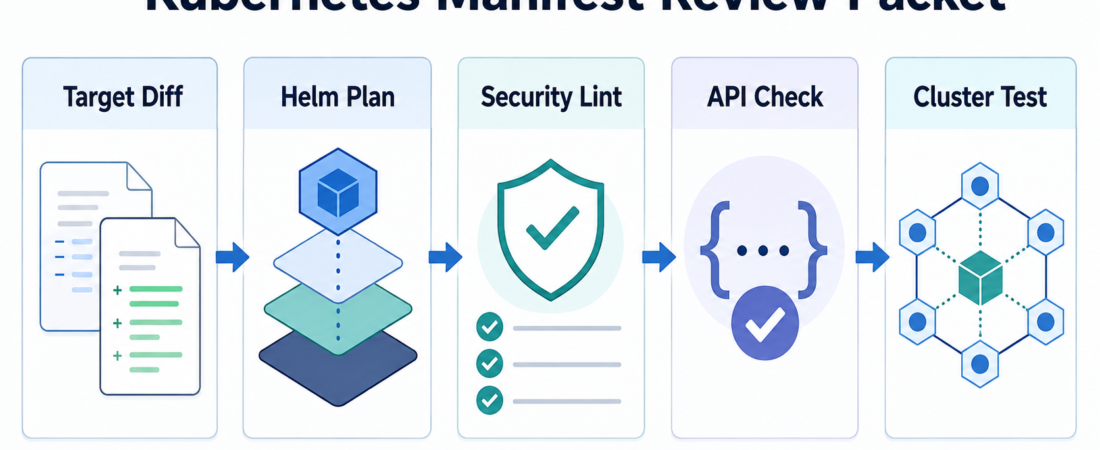
A Kubernetes Manifest Review Packet Before Agent-Driven Cluster Changes
Kubernetes cluster changes are easy to describe and surprisingly hard to review. A pull request may include raw manifests, Helm values, generated YAML, environment overlays, deprecated API versions, security-sensitive defaults, and tests that only make sense against a real cluster. A good agent workflow should not ask a reviewer to trust all of that from a summary. It should produce a bounded review packet.
What changes where
Rendered releases
Policy findings
Upgrade readiness
Declarative proof
In Short
Before an agent-driven Kubernetes change reaches a merge button, ask for a packet that separates intent from evidence. The packet should show the environment target, rendered manifests, security and readiness findings, deprecated API checks, and a small test result that proves the expected behavior. That does not make the change risk-free. It gives the human reviewer enough structure to say yes, no, or “rerun this with a narrower scope.”
Kubernetes documentation is the source of truth for objects, workload behavior, and debugging concepts. Helm documentation should guide how charts are rendered and released. Kluctl and KubeLinter documentation can help define repeatable diff and lint steps. The ASE skills below are useful because they make those checks easier to run from an agent workflow without turning the review into a wall of generated YAML.
Who this is for
This guide is for platform engineers, SREs, DevOps teams, and small product teams that let agents prepare Kubernetes pull requests or deployment notes. It is especially relevant when the agent can edit Helm values, Kustomize-style overlays, environment-specific configs, policy files, or operational runbooks.
It is also for reviewers who are tired of vague summaries like “updated manifests for staging.” A reviewer needs to know which namespace, cluster, release, image, resource, permission, and API version changed. They also need to know which checks were run after the manifests were rendered, not just before the agent touched the files.
Starter workflow
Start with the target. The packet should name the cluster or environment class, the namespace, the workload, the release name if Helm is involved, and the exact files changed. If the same declarative project can deploy to multiple environments, the packet should show the selected target and the diff for that target only. Reviewers should not have to infer whether a staging value also changes production.
Next, render the manifests. A Kubernetes review is weak if it only inspects templates and values separately. Helm charts, shared values, and overlays can combine in ways that are hard to see from the source files. The packet should include a rendered summary: new or changed objects, image tags, ServiceAccounts, RBAC resources, Services, Ingresses, ConfigMaps, Secrets references, probes, limits, requests, and rollout settings.
Then lint for security and readiness. This is where agents can save time, but only if the output is bounded. Ask for findings grouped by severity, with the file or object name, the rule name, and a short reviewer action. Avoid dumping every low-value style warning into the same section as a privilege escalation risk.
After linting, check API compatibility. Deprecated Kubernetes API versions often sit quietly in manifests until a cluster upgrade turns them into a release blocker. A useful packet calls out deprecated or removed APIs and names the Kubernetes version boundary that makes the finding relevant. If no deprecated APIs are found, say which paths or rendered outputs were checked.
Finally, run the smallest meaningful test. For a controller, that may be a declarative suite against a real or ephemeral cluster. For a simple workload, it may be a dry run, server-side validation, or a focused smoke test. The important part is not the number of tests. It is whether the test evidence matches the change being reviewed.
Recommended ASE skills
Use Deploy and diff environment-specific Kubernetes targets from one declarative project with Kluctl when the review depends on knowing exactly what changes for a selected environment. This is the right starting point for target-aware diffs.
Use Plan and apply many Helm releases from one declarative state before cluster changes drift out of sync with Helmfile when the change spans multiple Helm releases or values files. It helps keep rendered release intent visible before apply-time drift becomes the main story.
Use Lint Kubernetes manifests and Helm charts for security and readiness issues before cluster deployment with KubeLinter for a focused lint section. Keep the findings grouped and actionable so the reviewer can separate policy concerns from routine cleanup.
Use Find deprecated Kubernetes APIs before cluster upgrades with kubent when the packet needs upgrade-readiness evidence. This is useful before cluster version changes and before accepting old manifests from generated examples.
Use Run declarative Kubernetes test suites against clusters before operator or manifest changes merge with KUTTL when the change needs proof against cluster behavior, not just static validation. It is a better fit for operators, controllers, and resources whose behavior depends on reconciliation.
What to watch
Watch the render boundary first. Linting source templates is not the same as linting rendered manifests. If the agent reports clean results, the packet should make clear whether the checks ran against templates, rendered YAML, or live cluster state.
Watch credentials and context next. Kubernetes tooling often reads the current kubeconfig context by default. A review packet should state whether commands were run locally, in CI, or against a named cluster context. It should also avoid exposing secrets while still naming which Secret references or external secret resources changed.
Watch generated confidence. Agents are good at writing summaries that sound complete. Require concrete evidence: command names, target names, changed object counts, notable findings, and a final reviewer decision field. If the packet cannot name the target or render output, it is not ready for production review.
FAQ
Should an agent apply Kubernetes changes directly?
Usually no. Let the agent prepare diffs, rendered outputs, lint findings, compatibility checks, and tests. Keep apply, promotion, and rollback decisions under the team’s normal release controls unless the environment is explicitly designed for automated deployment.
Is a dry run enough for manifest review?
It depends on the change. A dry run can catch schema and admission issues, but it may not prove controller behavior, rollout safety, network reachability, or application health. Use it as one signal, not the whole packet.
What belongs in the final handoff?
Include the target, files changed, rendered object summary, lint results, deprecated API status, test result, known risks, and the recommended human decision. That gives the reviewer a clear path without hiding the uncertainty that still needs judgment.