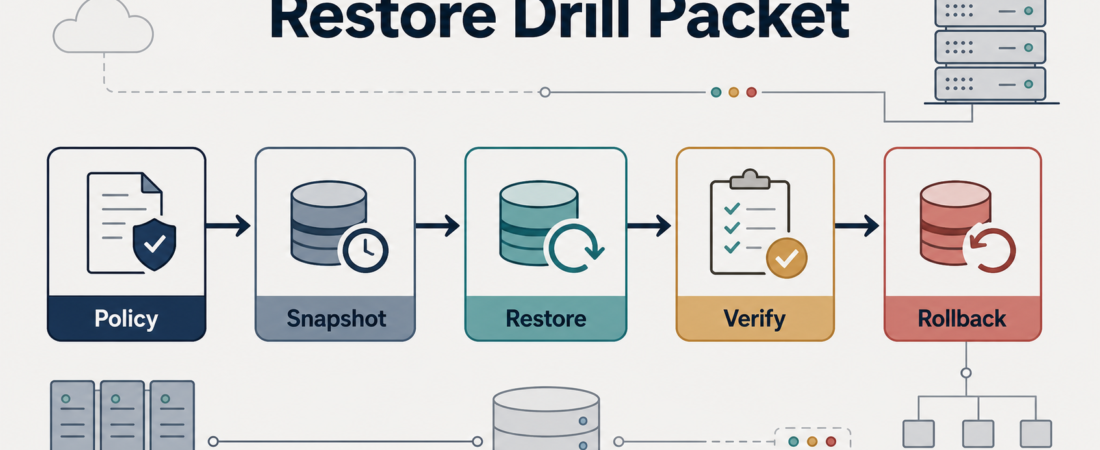
A Backup Restore Drill Packet for Agent-Managed Systems
Backups are not proven when an agent finishes a scheduled run. They are proven when a small restore drill shows that the policy, snapshot, credentials, destination, and rollback notes still work under review. That distinction matters for agent-managed systems because automation can make backup jobs look tidy while hiding drift in retention settings, repository access, or restore steps.
| Drill packet part | Evidence to capture | Human review point |
|---|---|---|
| Policy | Source paths, schedule, retention, encryption, destination | Confirm the agent is backing up the right system |
| Snapshot | Latest run ID, repository check, error output | Decide whether a warning blocks expansion |
| Restore | Temporary restore path, file counts, checksum sample, cleanup note | Approve rollback use only after proof is visible |
In Short
A backup restore drill packet is a short evidence bundle that an agent prepares before backup automation expands to more hosts, larger datasets, or production rollback authority. The packet should answer 5 questions: what is protected, where snapshots live, whether encryption and retention match policy, whether a restore was tested, and what a human must approve before rollback.
The practical target is modest. Pick one representative service, restore into a disposable path, verify a few expected files or records, and save the command output.
Who this is for
This is for small platform, SRE, DevOps, and founder-led engineering teams that already let agents run operational checks but do not want those agents changing backup policy blindly.
The packet is especially useful when a backup tool is already installed but restore confidence is low. BorgBackup, restic, and Kopia all support encrypted backup patterns, but the operational question is not which project has the longest feature list. The question is whether your agent can collect enough source-backed proof for a person to trust the next step.
Starter workflow
Start with a read-only inventory. Have the agent locate the backup configuration, repository destination, included paths, excluded paths, retention policy, and encryption mode. For Borg-based setups, the official BorgBackup documentation covers encrypted, deduplicated archives; borgmatic then adds a declarative layer for backup, prune, check, and restore jobs. For restic, the official documentation describes repositories, snapshots, forget policies, and check commands. For Kopia, the docs cover encrypted snapshots and restore operations across local and remote storage targets.
Next, make the agent run a snapshot health check without changing retention. The output should include the tool version, repository location with secrets redacted, the latest snapshot or archive ID, and the exact check command. If the tool reports warnings, the agent should classify them as blocking, review-needed, or informational. It should not auto-prune or rewrite policy during the drill.
Then perform one bounded restore. Restore a small path into a temporary directory, not over the live service. Verify at least 3 things: expected file names, a checksum or size sample, and permission ownership where that matters. If the protected system is a database, restore into a disposable database or export directory and confirm that a small query or schema check works.
Finally, create a rollback note. This is not permission to roll back production. It is a short record of the exact snapshot ID, restore command, tested path, elapsed time, cleanup command, and the person who reviewed the result.
Recommended ASE skills
Use the required backup skills first. Run policy-driven Borg backups, checks, and restores from one config with borgmatic is the best fit when you want one declarative config for backup, prune, check, and restore supervision. Pair it with BorgBackup Deduplicating Encrypted Backup Program when the team needs to understand the underlying archive model.
Restic Fast Encrypted Backup Program is a good choice for encrypted backups across many storage backends. If the team already uses profile files to keep restic jobs consistent, add Run profile-based restic backups and verification checks with resticprofile so the agent follows named profiles instead of ad hoc commands.
Snapshot and restore encrypted file trees with Kopia fits teams that want incremental encrypted snapshots and restore checks across local, NAS, SFTP, WebDAV, or cloud targets. For database-heavy systems, Run PostgreSQL backup restore and WAL recovery workflows with pgBackRest belongs in the drill packet because file restore proof is not the same as database recovery proof.
What to watch
Do not let the agent treat a successful backup run as restore proof. A green scheduled job can still hide missing excludes, expired credentials, unreadable repositories, or snapshots that cannot rebuild the service that matters.
Be strict with secrets. The packet should include destination type, repository name, snapshot ID, and redacted configuration excerpts. It should not paste repository passwords, cloud access keys, private SSH keys, or full environment files into a blog, ticket, chat, or long-lived note.
Keep the drill small enough to repeat. If the agent finds drift, fix the policy first, then rerun the same drill so the evidence stays comparable.
FAQ
Should an agent run restores automatically?
It can run bounded restores into disposable paths when the command, destination, and cleanup are already documented. It should not overwrite live data or initiate production rollback without explicit human approval.
How many files should a drill verify?
Use enough to prove the backup is useful, not enough to turn the drill into a migration. For file systems, 3 to 10 representative files plus one checksum sample is often enough for a daily or weekly check. For databases, use a schema check and one small read query against a restored copy.
Which backup tool should we start with?
Start with the tool already closest to your system. Borgmatic is strong when Borg policy should live in one config. Restic is practical when storage backend flexibility matters. Kopia is a good fit for encrypted snapshot management with restore tests across several target types. The drill packet matters more than switching tools.
What should the final packet contain?
Include the policy summary, snapshot ID, check output, restore command, verification result, cleanup status, unresolved warnings, and the human review decision. If any of those are missing, the agent should mark the drill incomplete instead of calling the system protected.
Official references: BorgBackup documentation, restic documentation, and Kopia documentation.