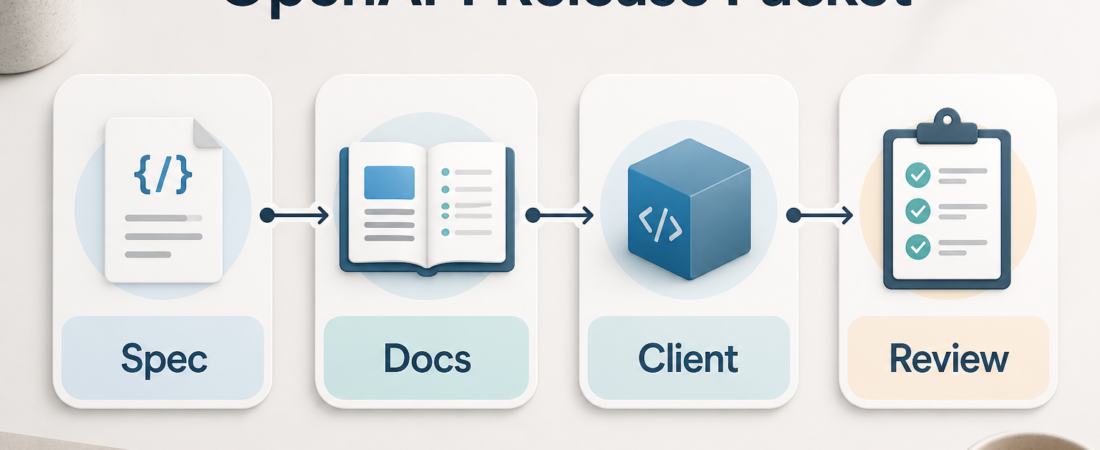
An OpenAPI Release Packet Before Agents Generate Clients
OpenAPI files are often treated as a handoff artifact: the API team updates the spec, a docs job renders reference pages, and client SDKs are regenerated somewhere nearby. That is workable when humans read every diff. It is weaker when agents start proposing endpoint changes, updating examples, or generating clients from whatever spec is on disk.
| Packet step | What to check | Release signal |
|---|---|---|
| Validate | OpenAPI syntax, schemas, examples, and breaking changes | Spec can be trusted as the source |
| Render | Reference docs, error examples, auth notes, and operation summaries | Humans can review the API surface |
| Generate | Client SDK diff, compile check, smoke request, and changelog note | Agents have a bounded release packet |
In Short
Before agents generate API clients, ask them to produce an OpenAPI release packet. The packet should validate the spec, render the docs view a reviewer will see, generate or refresh one client, and summarize the risks that still need human approval. The goal is not more process. It is to stop a small spec mistake from becoming a published SDK mistake.
The OpenAPI Specification defines a standard description format for HTTP APIs. Redocly documents CLI workflows for linting and documentation generation, and OpenAPI Generator documents generators for client libraries, server stubs, and related API artifacts. Those tools give an agent a useful path, but they also need a release boundary: validate first, generate second, publish only after review.
Who this is for
This is for platform, API, DevRel, and SDK teams that already use OpenAPI but are adding agents to release work. It fits teams where agents can update examples, write changelog notes, draft docs, or regenerate clients, while humans still own compatibility and publication decisions.
It is especially useful when the API spec lives near application code and changes frequently. In that setup, a route change can quietly affect generated TypeScript, Python, Java, or Go clients. A release packet makes the agent show the chain of evidence before the change leaves the repository.
Starter workflow
Start with the spec as the source of truth. Ask the agent to identify the changed paths, methods, request schemas, response schemas, auth requirements, and examples. If the change is meant to be backward compatible, require a short compatibility note. If it is not compatible, require the breaking behavior to be named plainly.
Run validation before generation. Use an OpenAPI validator for structural correctness, then use a linter for style and governance checks such as missing operation IDs, weak descriptions, inconsistent tags, absent examples, or incomplete error responses. The output should separate hard failures from warnings so the reviewer knows what blocks release.
Next, render the documentation view. A raw YAML or JSON diff is not enough, because most users will meet the API through rendered reference docs. Ask the agent to include links or screenshots from the generated docs build only when they are real artifacts from the repo. Avoid fake screenshots in the packet. The reviewer should be able to open the rendered operation and confirm the public contract reads correctly.
Then generate one representative client or the client most affected by the change. The packet should include the generator command, generated file summary, compile or typecheck result, and one smoke example that uses the changed operation. If generation causes broad churn, stop and ask why before publishing. Broad churn may be legitimate after a generator upgrade, but it should never be hidden inside a routine endpoint change.
Finish with a human review block: what changed, what passed, what failed, what remains uncertain, and whether publication is recommended. That last line is an advisory statement, not an auto-release trigger.
Recommended ASE skills
Use the required OpenAPI skills first, then add repository or release-review skills only where your team needs them:
- OpenAPI Spec Validator and Linter for syntax, schema, and spec hygiene checks before generation.
- Redocly CLI OpenAPI Linter and Documentation Generator for documentation rendering and configurable API governance checks.
- OpenAPI Generator API Client and Server Stub Tooling for controlled client generation from the reviewed spec.
- Spectral OpenAPI and AsyncAPI Linter for custom lint rules that match team conventions.
What to watch
Watch for agents treating generated output as proof that the spec is right. A generator can produce code from a flawed contract. It does not know whether an error schema is useful, whether an auth note is missing, or whether an operation name will confuse customers.
Watch version drift. If the packet changes the OpenAPI version, generator version, lint rules, and endpoint behavior in one pass, review becomes harder than it needs to be. Keep tool upgrades separate from API behavior changes unless the release is explicitly about the tooling.
Also watch for examples that pass syntactically but fail as guidance. Request and response examples should be realistic, minimal, and aligned with the rendered docs. If an agent writes examples, require them to validate against the schema and survive at least one human read.
FAQ
Should agents publish generated clients automatically?
No. Let agents prepare the packet, run checks, and recommend next steps. Publishing SDKs or public docs should stay behind the team’s normal release approval path.
Is one generated client enough?
For a daily workflow, one representative client is a practical minimum. For a major API release, run every supported client and compare the generated diffs across languages.
What should block release?
Structural spec errors, broken docs builds, generated clients that do not compile, missing auth or error behavior, and unreviewed breaking changes should block release.
Where do official docs fit?
Use official OpenAPI, Redocly, and OpenAPI Generator documentation for claims about tool behavior. Keep internal policy decisions in your own release checklist.