Skill Spotlight: OpenSRE for Incident Triage Evidence
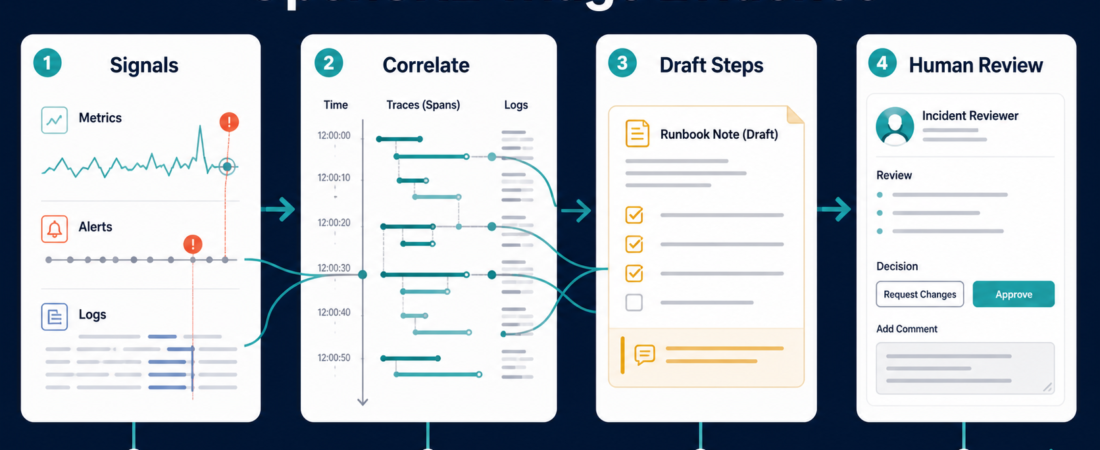
OpenSRE is useful when an incident has enough telemetry to inspect but not enough shared context for a clean first read. The right job is not to let an agent remediate production on its own. The better job is to gather evidence across logs, metrics, traces, and runbook context, then turn that evidence into a reviewable triage packet for the operator who still owns the call.
| Triage step | Evidence to gather | Human checkpoint |
|---|---|---|
| Scope | Affected service, time window, alerts, recent changes | Confirm impact before paging wider teams |
| Correlate | Logs, metrics, traces, and runbook notes | Separate evidence from guesses |
| Recommend | Likely causes, next checks, rollback or mitigation options | Approve any production action manually |
In Short
Use OpenSRE as an incident evidence collector and first-pass reasoning aid. On ASE, the relevant skill is Investigate production incidents across observability signals and draft next remediation steps with OpenSRE. Its value is in pulling scattered observability signals into one investigation loop before a human operator decides what to do next.
That framing matters. Google SRE documents reliability work as an engineering practice for operating services. OpenTelemetry’s documentation organizes observability around signals such as traces, metrics, and logs. OpenSRE fits between those two ideas: collect the signals, relate them to the service context, and produce a packet that can be challenged during incident review.
Who this is for
This is for SRE, platform, DevOps, and on-call engineering teams that already have observability data but still lose time stitching it together during incidents. It is especially useful when alerts point at symptoms instead of causes: latency moved first, error rate followed, a deploy happened nearby, and the relevant trace or log line is buried in another system.
It is also a fit for teams introducing agents into operational workflows with strict boundaries. The agent can summarize signals, suggest next checks, and draft remediation options. It should not silently restart services, roll back releases, change infrastructure, or close an incident. Keep those steps behind explicit human review.
Starter workflow
Start with a narrow incident question. A good prompt is not “fix checkout.” It is closer to: “For checkout-api between 14:05 and 14:25 UTC, compare error logs, latency metrics, traces, and recent deploy context. Draft likely causes and the next three checks an on-call engineer should review.”
Then give OpenSRE read-only access to the evidence surfaces it needs. The minimum packet usually includes alert metadata, service name, incident window, recent deploys or config changes, dashboards, trace exemplars, logs, and any runbook entries for that service. If your telemetry is OpenTelemetry-aligned, keep the language consistent: traces show request paths, metrics show aggregate movement, and logs provide event-level detail.
Ask for output in three blocks. First, confirmed facts with timestamps and links. Second, hypotheses with the evidence for and against each one. Third, recommended next checks or remediation options, clearly labeled as options rather than actions already taken. The operator should be able to read the packet, reject weak claims, and decide the next move without reverse-engineering the agent’s reasoning.
After the incident, keep the packet. It can seed the post-incident review, improve the runbook, and expose missing telemetry. If the agent could not answer because traces were absent or logs lacked request IDs, that is useful evidence too.
Recommended ASE skills
Start with the OpenSRE skill, then add adjacent observability skills only where they match your stack:
- OpenSRE incident investigation for the cross-signal triage packet.
- SigNoz Open-Source Observability Platform when logs, metrics, and traces should live in one OpenTelemetry-oriented workspace.
- Logfire Python Observability SDK for LLM and Agent Tracing when Python or agent workloads need tracing context.
- Monoscope MCP and agent-mode CLI when agents need structured telemetry investigation access.
- OpenLLMetry when LLM and agent workflows need OpenTelemetry-based tracing.
What to watch
The main risk is false confidence. Incident language can sound decisive even when the evidence is thin. Require citations back to the specific alert, log query, trace, metric panel, deploy record, or runbook section behind each claim. If a statement has no source, treat it as a hypothesis.
Watch permissions closely. Read-only observability access is a different risk profile from write access to Kubernetes, feature flags, CI, databases, or incident tooling. Do not combine evidence collection and production mutation in the same first deployment. Add action tools later only after the review path, audit trail, and rollback process are clear.
Also watch for telemetry bias. If only one service is instrumented well, the agent may over-focus there because the data is easier to read. A good incident packet should call out missing or low-quality evidence instead of filling gaps with confident prose.
FAQ
Should OpenSRE make remediation changes automatically?
Not as the starting point. Use it to gather evidence and draft options. Let the on-call engineer approve production changes through the team’s normal incident process.
What does OpenTelemetry add to this workflow?
OpenTelemetry gives teams a common vocabulary for signals such as traces, metrics, and logs. That makes it easier for an agent-assisted investigation to ask consistent questions across systems.
How many skills should a team add at once?
Start with one investigation skill and one observability surface. Add tracing or evaluation skills after you see which evidence is missing in real incidents.
What is the success signal?
A good run produces a shorter time to first credible hypothesis, clearer evidence in the incident channel, and better post-incident notes. It does not replace operator judgment.