July ASE Roundup: Practical Agent Workflows Worth Rechecking
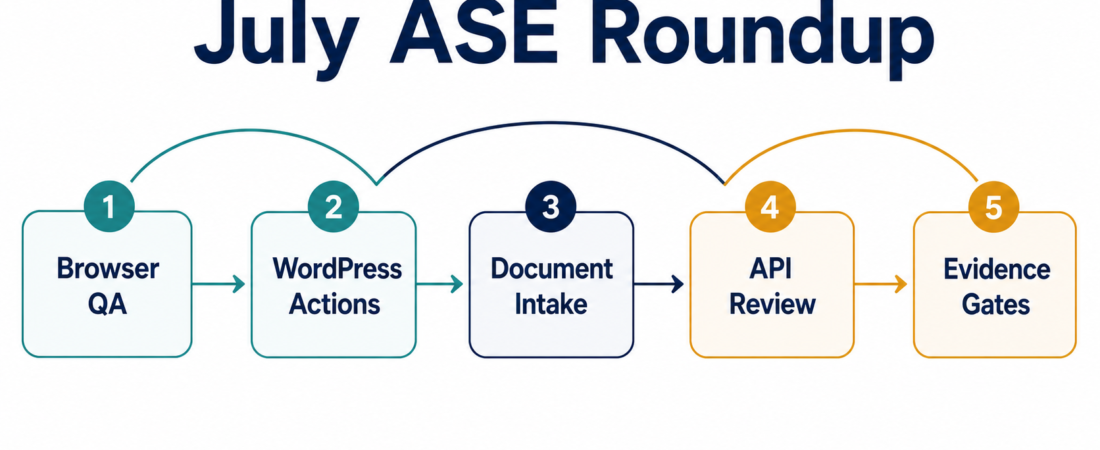
July was a useful stress test for Agent Skill Exchange because the strongest posts were not abstract arguments about agents. They were practical routes: how to check browser changes, how to keep WordPress actions bounded, how to convert messy documents into reviewable text, and how to preserve evidence before a human signs off. If you are rechecking your agent workflow backlog, start with the paths that reduce operational risk before they promise speed.
| Route | When to revisit it | Evidence to keep |
|---|---|---|
| Browser QA | Agent-written UI or flow changes | Trace, screenshot, failure note |
| WordPress actions | CMS writes, REST routes, publishing work | Capability, schema, rollback point |
| Document intake | Files that need review before reuse | Source file, markdown output, exceptions |
In Short
The July ASE roundup is not a popularity list. It is a reminder to recheck the workflows that make agent work inspectable: browser automation for user-facing changes, WordPress ability and REST boundaries for site operations, document conversion for review packets, and release checks that leave a clear trail. The useful question is not, “Which skill is hottest?” It is, “Which workflow can fail in a way my team can see, explain, and roll back?”
That framing matters because agent work often crosses several systems in one task. A single request may read a source document, update a CMS entry, call a local test runner, and summarize what changed. Without a routing habit, those steps blur together. With a routing habit, each step has a smaller purpose, a narrower permission boundary, and a clearer handoff to review.
Who this is for
This is for operators, founders, engineering leads, and technical content teams using ASE as a practical catalog rather than a browsing feed. It is especially relevant if your team added agent-assisted workflows during July and now needs to decide what should become routine, what needs more guardrails, and what should stay experimental.
It is also for teams catching up after a few weeks away. ASE added and surfaced several skills around browser QA, WordPress operations, document intake, API review, and evidence gathering. You do not need to adopt all of them. Pick the workflow that maps to the next real bottleneck: proving a web change works, keeping a CMS write bounded, turning files into reviewable text, or checking an interface before production access.
Starter workflow
Start with one live use case, not a category tour. Choose a recurring job that already causes review friction: a fragile checkout flow, a WordPress publishing action, a REST endpoint change, or a pile of source documents that must become notes before anyone can act on them.
Next, define the evidence you expect before a human approves the result. For browser work, that might be a Playwright trace, a screenshot, and the exact failed selector when something breaks. For WordPress work, it might be the ability name, permission callback, REST schema, and rollback note. For document intake, it might be the original file, converted Markdown, and a list of fields that could not be trusted.
Then pick one ASE skill route and run it in a narrow lane. Browser automation should test an already-defined path. WordPress actions should expose only the operation the agent needs. Document conversion should preserve source context rather than laundering uncertainty into clean prose. API review should happen before an agent is allowed to call production. If the route produces evidence a reviewer can use, keep it. If it only produces a confident summary, treat it as unfinished.
Recommended ASE skills
Use the queue-required skills first. The Playwright MCP server skill is a good fit when an agent needs browser and API automation through an MCP interface. Pair it with Playwright CLI browser testing when the work is local, scriptable, and needs concise evidence rather than a long browser transcript.
For WordPress work, WP Abilities API helps define narrower action surfaces, while WordPress REST API endpoint guardrails help keep schema, validation, and permission checks in view before agents call custom routes.
For file-heavy review, MarkItDown Document-to-Markdown Converter by Microsoft is worth rechecking because it turns common office, PDF, web, audio, and image inputs into Markdown for downstream LLM use. The point is not to pretend conversion is perfect. The point is to create a reviewable intermediate artifact before summarization, tagging, or publishing work continues.
What to watch
Watch for vague routing. If a single skill is expected to fetch files, make decisions, update production, and write the review note, split the workflow. The more systems a task touches, the more valuable intermediate evidence becomes.
Watch for stale metrics. July roundup work should not lean on stars, downloads, or “top tools” claims unless the source and date are explicit. ASE is more useful when it points to source-backed skill pages and practical adoption checks, not broad rankings that age badly.
Watch for permission creep. WordPress, browser automation, and document workflows can all become too broad if the first successful run turns into a general permission grant. Keep the lane narrow: one workflow, one evidence packet, one review point, then expand only when the team understands the failure mode.
FAQ
Should I treat this roundup as a list of the best July skills?
No. Treat it as a recheck list for practical workflows. The right starting point is the bottleneck your team already has, not a generic ranking.
Why include browser QA, WordPress, and document intake together?
They often appear in the same operational chain. A team may inspect a source document, update a CMS page, and verify the published flow. Those steps need different boundaries and different evidence.
How many skills should I add at once?
Usually one workflow route at a time. If the first route creates evidence that a human can review, add the adjacent route next. If it does not, fix the review habit before adding more automation.
What source should I use for this roundup?
Use the live ASE blog and the linked ASE skill pages as the source of record for this recheck. Avoid claims that require vendor metrics unless the source page itself supports them.